
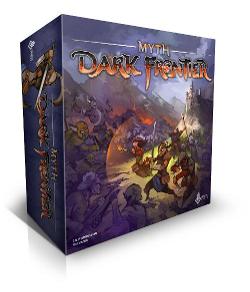
2017 · Miniatures
Myth: Dark Frontier
Players take on the role of heroes defending Farrenroc, the last city resisting the spreading forces of Darkness. In this cooperative game for 2–4 players, heroes travel, battle enemies, complete quests, fortify locations, and establish strongholds to provide resources and support. Each hero has a deck of five action types: Travel, Battle, Encounter, Fortify, and Quest. Players select three actions and assign them to morning, day, and night time slots. Hero and enemy actions are then shuffled and resolved in sequence, making timing and coordination important as the Darkness advances toward the city. Each opposing army introduces its own minions, captains, boss, and treacheries.
- Players
- 2–4 best 2
- Playing time
- 90–180 min
- Age
- 10+
- Complexity
- 3.1 / 5
About the game
- Publisher





On Ludoya's tables
Full stats in Ludoya- 2
- Plays logged
- 1
- Players
- 1
- In collections
4.6/10
from 1 Ludoya review
Evan4.6 This is a co-op game where you need to protect the castle in the center of the board from waves of monsters. You have two ways to win. The first way is through players walking their characters to quest locations and then completing the quests, which removes a monster spawn point from the board. If you can do this fast enough you can prevent the spawning of the boss monster, the killing of which is the second victory condition. The game has a minor programing element where at the start of the turn you select one card for each of the three phases to resolve, but the order of player and monster activations gets randomized within that phase. As you play, you get higher stats, more gear, better resource generation to spend on quests. So far I'm totally on board. But the game has some problems. The first and biggest problem is that much of the game is dice roll driven. Old school dice rolls, where you need to meet or beat a number on the card to get something good, and then they double down, and if you happen to miss that number something bad happens. Much of these die rolls are also the result of flip luck from the various card decks, so if you happened to flip a card that requires a skill test of a skill your character is poor at, then that's just what happened. In our game, we lost by one city damage point right before we were about to deliver the final blow to the boss. If one of my teammates hadn't failed a particular one die skill check on a random encounter card, then the city would have had one more health and we would have won the game. I understand that a lot of games use dice like this, I've just been less and less able to tolerate this form of randomness as I play more games. Since this is a co-op however, I'm trying to be a little less judgemental about the die luck specifically. The next problem is just basic usability. The cards refer to icons and resources by thematic name rather than icon, and the rulebook isn't organized very well. In both games I've played this problem has stopped us up. Overall I'm not sure how to feel. The game has a lot of promising features, but it's not the style of game I usually play and enjoy. :star: Art, Iconography and components functional :star: Clever or interesting mechanisms :star: Reasonably low downtime between turns with mildly AP players :star: Multiple plays stay interesting :nostar: Low or mitigatable luck elements :star::star::nostar::nostar::nostar: Raw enjoyment
Similar games
 Chronicles of Drunagor: Age of Darkness2021
 Pandemonium2017
 Fallen2014
 Agemonia2024
 Legends of Andor: The Last Hope2016
 HEXplore It: The Domain of Mirza Noctis2022
 Lands of Evershade2026
 Tainted Grail: Kings of Ruin2024
 Solomon Kane2021
 Malhya: Lands of Legends2025
 Sword & Sorcery: Ancient Chronicles2021
 Shadows of Kilforth: A Fantasy Quest Game2019
Free, on web, Android and iOS
Play Myth: Dark Frontier with Ludoya
- Keep it in your collectionTrack your copy and its expansions, lend it to friends, or put it on your wishlist and get told when the price drops.Add it to your collection
- Log every playScores, winners, timers and photos, then your stats: win rate, favourite player count, best score.Log a play
- Score it without paperUse the community's score sheets and play helpers, and let Ludoya add up the points.Find score sheets
- Find people to play it withClubs, game nights and events near you that bring this game to the table.See events
Game facts (players, playing time, age, credits) from BoardGameGeek.