
2016 · Science Fiction
Paradox
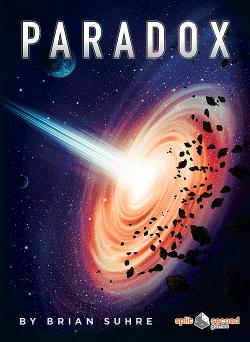
In the near future of Paradox, a space-time disturbance called The Quake is fracturing entire worlds’ timelines and removing these worlds from existence. Two to four players take on the roles of scientists working quickly to repair these worlds’ connections to their past, present, and future by making new time strands — however, every repaired connection ripples through time and fuels the Quake to fracture more worlds. When the storm’s power fades, the most successful scientist will be hailed as a hero throughout the multiverse. Paradox takes familiar board game elements such as card drafting, set collection, and resource management, then adds a Bejewelled-like grid of colorful disks for each player to manipulate, along with a universe of worlds that must be protected by game’s end. As a result, Paradox presents players with a unique experience that is simple to learn yet challenging to master as players navigate three interlocking systems to protect these worlds from the chaotic forces of the Quake. Paradox is designed by Brian Suhre and is illustrated by 15 artists, each with their unique view of one of the worlds. Paradox plays in about 20-30min per player. UPC 748252122094
- Players
- 2–4 best 3
- Playing time
- 40–120 min
- Age
- 10+
- Complexity
- 2.5 / 5
About the game
- Design
- Publisher





Where to buy it
Shop prices and second-hand copies, checked every day.
On Ludoya's tables
Full stats in Ludoya- 2
- Plays logged
- 1
- Players
- 2
- In collections
3.5/10
from 1 Ludoya review
Evan3.5 This is an interesting, puzzily game. On each turn the first thing you do is a 'take cards phase'. Cards are big points if you collect sets of same letter. to get those points you need to clear bits of your grid just like in bejeweled. This is a 5x5 token grid of assorted colors. Each turn you get 2 actions to swap 2 tokens with matching letters, and they clear when you have 4 of 5 of a color in a row. You swap from your own board, or this ever changing 3 token public pool in the center. Meanwhile you have this planet track that has planet tokens with letters matching your cards and a disaster token that rotates. When the disaster lands on a planet it flips to the red side meaning that the cards that match the letter don't score. Two of your colors let you unflip or protect a planet. So the big question for me is how many of your bad turns boil down to your own efficiency problems vs luck of the draw? Hard to tell. The downtime between turns is long, especially with 4 players. :star: Art, Iconography and components functional :star: Clever or interesting mechanisms :nostar: Reasonably low downtime between turns with mildly AP players :star: Multiple plays stay interesting :nostar: Low or mitigatable luck elements :star::star::nostar::nostar::nostar: Raw enjoyment
Similar games






Free, on web, Android and iOS
Play Paradox with Ludoya
- Keep it in your collectionTrack your copy and its expansions, lend it to friends, or put it on your wishlist and get told when the price drops.Add it to your collection
- Log every playScores, winners, timers and photos, then your stats: win rate, favourite player count, best score.Log a play
- Score it without paperUse the community's score sheets and play helpers, and let Ludoya add up the points.Find score sheets
- Find people to play it withClubs, game nights and events near you that bring this game to the table.See events
Game facts (players, playing time, age, credits) from BoardGameGeek.