
2020 · Wargame
Root: The Clockwork Expansion
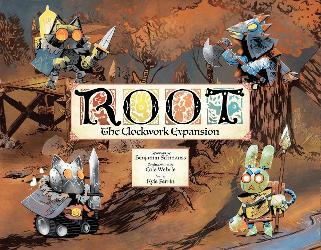
Adds four automated factions that can replace or supplement human players for competitive or cooperative play. Each automaton has a distinct programmed strategy: one patrols and builds tracks while advancing infrastructure; another floods clearings with waves of forces unless checked; a third enforces order by policing radicals and destroying bases; the fourth roams the map and can be hunted or influenced with items. Use these clockwork opponents to fill out low-player games, create asymmetric challenges, or team up with other players against automated adversaries.
- Players
- 1–4 best 1
- Playing time
- 60–90 min
- Age
- 10+
- Complexity
- 4 / 5
About the game
- Art
- Publisher



Expansion for
See them in Ludoya
Expansions
See them in Ludoya
Where to buy it
Shop prices and second-hand copies, checked every day.
On Ludoya's tables
Full stats in Ludoya- 19
- Plays logged
- 19
- Players
- 1h 13m
- Average play
- 152
- In collections
- 5
- On wishlists
- 1
- Pre-ordered
7.9/10
from 14 Ludoya reviews
Rules questions
Answered from the rulebook by Ludoya's rules assistant.
If a bot has several clearings that match an action, how does it pick which one?
A bot first follows the action’s targeting rules; if multiple clearings still qualify it chooses the clearing with the highest priority marker (1 is highest). If no prompted clearing is legal it cycles through tied clearings then to the next priority until it finds a legal target (Clearing Target Priority / Target Legality). (page 2)
Can bots craft items without workshops, and how many victory points do they get for crafted items?
Yes — bots craft items without activating crafting buildings, but whenever a bot crafts an item it scores only 1 VP (and bots cannot craft cards with persistent effects). (page 2)
When I include bots, where and when do I place the priority markers and pick bot difficulty/traits?
After you choose the map place the clearing priority markers according to the map chart, and between setup Step 1 and Step 2 choose each bot’s difficulty (easy–nightmare) and any trait cards, placing those cards near the bot’s faction board. (page 3)
How does the Electric Eyrie’s Decree resolve, and what makes it fall into Turmoil?
The Eyrie adds revealed order cards to its Decree and resolves each Decree column left-to-right (recruit, then move, then battle for that column); in Daylight it must also try to build a roost in a ruled clearing, and if it is ever prompted to place a roost but cannot it immediately falls into Turmoil (Humiliate, Purge, Rest). (pages 6–7)
What triggers an Automated Alliance revolt, and can a revolt fail?
In Birdsong the Alliance revolts if the order card is not a bird and the ordered base is not already on the map, removing enemy pieces from the ordered sympathetic clearing and placing the base; revolts can fail for three reasons (the order card is a bird, the base is already on the map, or no sympathetic clearing matches that base) and failures trigger Public Pity instead. (pages 8–9)
How do the Vagabot’s items, exhaustion, Battle Track, damage, and repairs interact?
The Vagabot treats all items identically, exhausting undamaged items to take actions; when it takes hits it damages exhausted items first (then unexhausted), and when it has 6/9/12 undamaged items items fill the Battle Track to raise its max rolled hits (and give an extra hit at 12). Repairs and refresh happen in Evening (repair unexhausted damaged items before exhausted ones and refresh depends on whether any items are damaged). (pages 10–12)
Free, on web, Android and iOS
Play Root: The Clockwork Expansion with Ludoya
- Keep it in your collectionTrack your copy and its expansions, lend it to friends, or put it on your wishlist and get told when the price drops.Add it to your collection
- Log every playScores, winners, timers and photos, then your stats: win rate, favourite player count, best score.Log a play
- Settle rules questionsAsk anything about the rules and get an answer from the rulebook, with the page to check it on.Ask the rules assistant
- Find people to play it withClubs, game nights and events near you that bring this game to the table.See events
Game facts (players, playing time, age, credits) from BoardGameGeek.