
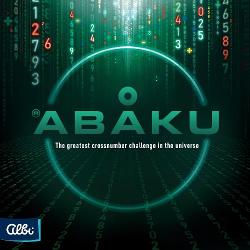
2008 · Educational
Abaku
Players place digit tiles on a shared grid to form intersecting arithmetic equations; sequences of digits are read as math statements rather than words or symbols. Tiles are placed horizontally or vertically, and every new sequence created by a placement must evaluate to a true equation using operations such as addition, subtraction, multiplication, division, squares, cubes, and integer roots. On a turn, a player adds one or more tiles and scores for all valid equations formed by that placement. Certain board spaces modify tile or equation values. The game supports solo or multiplayer play for up to four players and awards victory to the highest scorer.
- Players
- 1–4 best 2
- Playing time
- 30–60 min
- Age
- 8+
- Complexity
- 2.5 / 5
About the game
- Design
Where to buy it
Shop prices and second-hand copies, checked every day.






Free, on web, Android and iOS
Play Abaku with Ludoya
- Keep it in your collectionTrack your copy and its expansions, lend it to friends, or put it on your wishlist and get told when the price drops.Add it to your collection
- Log every playScores, winners, timers and photos, then your stats: win rate, favourite player count, best score.Log a play
- Score it without paperUse the community's score sheets and play helpers, and let Ludoya add up the points.Find score sheets
- Find people to play it withClubs, game nights and events near you that bring this game to the table.See events
Game facts (players, playing time, age, credits) from BoardGameGeek.