
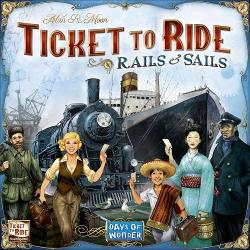
2016 · Nautical
Ticket to Ride: Rails & Sails
Players build intermodal networks of trains and ships to connect cities on a double-sided board that depicts either the world or the Great Lakes. On each turn players draw colored train or ship cards, play sets of cards to claim rectangular train routes or oval ship routes with matching tokens, or take special actions like swapping tokens or placing harbors. Tickets require connecting two cities or completing multi-city tour routes for varying points, and unfulfilled tickets subtract points at game end. The game separates train and ship decks (with wilds in the train deck), gives each player a mix of train and ship tokens and three harbors to place for bonus scoring, and ends after a player’s token supply falls below a threshold and final turns are taken.
- Players
- 2–5 best 4
- Playing time
- 60–120 min
- Age
- 10+
- Complexity
- 2.5 / 5
About the game
- Design
- Publisher




Expansions
See them in Ludoya Ticket to Ride: Europa 19122009
 Ticket to Ride: Alvin & Dexter2011
 Tåg till Rydsgård (fan expansion for Ticket to Ride)2022
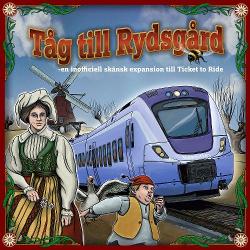 Tåg till Rydsgård: andra upplagan (fan expansion for Ticket to Ride)2024
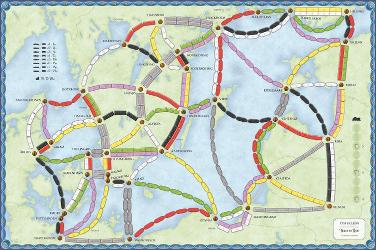 Baltic Sea (Östersjön) (fan expansion for Ticket to Ride: Rails & Sails)2023
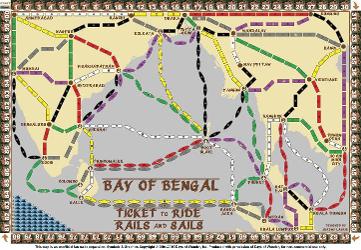 Bay of Bengal (fan expansion for Ticket to Ride)2017
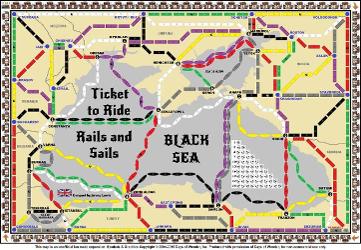 Black Sea (fan expansion for Ticket to Ride: Rails & Sails)2017
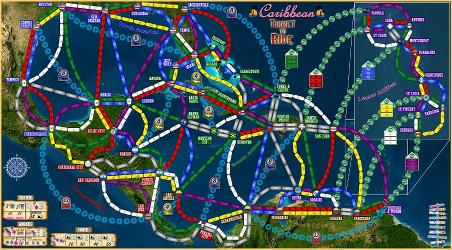 Caribbean (fan expansion for Ticket to Ride: Rails and Sails)2024
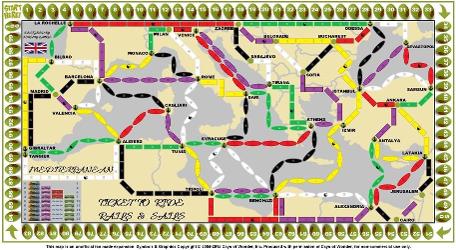 Mediterranean (fan expansion for Ticket to Ride: Rails and Sails)2017
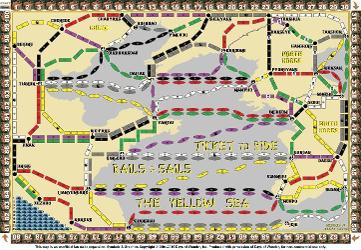 Yellow Sea (fan expansion for Ticket to Ride: Rails and Sails)2017
Where to buy it
Shop prices and second-hand copies, checked every day.
On Ludoya's tables
Full stats in Ludoya- 144
- Plays logged
- 173
- Players
- 1h 5m
- Average play
- 69
- In collections
- 5
- On wishlists
7.5/10
from 23 Ludoya reviews
- Base [ 04 ] -
Javo7.0 Añade un punto extra de dificultad ya que tienes que gestionar barcos y trenes y los billetes tour le dan un toque más estratégico y arriesgado. Por lo demás alarga en tiempo la fórmula del juego base. Recomendable si te gusta mucho el juego base y buscas algo más sino con el original ya tienes suficiente.


Rules questions
Answered from the rulebook by Ludoya's rules assistant.
Can I use ship cards to claim a train route (or train cards to claim a ship route)?
No — routes with rectangular spaces are train routes and must be claimed with train pieces and Train cards; routes with oval spaces are ship routes and must be claimed with ship pieces and Ship cards, and the cards must match the route’s color/count (gray routes accept any one color). (page 4)
If there's a face‑up Wild Travel card, can I take it as my second travel card this turn?
No — taking a face‑up Wild card is the only Travel card you may take that turn; a Wild flipped as a replacement or left faceup cannot be taken as your second card, though drawing a Wild from the top of a deck in a blind draw still counts as a single card and you may draw a second card that turn. (page 4)
How do Double‑Ship cards work when claiming ship routes?
Double‑Ship cards can place up to two ships per card, so you may combine Double‑Ship and Single‑Ship cards to match the route’s number of spaces (for example, a five‑space ship route can be claimed with two Double‑Ship cards and one Single‑Ship card, or three Double‑Ship cards but you still place only five ships). (page 4)
What does the "Pair" symbol on some train routes mean — do I need two cards for each space?
A Pair space requires two Train cards of the same color instead of one for that space; you may use any color and different spaces need not use the same color, and Wild cards may be used as part of a pair. (page 5)
What do I need to build a harbor, and what happens if I don't build my harbors?
To build a harbor you must play two Train cards AND two Ship cards, all the same color and bearing the harbor symbol (Wilds may substitute); built harbors score 20/30/40 points depending on completed tickets into them, and each harbor you do not build costs you 4 points at game end. (page 6)
When does the game end — how do the final turns work?
When any player’s supply of plastic pieces contains six pieces or fewer, every player (including that player) gets two more turns, after which the game ends and final scoring takes place. (page 7)
Similar games
 Ticket to Ride: 10th Anniversary2014
 Ticket to Ride: Europe – 15th Anniversary2021
 Ticket to Ride Legacy: Legends of the West2023
 Zug um Zug: Deutschland2012
 Ticket to Ride: Europe2005
 Ticket to Ride: Northern Lights2022
 Ticket to Ride2004
 Ticket to Ride: Nordic Countries2007
 Ticket to Ride: Märklin2006
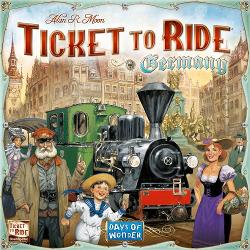 Ticket to Ride: Germany2017
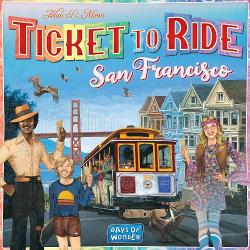 Ticket to Ride: San Francisco2022
 Ticket To Ride: Berlin2023
People who own it also own

Free, on web, Android and iOS
Play Ticket to Ride: Rails & Sails with Ludoya
- Keep it in your collectionTrack your copy and its expansions, lend it to friends, or put it on your wishlist and get told when the price drops.Add it to your collection
- Log every playScores, winners, timers and photos, then your stats: win rate, favourite player count, best score.Log a play
- Settle rules questionsAsk anything about the rules and get an answer from the rulebook, with the page to check it on.Ask the rules assistant
- Find people to play it withClubs, game nights and events near you that bring this game to the table.See events
Game facts (players, playing time, age, credits) from BoardGameGeek.