
1999 · Doprava
Bus
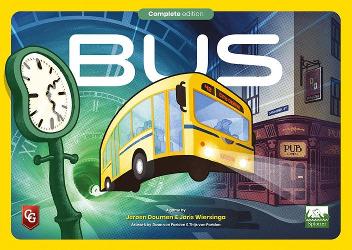
Players expand a public transit network and try to deliver passengers to their destinations over a sequence of turns. Each round players take actions from an action board: buy additional buses, extend route lines, introduce new passengers via trains, add buildings to the city, or run buses to pick up and score riders. Destination types change over time (work, bar, home), so players plan routes to follow passengers through shifting needs. Route extensions attach to either end of existing lines and must respect placement rules; building placement can block or spoil opponents’ routes. Some actions give a positional twist: the first player to take certain actions resolves them last, creating strategic timing decisions.
- Hráči
- 3–5 nejlépe pro 4
- Herní doba
- 120 min
- Věk
- 14+
- Složitost
- 3 / 5
O hře
- Publisher

Fotky od stolů Ludoya
Všechny fotky v LudoyaKde koupit
Ceny v obchodech a výtisky z druhé ruky, kontrolované každý den.
U stolů Ludoya
Kompletní statistiky v Ludoya- 144
- Zapsané partie
- 309
- Hráči
- 1h 16m
- Průměrná partie
- 53
- Ve sbírkách
- 22
- Na seznamech přání
7,6/10
z 30 recenzí na Ludoya
Amy7,8 Me ha gustado mucho, es un juego muy cabron que te invita a hacer daño a los demás y hacer que pierdan acciones, la duración de la partida y el diseño están ways, he disfrutado la partido mucho y me gustaría volver a jugarlo
Oscaarz6,0 Assez plaisant, 90 minutes avec 5 joueurs meme si 1er partie. J'aime bien le theme du transport en commun. A réessayer!
Evan7,2 This is a route building, pickup and deliver game by splotter, that has a somewhat similar feel to Food Chain Magnate, in that it's completely brutal and unforgiving of the smallest mistake. Each player gets a limited supply of action cubes, that when spent, are gone forever. Only one player having action cubes left is one of the endgame timers. You place cubes into an action board, which allows you to expand your route, deliver more people with a single action, place people who want to travel, place buildings for the people to travel to, move people, become first player, or halt the shifting of where the people want to go to. During the movement phase, the meeples will be available to travel if they aren't currently at an intersection where the place everyone wants to go to is. Not only that, but if a place like that is at their intersection, they take that place out of contention as well. This means that the places available and the meeples available to work with is surprisingly limited, and points are extremely tight. I found this game fascinating, and it did play a lot shorter than most Splotter games I've tried. :star: Art, Iconography and components functional :star: Clever or interesting mechanisms :star: Reasonably low downtime between turns with mildly AP players :star: Multiple plays stay interesting :star: Low or mitigatable luck elements :star::star::nostar::nostar::nostar: Raw enjoyment


Otázky k pravidlům
Odpovědi z pravidel od asistenta pravidel Ludoya.
How many actions do I have to choose each round — do I have to pick exactly two or can I pick more?
You must choose at least two actions each round, but you may choose more up to the number of action stones you have remaining; some actions (buying a bus, clock, starting player) can be taken by only one player that round and other actions can be chosen by multiple players (page 2).
What is the “maximum number of buses” and why does it matter?
The maximum number of buses is the number of buses owned by the player who has the most buses, and it immediately determines how many passengers, line expansions and buildings players must add when those actions are taken (page 2).
When am I allowed to expand my line parallel to someone else’s line?
You may only build parallel in two cases: (1) if no empty streets are available at your head you may continue parallel until you reach an empty street, or (2) if your head is on the same crossing as another player's head (and all players with lines on that stretch also have their heads there), you may build parallel until the next crossing where you must take an empty street if available (page 3).
If I close a circle with my line, where are my line’s heads and how do I show them?
When you close a circle the line’s heads remain at the crossing where the circle was closed (giving you two heads there), and you must place the involved action stone on that crossing so everyone can see from which point you must connect next round (page 3).
How does Vrrooomm! (moving buses) work — which passengers can I move and where can I place them?
Each bus can carry one passenger; you may only transport passengers who ‘want to get away’ (i.e., are dissatisfied with the building on their crossing) and you must place them into an empty building of the correct type that lies on your own line, scoring one point per passenger moved (page 5).
What happens if I choose to stop time with the clock action?
If you stop time you take one clock stone (which counts as one minus point) and the time indicator stays where it is; if the last clock stone is taken the time-space-continuum ruptures and the game ends immediately with immediate scoring — further actions in that round are not played (page 5).
Podobné hry





Kdo ji má, má také








Zdarma, na webu, Androidu i iOS
Hrajte Bus s Ludoya
- Mějte ji ve své sbírceEvidujte svůj výtisk a jeho rozšíření, půjčujte ho přátelům, nebo si ho dejte na seznam přání a dozvíte se, když cena klesne.Přidat do sbírky
- Zapisujte každou partiiBody, vítězové, časovače a fotky, a pak vaše statistiky: úspěšnost, oblíbený počet hráčů, nejlepší skóre.Zapsat partii
- Vyřešte spory o pravidlaZeptejte se na cokoli k pravidlům a dostanete odpověď z pravidel i se stránkou, kde si ji můžete ověřit.Zeptat se asistenta pravidel
- Najděte lidi, se kterými ji zahrátKluby, herní večery a akce ve vašem okolí, kde se tato hra hraje.Zobrazit akce
Údaje o hře (hráči, herní doba, věk, autoři) z BoardGameGeek.