
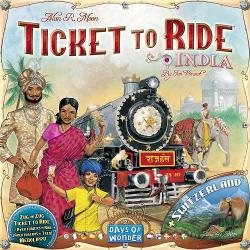
2011 · Rozšíření pro základní hru
Ticket to Ride Map Collection 2: India & Switzerland
Two double-sided maps present distinct regional scenarios for Ticket to Ride gameplay. The India side (2–4 players) adds scoring for the longest continuous path and for connecting cities on tickets via two distinct routes; the first two qualifying tickets score +5 each and the next three score +10 each, up to a 40-point bonus. Players still score normally for claiming routes and completing tickets. The Switzerland side (2–3 players) reprints the 2007 design with tickets that may link a city to a country or a country to its neighbors; completing such tickets scores the highest applicable value. Discarded tickets are removed from play, and Locomotives may be used only to build tunnels.
- Hráči
- 2–4 nejlépe pro 3
- Herní doba
- 30–60 min
- Věk
- 8+
- Složitost
- 2 / 5
O hře
- Autoři
- Ilustrace



Rozšíření pro
Zobrazit v Ludoya

Rozšíření
Zobrazit v Ludoya
Kde koupit
Ceny v obchodech a výtisky z druhé ruky, kontrolované každý den.
U stolů Ludoya
Kompletní statistiky v Ludoya- 219
- Zapsané partie
- 110
- Hráči
- 43m 44s
- Průměrná partie
- 84
- Ve sbírkách
- 3
- Na seznamech přání
7,7/10
z 21 recenzí na Ludoya
FazerGD7,5 +
Mohasz8,0 I really like the India map, it's great for 2 players and it works with more as well. The Mandala rule is a nice touch. The board looks beautiful. I'm not so keen on Switzerland though. It's not particularly bad but it has too many tunnels and can get frustrating easily. Also, the game can end in a ridiculous card drawing fest since there are several repeated country-to-country tickets.
Mestremuten6,0 Rating: 3/5 Production value: 3/4 Is the game in my collection/Love to have?: 0/1

Otázky k pravidlům
Odpovědi z pravidel od asistenta pravidel Ludoya.
How do Ferry routes work — do I have to use Locomotive cards for the locomotive symbols on the route?
To claim a Ferry you must play a Locomotive card for each Locomotive symbol shown on that route, plus the usual set of cards of the proper color for the remaining spaces (i.e., locomotives cover only the loco-symbol spaces and the color cards cover the others). (page 2)
In 2- or 3-player games can both tracks of a double-route be claimed by different players?
No — in 2- and 3-player games, once one track of a double-route is taken the other track is no longer available; only in 4-player games can both tracks be used. (page 2)
How many Destination Tickets do we draw at the start and during the game, and how many must we keep?
At the start each player is dealt 4 Destination Tickets and must keep at least 2; during the game a draw gives 3 Tickets and the player must keep at least 1. (page 2)
What happens to Destination Tickets I don't keep when I draw or at game start?
Destination Tickets you don’t keep — either at the start or after a mid-game draw — are discarded to the bottom of the Destination Tickets deck. (page 2)
What is the Indian Express bonus (longest path) and who gets it?
A 10-point Indian Express bonus is awarded to the player or players who have the Longest Continuous Path on the board. (page 2)
How does the Grand Tour (Mandala) bonus work — what makes a Ticket qualify and how are bonus points awarded?
A Ticket qualifies for a Grand Tour bonus if its two cities are linked by at least two distinct continuous paths of that player's trains (paths may intersect but may not share trains); bonuses scale by number of qualifying Tickets per the Mandala table (first two qualify for +5 each, next three +10 each, up to a maximum Grand Tour bonus of 40 points). (page 2)
Zdarma, na webu, Androidu i iOS
Hrajte Ticket to Ride Map Collection 2: India & Switzerland s Ludoya
- Mějte ji ve své sbírceEvidujte svůj výtisk a jeho rozšíření, půjčujte ho přátelům, nebo si ho dejte na seznam přání a dozvíte se, když cena klesne.Přidat do sbírky
- Zapisujte každou partiiBody, vítězové, časovače a fotky, a pak vaše statistiky: úspěšnost, oblíbený počet hráčů, nejlepší skóre.Zapsat partii
- Vyřešte spory o pravidlaZeptejte se na cokoli k pravidlům a dostanete odpověď z pravidel i se stránkou, kde si ji můžete ověřit.Zeptat se asistenta pravidel
- Najděte lidi, se kterými ji zahrátKluby, herní večery a akce ve vašem okolí, kde se tato hra hraje.Zobrazit akce
Údaje o hře (hráči, herní doba, věk, autoři) z BoardGameGeek.