
2013 · Economic
Bruxelles 1893
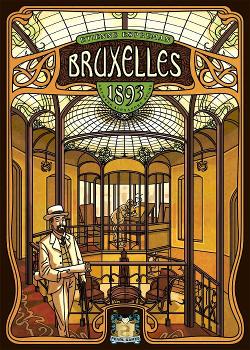
Players take the role of late-19th-century architects competing to create the most impressive Art Nouveau building and to produce works of art. The game uses worker placement with bidding and majority-control elements on a modular action board, so available actions vary by turn. Workers are placed to take paid actions (buy materials, add levels to a personal house, recruit patrons, create or sell art) or free actions that may risk losing a worker (acquire low-quality materials, activate patrons, visit the stock exchange, or take an action that normally costs money). Rounds end when all players pass, followed by an exhibition phase where art can be sold and prestige or bonus cards are awarded. After five rounds, final scoring awards points for architect level, completed work, bonus cards, and money on hand.
- Players
- 2–5 best 4
- Playing time
- 50–125 min
- Age
- 13+
- Complexity
- 3.6 / 5
About the game
- Design
- Publisher


Photos from Ludoya tables
All photos in Ludoya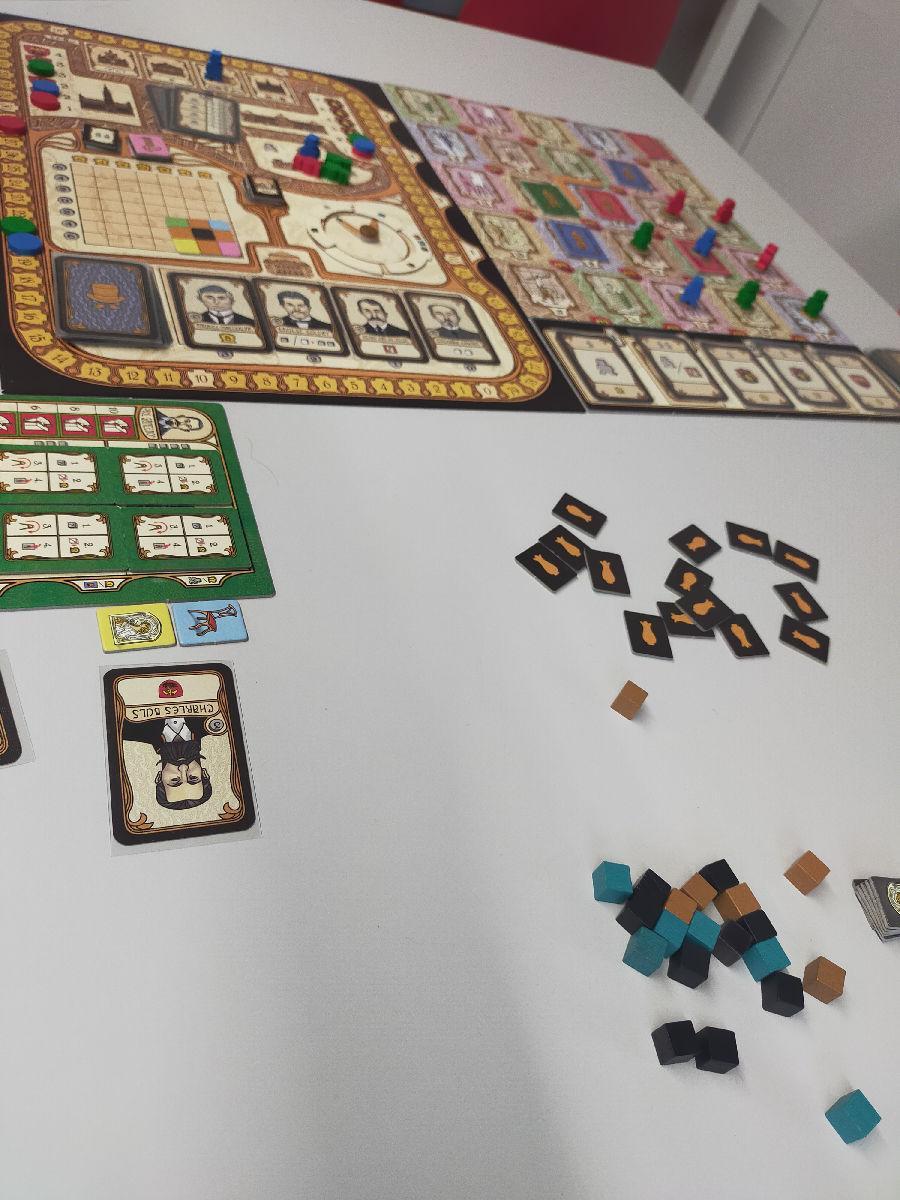
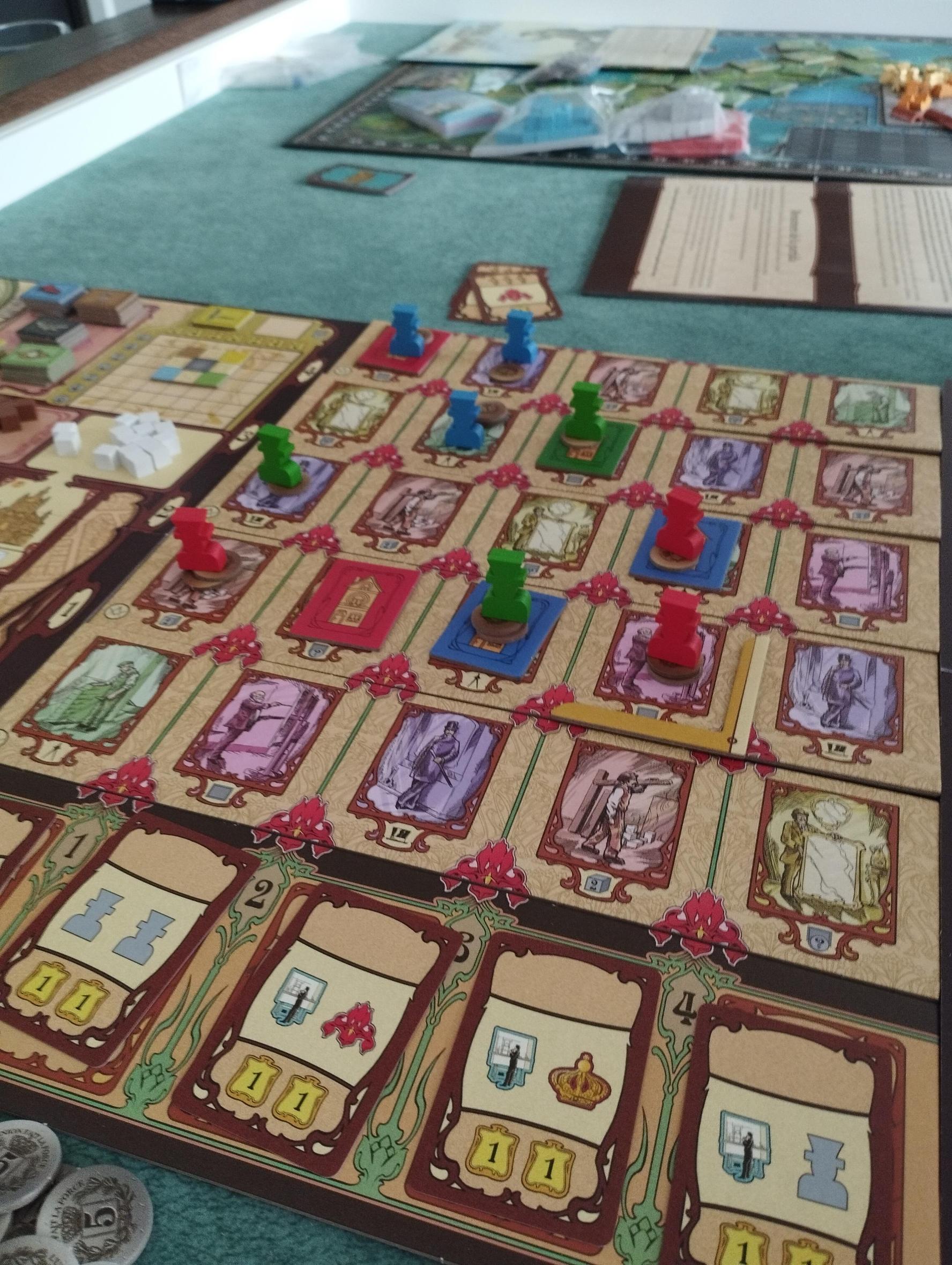
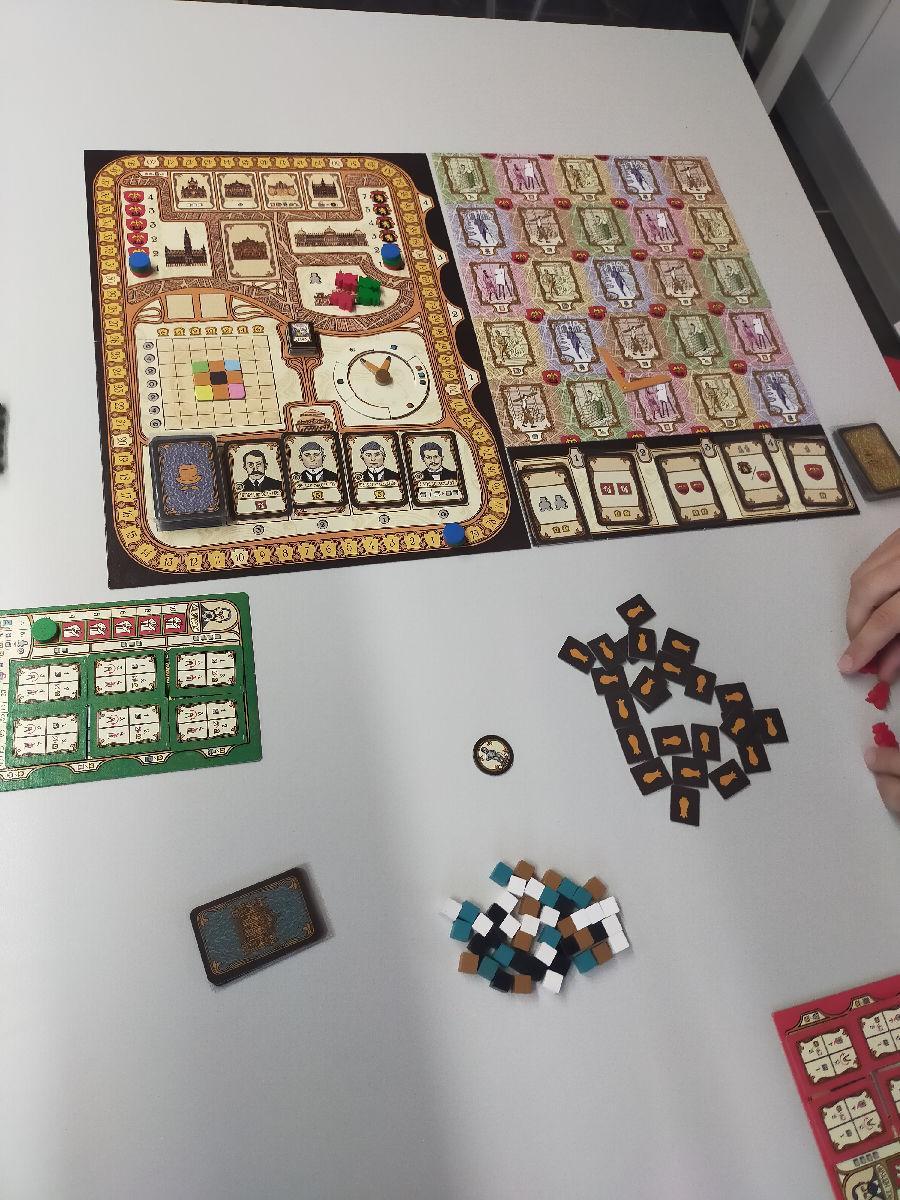
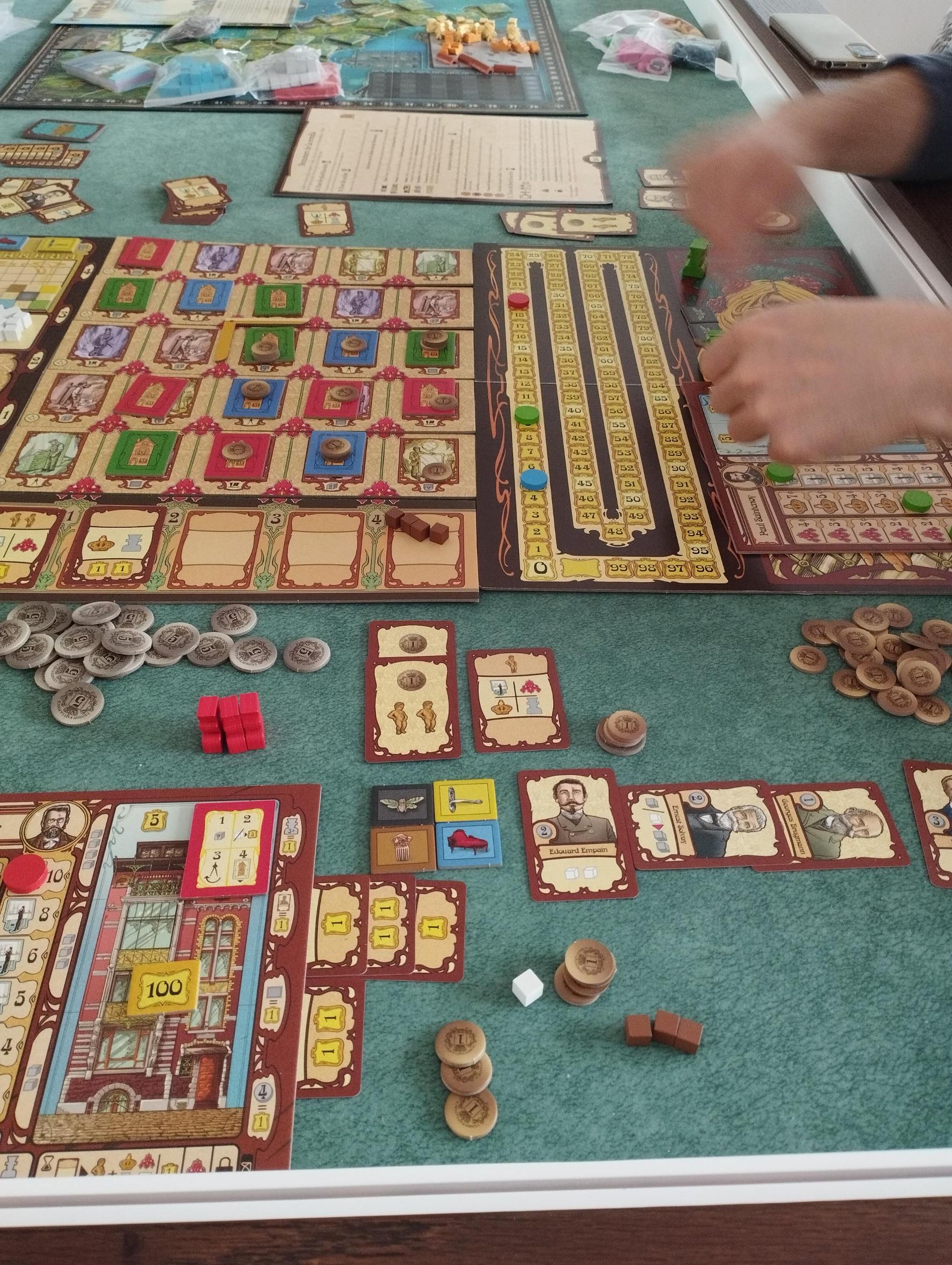
On Ludoya's tables
Full stats in Ludoya- 126
- Plays logged
- 168
- Players
- 1h 47m
- Average play
- 26
- In collections
- 11
- On wishlists
6.8/10
from 33 Ludoya reviews
Evan5.9 In this game, action spaces are laid out in a grid. When a player puts a meeple in a space to take the corresponding action, they do so along with some number of dollars. At the end of the action round, whichever player's collective bids in each column are the largest get the special card at the bottom. The card can then be used for it's powerful central buff, or it can be tucked under a player mat to amplify one of the end game scoring category multipliers. Add to that, at the end of each round, there's a little majority scoring amongst who occupies the most worker spots surrounding the shield icons, and then add the fact that players can put their own claim markers on buildings which means they get a cool benefit when someone else uses that spot, and you've got one of the most interesting, and player interactive worker placement games I've ever seen. There's more to it than just that, there are actually multiple paths to victory, and cool cards to combo and basically everything I could ever want from a game like this, short of a more nicely illustrated board. :star: Art, Iconography and components functional :star: Clever or interesting mechanisms :star: Reasonably low downtime between turns with mildly AP players :star: Multiple plays stay interesting :star: Low or mitigatable luck elements :star::star::nostar::nostar::nostar: Raw enjoyment
Rules questions
Answered from the rulebook by Ludoya's rules assistant.
How do I pick the City of Brussels shield from the Stock Exchange card and set the playable area on the Art Nouveau board?
On the revealed Stock Exchange card read the line for your player count, pick one of the two shield coordinates shown, place the Bracket on that shield and orient it to designate the largest of the four quadrants; that quadrant (bounded by the horizontal and vertical lines through the chosen shield) is the playable area for the round (page 4).
If I place an Assistant on the Art Nouveau board do I have to perform that action or can I just bid to compete for the Bonus card?
You are not required to carry out the action after placing an Assistant on the Art Nouveau board — you may place an Assistant and bid solely to participate in the auction for the Bonus card (page 5).
When I build a Building tile, what must I pay according to the compass needles?
You must pay using both construction units indicated by the two compass needles (they always point to two different spaces); if one needle is the “empty” space you must pay the entire cost with the other unit, and if one is the “1 noble material” you may use any noble material for that unit but still must pay at least one unit of the other needle’s type (page 6).
When I sell a Work of Art, can I sell a color already visible in the shop, and how do I get money and VPs?
You cannot sell a work whose color is already visible in the two shop slots; to sell you move the Workshop cursor a number of spaces equal to how many works you currently own, then collect the money and VPs indicated by the cursor dot that matches the color you sold (row = money, column = VPs), and place the sold tile onto one of the two shop spaces (page 5).
What happens when I pass — who gets the Exhibition tile and what income do players receive?
The first player to pass takes the Exhibition tile and immediately receives 1 BF plus 1 BF per color of Work of Art they own (up to 6 BF); other players who pass later each receive 1 BF per color of Work of Art they own (up to 5 BF) (page 7).
At the end of the game how do kept Public Figure cards affect scoring if I can't pay their cost?
At game end each player must pay the amounts on the Public Figure cards they kept; for each card they cannot pay they lose that card and also lose 5 VPs (page 10).







Free, on web, Android and iOS
Play Bruxelles 1893 with Ludoya
- Keep it in your collectionTrack your copy and its expansions, lend it to friends, or put it on your wishlist and get told when the price drops.Add it to your collection
- Log every playScores, winners, timers and photos, then your stats: win rate, favourite player count, best score.Log a play
- Settle rules questionsAsk anything about the rules and get an answer from the rulebook, with the page to check it on.Ask the rules assistant
- Find people to play it withClubs, game nights and events near you that bring this game to the table.See events
Game facts (players, playing time, age, credits) from BoardGameGeek.