
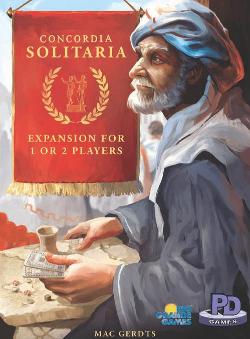
2021 · Expansion for Base-game
Concordia: Solitaria
Adds a solo and two-player mode that pits the player(s) against an automated opponent called Contrarius. Players use the same card-driven action system as the base game; each card played also dictates the adversary’s response, so planning and card sequencing shape both sides’ moves. Can be used with any map or other expansions for the base game and supports three difficulty settings (standard, veteran, expert). Includes a deck of cards, dice and rules to integrate Contrarius into solo or cooperative two-player sessions.
- Players
- 1–2 best 1
- Playing time
- 30–60 min
- Age
- 14+
- Complexity
- 2.8 / 5
About the game
- Publisher




Expansion for
See them in Ludoya
Where to buy it
Shop prices and second-hand copies, checked every day.
On Ludoya's tables
Full stats in Ludoya- 7
- Plays logged
- 6
- Players
- 1h 5m
- Average play
- 54
- In collections
- 8
- On wishlists
8.2/10
from 10 Ludoya reviews
Rules questions
Answered from the rulebook by Ludoya's rules assistant.
Do I resolve Contrarius’s reaction before or after my card action?
First carry out your card’s action, then resolve the reaction shown in the card’s Contrarius box. (Solo rules, p. 4)
How does Contrarius decide where to build a house?
The specified die sets the city’s goods type; among reachable cities without one of its houses, Contrarius prefers an empty city, then a new province, then alphabetical order. If no city of that goods type is available, it tries the next lower type in the listed cycle. (Solo rules, p. 9)
Can I use the Diplomat to copy the same Contrarius card more than once?
No. Copy one face-up Contrarius card’s action, resolve its reaction, then turn that card face down; each card can be copied only once. (Solo rules, p. 5)
What happens if Contrarius triggers the end of the game?
You play one final personality card and take its action without a Contrarius reaction. If you trigger the end instead, the game ends after Contrarius’s reaction to that card. (Solo rules, p. 10)
What if Contrarius can’t carry out a reaction, such as building a house or taking a card?
If it cannot build at all, it places a colonist instead; if it cannot place the indicated colonist, it places the other type, or takes the first display card if all six are already placed. If a die points to an unavailable card, it takes the first available card; if none remain, it builds using the white die. (Solo rules, p. 10)
Free, on web, Android and iOS
Play Concordia: Solitaria with Ludoya
- Keep it in your collectionTrack your copy and its expansions, lend it to friends, or put it on your wishlist and get told when the price drops.Add it to your collection
- Log every playScores, winners, timers and photos, then your stats: win rate, favourite player count, best score.Log a play
- Settle rules questionsAsk anything about the rules and get an answer from the rulebook, with the page to check it on.Ask the rules assistant
- Find people to play it withClubs, game nights and events near you that bring this game to the table.See events
Game facts (players, playing time, age, credits) from BoardGameGeek.