
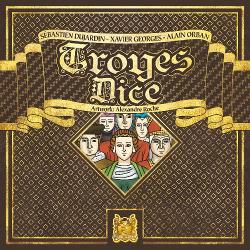
2020 · Dice
Troyes Dice
Players represent a wealthy medieval family shaping the development of a city divided among three social orders: nobility, commons, and clergy. The game uses rolled dice as shared resources; players assign dice to actions on their personal sheet to recruit citizens, develop markets, fund the cathedral, build prestige buildings, and respond to twice-daily events and raids. Choices balance immediate gains against longer-term scoring opportunities across multiple tracks and construction goals. Score results from fame accrued through buildings, market development, event resolution, and civic contributions; the highest total wins.
- Players
- 1–10 best 1
- Playing time
- 20–30 min
- Age
- 12+
- Complexity
- 2.3 / 5
About the game
- Publisher





Where to buy it
Shop prices and second-hand copies, checked every day.
On Ludoya's tables
Full stats in Ludoya- 122
- Plays logged
- 115
- Players
- 39m 14s
- Average play
- 38
- In collections
- 4
- On wishlists
6.8/10
from 9 Ludoya reviews
Mestremuten7.0 Rating: 3/5 Production value: 3/4 Is the game in my collection/Love to have?: 1/1
First impressions · 2 plays
Rules questions
Answered from the rulebook by Ludoya's rules assistant.
How do I know what a die costs, and can I ever use the black die?
Pay the cost shown for that die’s plaza; the die on the 0-cost plaza is free. You choose from the three remaining transparent dice— the black die is never available to buy or use (p. 5).
When does the black die attack my scoresheet, and what gets crossed out?
The black die attacks a scoresheet starting on day 3, targeting the die matching its value and the destroyed plaza’s color. Cross out that die and any unbuilt prestige or work buildings in that colored section of the column; buildings already constructed remain, and a Fortress protects its column (pp. 4, 7).
Can I change a die’s value or color before using it?
Yes. Spend 1 influence per step to adjust its value, without wrapping from 1 to 6; spend 2 knowledge to change its color. Pay the plaza cost to take the die before modifying it (pp. 5–6).
When I gain resources, do I also get citizens?
Circle resources equal to the chosen die’s value on the track matching its color. If a resource space is linked to a citizen, circle that citizen too; each circled citizen is worth 1 VP (p. 6).
What if I can’t afford any die?
If you don’t have enough resources to buy a die and no die is available for free, you take no action and gain 1 of each resource instead (p. 5).
Similar games
 Bravo!2019
 Qwixx Deluxe2016
 Lost Cities: Roll & Write2021
 Rajas of the Ganges: The Dice Charmers2020
 French Quarter2024
 Paper Dungeons: A Dungeon Scrawler Game2020
 Riverside2021
 Roll & Raid2020
 Dungeon Pages: Core Set2023
 2D6 Dungeon: A Dungeon Crawler2023
 Fleet: The Dice Game (Second Edition)2020
 Fleet: The Dice Game2018
People who own it also own



Free, on web, Android and iOS
Play Troyes Dice with Ludoya
- Keep it in your collectionTrack your copy and its expansions, lend it to friends, or put it on your wishlist and get told when the price drops.Add it to your collection
- Log every playScores, winners, timers and photos, then your stats: win rate, favourite player count, best score.Log a play
- Settle rules questionsAsk anything about the rules and get an answer from the rulebook, with the page to check it on.Ask the rules assistant
- Find people to play it withClubs, game nights and events near you that bring this game to the table.See events
Game facts (players, playing time, age, credits) from BoardGameGeek.