
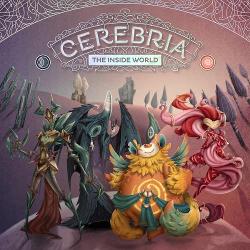
2018 · Fantasy
Cerebria: The Inside World
Cerebria: The Inside World is a board game for 1–4 players. It plays in 60–120 minutes and is meant for ages 14 and up. Ludoya players call it best with 2. It is rated 7 out of 10 by 12 Ludoya reviewers. The cheapest copy in stock is $52.00 (United States).
Two teams of Spirits—embodiments of Bliss and Gloom—vie to shape a personified inner world through area control and objective scoring. Players take turns spending Willpower to move Spirits across Realms and Frontiers, invoke and upgrade Emotion cards that occupy board areas, remove opposing Emotions, and erect Fortresses to lock in influence. Willpower is mainly gathered from central Spheres, while a limited shared Ambition resource unlocks the most powerful effects. Teams score via public minor Intentions or by fulfilling changing major Aspirations, which add permanent Bliss or Gloom Fragments to the evolving central Identity; the side with greater influence on the finished Identity wins.
- Players
- 1–4 best 2
- Playing time
- 60–120 min
- Age
- 14+
- Complexity
- 4.3 / 5







Where to buy it
Shop prices and second-hand copies, checked every day.
On Ludoya's tables
Full stats in Ludoya- 51
- Plays logged
- 97
- Players
- 2h 7m
- Average play
- 38
- In collections
- 14
- On wishlists
7.0/10
from 12 Ludoya reviews
Origin box with Painted Minis

Rules questions
Answered from the rulebook by Ludoya's rules assistant.
How is control of a Frontier or a Realm actually determined — do you count cards or something else?
Frontier control is determined by the Frontier's Triad (the Frontier slot plus the two adjacent slots): if only one team has Emotions there they control it, otherwise add each team's Emotion Intensities (the highest-numbered filled Essence space on each card) in the triad and the higher total controls; tied or empty = no control (pages 12–13).
If there's an opposing Emotion in the Realm, does an Emotion on the adjacent Frontier still count toward that Realm?
An Emotion on a Frontier can be blocked from influencing a particular Realm if an opposing Emotion occupies the adjacent Realm slot (the blocked Emotion still affects its Frontier and the other adjacent Realm); Realms are scored by adding Intensities of unblocked Emotion slots plus any Fortress bonus (pages 12–13).
How much Willpower do I get from Absorb, and when does a Revelation/Origin rotation happen?
Absorb gives a base of 2 Willpower plus +1 for each adjacent Frontier your team controls (and any Emotion effects); you then take the Sphere's optional bonus, and if the Sphere becomes empty you resolve a Revelation and then rotate the Origin one step clockwise (pages 22–23).
Can I build or upgrade a Fortress in an opponent-controlled Realm, and how do Exalt and Raze work?
You may Fortify only in a Realm your opponent does not control and only if the Fortress location is empty (placing a Minor Fragment and +1 Intensity); Exalt upgrades your existing Minor to a Major by spending 1 Ambition (and the Fortify cost), while Raze lets you, for a Willpower + Ambition cost, remove or downgrade an opponent's Fragment and may be used even in an opponent-controlled Realm and grants an extra Action (page 17).
What are the requirements and costs to Empower an Emotion?
To Empower you must be adjacent to the Mild Emotion, it must meet its Empower threshold of Essence, and you spend 3 Willpower to replace it with its Strong counterpart while transferring Essence (tokens other than Essence are discarded); upgrades like Channeled Power let you spend 1 Ambition to add 1 Essence before empowering (page 18).
How do Ambition tokens work — how do you gain/spend them and what can you do with them?
Ambition is a shared pool (max 3) that starts empty; you commonly gain Ambition by flipping a face-down Ambition token instead of drawing 2 Emotion cards at end of your turn, and spending Ambition flips a token to the spent side; Ambition can pay for powerful Abilities such as adding a Vibe token, rotating the Origin, or buying an Additional Action, with each Ambition Ability usable only once per turn (page 21).
Similar games
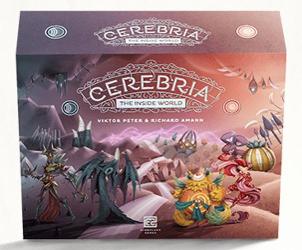 Cerebria: The Inside World – Origin Box2018
 Defenders of the Wild2024
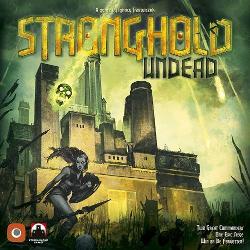 Stronghold: Undead (Second Edition) – Kickstarter Edition2021
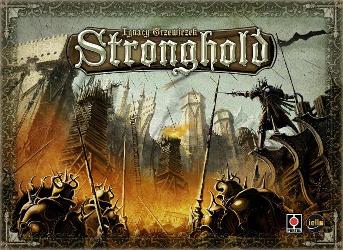 Stronghold2009
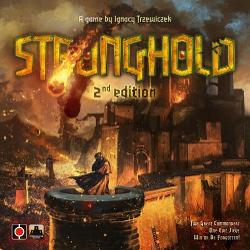 Stronghold: 2nd edition2015
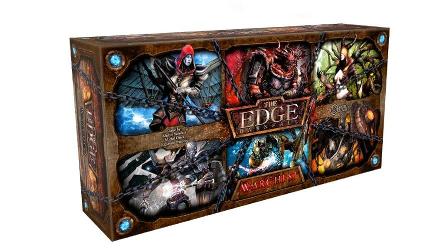 The Edge: Dawnfall2018
 Legend of the Five Rings: The Card Game2017
 The Defence of Procyon III2021
 Defenders of the Realm2010
 Arkham Horror: The Card Game2026
 Slay the Spire: The Board Game2024
 Primal: The Awakening2024
People who own it also own
 Barragoon2014
 Perseverance: Castaway Chronicles – Episodes 1 & 22022
 Mare Nostrum: Empires2016
 Argent: The Consortium2015
 Mythic Battles: Pantheon2017
 Bios: Genesis2016
 Civilization: A New Dawn2017
 Septima2023
 Trickerion: Legends of Illusion2015
 The Other Side of the Hill2024
 Raiders of the North Sea2015
 Mombasa2015
Free, on web, Android and iOS
Play Cerebria: The Inside World with Ludoya
- Keep it in your collectionTrack your copy and its expansions, lend it to friends, or put it on your wishlist and get told when the price drops.Add it to your collection
- Log every playScores, winners, timers and photos, then your stats: win rate, favourite player count, best score.Log a play
- Settle rules questionsAsk anything about the rules and get an answer from the rulebook, with the page to check it on.Ask the rules assistant
- Find people to play it withClubs, game nights and events near you that bring this game to the table.See events
Game facts (players, playing time, age, credits) from BoardGameGeek.