
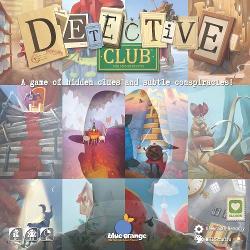
2018 · Card Game
Detective Club
Players use illustrated cards to clue a secret word while hiding or exposing a secret role. Each round assigns one player as an undercover conspirator paired with a clue-giver; both know the secret word and must communicate it using only two surreal illustration cards. Other players are detectives who also know the word but not who else knows it, so they must interpret clues, discuss, and deduce identities. Play alternates between giving creative visual clues, debating interpretations, and voting to accuse suspected conspirators. Rounds reveal whether the conspirator fooled the table or was identified.
- Players
- 4–8 best 6
- Playing time
- 45 min
- Age
- 8+
- Complexity
- 1.2 / 5
About the game
- Design
- Art
- Publisher



Expansions
See them in Ludoya
Photos from Ludoya tables
All photos in Ludoya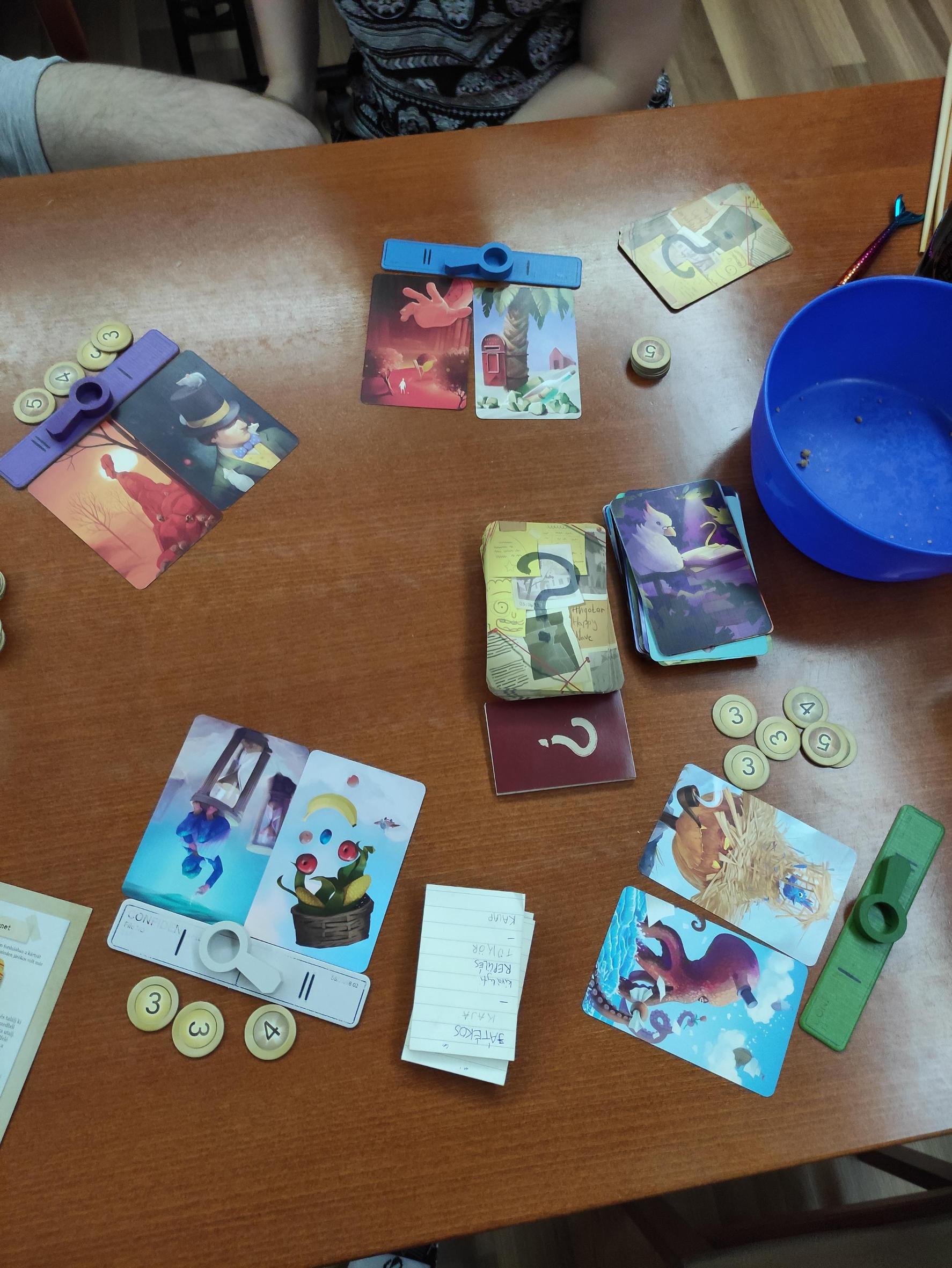
Where to buy it
Shop prices and second-hand copies, checked every day.
On Ludoya's tables
Full stats in Ludoya- 79
- Plays logged
- 236
- Players
- 55m 30s
- Average play
- 51
- In collections
- 13
- On wishlists
6.7/10
from 21 Ludoya reviews
Garfield3.0 If you get shitty cards, you can't do much. Inventing a story makes you very suspicious. [c] Theme: ★☆☆☆☆ <!-- size 7]Nope --> Gameplay: ★★☆☆☆ <!-- size 7]A little bit boring --> Interaction: ★★☆☆☆ <!-- size 7]Take a look at the cards of the others --> Artwork: ★★★★☆ <!-- size 7]Very nice illustrations --> Luck: ★★★★☆ <!-- size 7]Card drawing --> Strategy: ★★☆☆☆ <!-- size 7]Really not much --> Components: ★★☆☆☆ <!-- size 7]Big cards, that's it --> Play duration: ★★★★☆ <!-- size 7]Very good --> Easy to teach: ★★★★☆ <!-- size 7]Should be easy --> Rules quality: <!-- size 7]not yet read --> Setup time: ★★★★★ <!-- size 7]Very fast --> No downtime: ★★★★☆ <!-- size 7]Almost no downtime --> Replay value: ★★★☆☆ <!-- size 7]Different cards, different stories to tell --> [/c]
No plays logged
Mohasz7.5 Great party game. 8.5 -> 7.5 - For some reason, I enjoy it a little less now. I'm starting to appreciate Dixit's simplicity more and more as time goes by.
No plays logged
Rules questions
Answered from the rulebook by Ludoya's rules assistant.
How many cards should I have in my hand and when do I draw new ones?
Each player must always have 6 Evidence Cards in hand; whenever you play an Evidence Card you immediately draw a replacement from the deck (page 1).
Who is the Conspirator and how is that determined?
The Active Player writes the secret word on every notebook except one; the player who receives the empty notebook is the Conspirator (page 2).
When does the Active Player play their second card — before or after everyone plays their first card?
The Active Player plays a first card, then each other player plays one card (starting to the Active Player’s left); once all players have played one card, the Active Player plays a second card, and then play continues until everyone has played two cards (page 2).
Does the Active Player vote in the accusing/voting phase?
No — the Active Player does not participate in the vote; only the other players place Voting Tokens (page 3).
How is scoring resolved if 0, 1 or 2+ tokens are placed on the Conspirator?
Each Detective who voted correctly scores 3 VP; if there are 0 or 1 tokens on the Conspirator, the Conspirator scores 5 VP and the Active Player scores 4 VP; if there are 2 or more tokens on the Conspirator, neither the Conspirator nor the Active Player score (page 3).
How many rounds does the game last?
The game ends after each player has been Active Player once when playing with 6–8 players, or twice when playing with fewer than 6 players (pages 1 and 3).

















Free, on web, Android and iOS
Play Detective Club with Ludoya
- Keep it in your collectionTrack your copy and its expansions, lend it to friends, or put it on your wishlist and get told when the price drops.Add it to your collection
- Log every playScores, winners, timers and photos, then your stats: win rate, favourite player count, best score.Log a play
- Settle rules questionsAsk anything about the rules and get an answer from the rulebook, with the page to check it on.Ask the rules assistant
- Find people to play it withClubs, game nights and events near you that bring this game to the table.See events
Game facts (players, playing time, age, credits) from BoardGameGeek.