
2018 · Print & Play
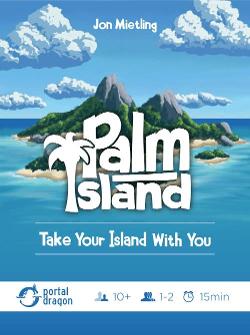
Palm Island
Palm Island is a board game for 1–2 players. It plays in 15 minutes and is meant for ages 10 and up. Ludoya players call it best with 1. It is rated 7.4 out of 10 by 20 Ludoya reviewers. The cheapest copy in stock is $16.39 (United States).
Players manage a small tropical village using a compact, table-free card system that fits in one hand. Over eight rounds, a 17-card deck transforms as players gather and store resources, pay for upgrades, and build or improve structures to unlock new abilities. Decisions carry over between rounds as the village evolves and players score victory points after the final round. Includes solo, cooperative, and competitive modes with specific objective cards; villagers and additional decks can be added to modify player count and introduce new abilities and challenges.
- Players
- 1–2 best 1
- Playing time
- 15 min
- Age
- 10+
- Complexity
- 1.8 / 5
About the game
- Design
- Publisher


Where to buy it
Shop prices and second-hand copies, checked every day.
On Ludoya's tables
Full stats in Ludoya- 321
- Plays logged
- 56
- Players
- 20m 48s
- Average play
- 67
- In collections
- 13
- On wishlists
7.4/10
from 20 Ludoya reviews
Fun game that can go with you anywhere! I am a sucker for in hand games and this one is a great example - I also like the campaign-esque elements.
Nice, very portable game...
Juli7.0 - Small box - Quick game: under 15 mins - Solo mode - Own Digital version - Digital version (iOS app)



Rules questions
Answered from the rulebook by Ludoya's rules assistant.
Can I take an action on the second card, or only the top card?
You may use any action shown on the active area of either of the top two cards; if you use the second card, the first card stays in place and you then begin the next turn (page 6).
How do I pay for an action—do I pull stored cards out of the deck?
To pay, rotate one or more stored resource cards 90° counterclockwise without changing their position in the deck; any extra resources on a card beyond what you need are lost (pages 4, 6–7).
What happens if a stored resource card becomes the top card of my deck?
If a stored resource card ever becomes the top card, you must immediately discard it by rotating it 90° counterclockwise and placing it at the back of the deck (page 7).
How many stored resource cards can I have sticking out of the deck?
You may have at most four stored resource cards sticking out at a time; to store a new resource when four are already stored you must first reset one stored card by rotating it counterclockwise to free a slot (page 7).
Can I discard the second card of the deck to skip it?
No — you may only choose to discard the top (first) card by placing it at the back of the deck; you may never discard the second card, and if you cannot interact with either top two cards you must discard the first (page 6).
How do Feat cards get earned and used in future solo games?
At the end of a solo game check each Feat's criteria and if met rotate or flip that Feat so its unlock marker is in the top-left to mark it earned; when using an earned Feat orient it with the unlock marker top-left and place it at the back of your deck (page 9).












Free, on web, Android and iOS
Play Palm Island with Ludoya
- Keep it in your collectionTrack your copy and its expansions, lend it to friends, or put it on your wishlist and get told when the price drops.Add it to your collection
- Log every playScores, winners, timers and photos, then your stats: win rate, favourite player count, best score.Log a play
- Settle rules questionsAsk anything about the rules and get an answer from the rulebook, with the page to check it on.Ask the rules assistant
- Find people to play it withClubs, game nights and events near you that bring this game to the table.See events
Game facts (players, playing time, age, credits) from BoardGameGeek.