

2019 · Fantasy
Roam
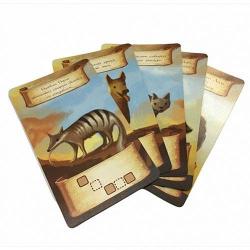
Players explore the waking world of Arzium, seeking sleepwalking inhabitants and recruiting them into their party. On a shared landscape made from double-sided tarot-sized adventurer cards, players activate characters in their party to place search tokens in unique patterns. When all squares on a landscape card are searched, the player who contributed the most searches claims that card and adds the adventurer to their party, gaining points and a new search pattern. Searches also collect coins that can be spent on special actions or artifacts. The game ends when a player reaches ten adventurers; the highest score wins.
- Players
- 2–4 best 3
- Playing time
- 30–45 min
- Age
- 8+
- Complexity
- 1.8 / 5
About the game
- Design
- Art
- Publisher


Expansions
See them in Ludoya
Where to buy it
Shop prices and second-hand copies, checked every day.
On Ludoya's tables
Full stats in Ludoya- 203
- Plays logged
- 182
- Players
- 36m 52s
- Average play
- 66
- In collections
- 4
- On wishlists
- 2
- Pre-ordered
7.2/10
from 22 Ludoya reviews
Elvira8.0 Also for sale

Rules questions
Answered from the rulebook by Ludoya's rules assistant.
Can I rotate a character card's placement pattern when I place markers?
No — you must place markers in the same direction the card is facing and you may not rotate placement patterns. (p.6–7)
If a square is already occupied, do I skip it or can I remove the other player's marker?
Skip that square while placing and continue with the remaining markers; you may not reclaim or remove markers normally until the card they occupy is completed. (p.6) Note: an artifact ability can replace another player's marker when used. (p.16)
Can a "blank" marker on a character card extend off the edge of the map?
Yes — a blank marker shown on a character card may extend beyond the map edge, but normal marker patterns must fit entirely within the map borders. (p.8–9)
Can I pay coins to place extra blank markers, and can I use coins I gain during the same turn?
Yes — you may pay 2 coins per blank shown on the card to place that blank (you can do this for each blank on the card) and you may use coins you gain during the same turn. (p.9)
How do you claim a completed land card, and what happens if there's a tie for most markers?
When all six squares of a land card are filled, the player with the most markers on that card claims it; tied players may each bid once (starting with the active player) to win the card, and only the winning bidder pays their bid. Also, any other player who had at least one marker on a claimed card gains one coin. (p.10–11)
Can squares hold more than one marker, and how does the Outpost bonus work?
By the standard rules each square may hold only one marker, but the stacking variant allows up to two markers per square; the Outpost variant awards 3 points to the first player who completely surrounds an opponent's marker on all eight adjacent squares. (p.6; p.14)





People who own it also own






Free, on web, Android and iOS
Play Roam with Ludoya
- Keep it in your collectionTrack your copy and its expansions, lend it to friends, or put it on your wishlist and get told when the price drops.Add it to your collection
- Log every playScores, winners, timers and photos, then your stats: win rate, favourite player count, best score.Log a play
- Settle rules questionsAsk anything about the rules and get an answer from the rulebook, with the page to check it on.Ask the rules assistant
- Find people to play it withClubs, game nights and events near you that bring this game to the table.See events
Game facts (players, playing time, age, credits) from BoardGameGeek.