
2018 · Politické
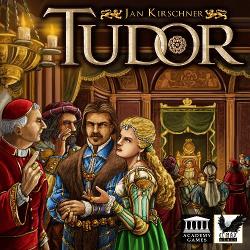
Tudor
Players act as noble families competing for influence at the Tudor court. Each turn, players place Courtiers into three Audience Chambers and then place a single Lord; only Courtiers in Chambers that contain any Lord may use that Chamber’s actions. Limited seating and opponent placement can displace Courtiers and change access to actions. Courtiers in an active Chamber each perform one of the two available actions (the occupying Lord may take both). Actions grant Court Cards and allow movement of Courtiers in the Throne Room to claim Court Tokens and advance on Court Offices. Reaching the top of an Office earns a Ring, which players display on a personal screen; Ring placement modifies the effects of future actions. Offices can be contested and stolen by opponents, shifting Prestige. Each game uses a scenario card plus two scoring cards to alter rules and scoring, producing variable strategic play. The winner is the player with the most Prestige at game end.
- Hráči
- 2–4 nejlépe pro 4
- Herní doba
- 90–120 min
- Věk
- 12+
- Složitost
- 2,9 / 5
O hře
- Autoři
- Ilustrace
Rozšíření
Zobrazit v Ludoya
Kde koupit
Ceny v obchodech a výtisky z druhé ruky, kontrolované každý den.
U stolů Ludoya
Kompletní statistiky v Ludoya- 27
- Zapsané partie
- 45
- Hráči
- 1h 38m
- Průměrná partie
- 25
- Ve sbírkách
- 2
- Na seznamech přání
4,9/10
z 10 recenzí na Ludoya
Evan4,6 Each round players put one or two workers into one of three lines for action spaces. Once everyone is done placing their workers, the workers push into the spaces displacing workers from previous rounds if the room overfills. Then players place their double action pawn into one of the three action boxes. Each action box has two possible actions, with basic workers getting to do either of the two, and your double pawn getting to do both of the two, with the trick of things being that if no player places their double pawn into a box, no regular workers get to act. The game has a variable number of rounds, a variable number of actions each round and variable scoring conditions, so it's a bit hard to talk about what your goals are since they'll be different each game, but generally the core of the game comes from moving your pawns around a central grid. When you move into or through a space, you have to spend cards that color match the tokens that get randomly seeded into the spaces. Then you collect the faction tokens of those spaces, and new ones get drawn from a bag and placed into those spaces. If you land on a circle token, you also claim it for an extra bonus effect, which also varies game to game. If you hit the back row, your meeple locks in, and you get to select a ring from the display. The rings are how you do any engine building in the game. Each player has a very silly player screen with big fingers sticking out the top. You start the game with two rings, which you place on the fingers of your screen. Having rings of specific sets of fingers unlocks better versions of the actions your workers get to take. Getting more rings opens up your ability to use the actions more effectively as some rely on having specifically colored rings, but it also gives you access to more of the improved versions of the actions. I really enjoy the action selection and resolution process, although there are a few points of frustration for me. The first is when you make it to the back of a column and get a new ring, your meeple remains there until someone else comes along and knocks you out. When they do so, they get to take one of your rings. This might turn off the special version of the action you were just about to resolve. This might also change your color mix so you could be unable to resolve your actions usefully. Since the action that moves your meeple can move you up to 7 spaces in a single move, it can be very hard to predict or plan for when someone is going to take your ring. Having then taken your ring, there's very little you can do in terms of a response, other than eventually work around to amassing enough cards in the right combinations to do the same. You do get to re-arrange the locations of your rings when you get knocked out, so you might be able to salvage something out of the situation, but generally I like it better in euro games when there's some amount of back and forth to effects like this. It can also feel rough when you've lined up enough cards for a good run down the chart, and someone beats you to it, picking up all the tokens and replacing them with new ones that don't match your hand at all. This at least isn't as bad since you still do have those cards in supply and they'll come in handy eventually. My last big criticism is that when players get uneven numbers of worker activation opportunities, those players get weak pass actions. They consist of either take a card matching the color of a ring you have, or move 1 space. Since when you get knocked out of a space, you opponent gets to take a ring of their choice from you, there are rough situations where they might take a ring from you and create a situation where in your pass action you are unable to draw the color of a card that would let you walk a space. In theory taking the time to draw more cards than you need for your moves would mitigate this, but as it is in euros, actions are tight. So, in conclusion, this game has silly components, a compelling system for actions, but feels only slightly too punchy for my taste. This could change once I see some more of the variable game setup cards. :star: Art, Iconography and components functional :star: Clever or interesting mechanisms :star: Reasonably low downtime between turns with mildly AP players :star: Multiple plays stay interesting :star: Low or mitigatable luck elements :star::nostar::nostar::nostar::nostar: Raw enjoyment
Garfield4,0 Themeless tile collecting game. [c] Theme: :star::nostar::nostar::nostar::nostar: <!-- size 7]Too abstract --> Gameplay: :star::star::nostar::nostar::nostar: <!-- size 7]Rinse and repeat. --> Interaction: :star::star::nostar::nostar::nostar: <!-- size 7]Almost none --> Artwork: :star::star::nostar::nostar::nostar: <!-- size 7]Nothing special --> Luck: :star::star::nostar::nostar::nostar: <!-- size 7]Not much --> Strategy: :star::star::star::nostar::nostar: <!-- size 7]AP danger --> Components: :star::star::star::nostar::nostar: <!-- size 7]Nothing special --> Play duration: :star::star::nostar::nostar::nostar: <!-- size 7]Too long --> Easy to teach: :star::star::star::nostar::nostar: <!-- size 7]Ok --> Rules quality: <!-- size 7]not read --> Setup time: :star::star::star::nostar::nostar: <!-- size 7]Ok --> No downtime: :star::star::nostar::nostar::nostar: <!-- size 7]AP danger --> Replay value: :star::star::nostar::nostar::nostar: <!-- size 7]Not much I can think of --> [/c]
Cool, original and demanding Eurogame!






Zdarma, na webu, Androidu i iOS
Hrajte Tudor s Ludoya
- Mějte ji ve své sbírceEvidujte svůj výtisk a jeho rozšíření, půjčujte ho přátelům, nebo si ho dejte na seznam přání a dozvíte se, když cena klesne.Přidat do sbírky
- Zapisujte každou partiiBody, vítězové, časovače a fotky, a pak vaše statistiky: úspěšnost, oblíbený počet hráčů, nejlepší skóre.Zapsat partii
- Počítejte body bez papíruPoužívejte výsledkové listy a herní pomocníky od komunity a nechte Ludoya sečíst body.Najít výsledkové listy
- Najděte lidi, se kterými ji zahrátKluby, herní večery a akce ve vašem okolí, kde se tato hra hraje.Zobrazit akce
Údaje o hře (hráči, herní doba, věk, autoři) z BoardGameGeek.