
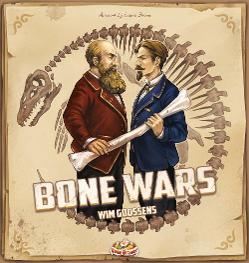
2024 · Prehistoric
Bone Wars
Players take the role of late-19th-century palaeontologists competing to discover, publish and claim dinosaur species amid a bitter rivalry. On each turn they play action cards into slots under their player board to dig in the field, recover fossils, activate team actions, or use their paleontologist to publish papers and debunk opponents. Published species are placed in bonus slots on the player board to grant escalating benefits, while published papers are scored on either Marsh’s or Cope’s side and earn loyalty points. Endgame scoring multiplies loyalty with published papers to determine victory, so players balance fieldwork, publication timing and patron loyalty.
- Players
- 1–4 best 3
- Playing time
- 60–120 min
- Age
- 12+
- Complexity
- 3.9 / 5
About the game
- Design
- Art
- Publisher

Where to buy it
Shop prices and second-hand copies, checked every day.
On Ludoya's tables
Full stats in Ludoya- 33
- Plays logged
- 37
- Players
- 2h 10m
- Average play
- 21
- In collections
- 9
- On wishlists
8.0/10
from 6 Ludoya reviews
Rules questions
Answered from the rulebook by Ludoya's rules assistant.
Do I have to pay both the action-slot cost and the card’s activation cost before performing actions?
Yes — you must pay the activation costs shown on the action slot AND any activation cost on the card you play before you perform its actions (both can add up to $0–$3+). (page 11)
Can I move my team for free during my turn, and can I split those free moves between actions?
Yes — you get a number of free moves (start with 1, can upgrade to 2–3) that you may use before, after, or while spending action points, and you may split them between actions. Also you can only move along the indicated paths/arrows and must move from your university to a dig site at the start of each round. (page 12)
When I Dig for Bones, can I take any bone token on the dig site?
No — which bone slots you may take from depends on the dig depth printed on your team card or action slot (top only, top+middle, or any of the three); if there are no accessible tokens you cannot do the action. Place any taken token into an empty crate or discard a token to make space. (page 12)
How exactly do I publish a paper — what bones do I discard and when do I get the rewards?
To publish you discard 2–4 different bone tokens matching the species’ required parts (torso, tail, skull type, limb) to assemble the skeleton, then archive the species card and add a paper tile to your patron’s bookshelf; you must allocate bones for all papers you publish before resolving any rewards, which depend on completeness and card prize bonuses. (pages 14–15)
Can I debunk an opponent’s paper by discarding different bone types, or do they have to be identical?
You must discard sets of identical bone tokens (2, 3, or 4 identical tokens) to debunk a paper; the number discarded must match the value of the paper you take from the opponent and you flip/move that paper to your patron’s side. (page 16)
What happens when I pass — what end-of-round steps must I perform?
When you pass you immediately perform the end-of-round sequence: 1) choose a new profession space and take its bonuses, 2) return your team to a university (and flip patron portrait if needed), 3) claim the grant at that university, and 4) gain any loyalty bonus from your patron loyalty track; note special neutral-team movement in <4‑player games and that in the final round only step 1 is performed. (page 20)









Free, on web, Android and iOS
Play Bone Wars with Ludoya
- Keep it in your collectionTrack your copy and its expansions, lend it to friends, or put it on your wishlist and get told when the price drops.Add it to your collection
- Log every playScores, winners, timers and photos, then your stats: win rate, favourite player count, best score.Log a play
- Settle rules questionsAsk anything about the rules and get an answer from the rulebook, with the page to check it on.Ask the rules assistant
- Find people to play it withClubs, game nights and events near you that bring this game to the table.See events
Game facts (players, playing time, age, credits) from BoardGameGeek.