
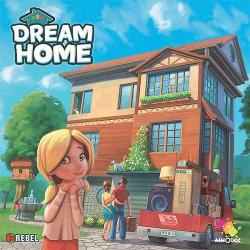
2016 · Card Game
Dream Home
Players act as home designers who plan and expand a house by drafting paired cards over twelve rounds. Each turn yields a room card plus an accessory (roof, helper, furnishing or tool) that players place on personal boards to construct and furnish their layouts. Gameplay focuses on arranging rooms and adding functional and decorative elements; scoring evaluates connectivity and usefulness of spaces as well as roof and furnishing quality. At game end, players compare finished houses and total points to determine the highest-scoring design.
- Players
- 2–4 best 4
- Playing time
- 30 min
- Age
- 7+
- Complexity
- 1.7 / 5
About the game
- Design
- Publisher


Expansions
See them in Ludoya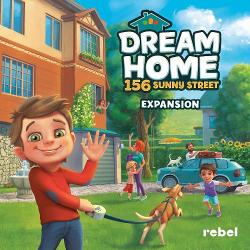

Where to buy it
Shop prices and second-hand copies, checked every day.
On Ludoya's tables
Full stats in Ludoya- 246
- Plays logged
- 153
- Players
- 32m 9s
- Average play
- 52
- In collections
- 6
- On wishlists
- 1
- Pre-ordered
6.5/10
from 33 Ludoya reviews
Great Family Card Drafting House Building game! Seems simpler than it really is, and has some cool mechanics. Beautiful artwork, and easy to play and to learn.
SrCornelius7.0 Local-(312)


Rules questions
Answered from the rulebook by Ludoya's rules assistant.
If I take the leftmost column, do I automatically become first player next round?
Yes — if you choose the leftmost column you take the bottom card and the first-player marker; if nobody chooses the leftmost column, the current first player keeps the marker for the next round. (p.4)
Can I place room cards anywhere on my home board?
No — rooms cannot have an empty space directly below them, basement cards must go on the two basement spaces, and normal/unique rooms must be placed on the top two floors. (p.6)
Does placing a décor token finish a room, and can finished rooms be expanded?
Normally placing a décor token finishes that room and it cannot be expanded further, and a room that has reached its maximum card size is also finished. The Interior Designer helper is an exception: while you have it the décor token does not finish the room during the game (though it still limits to one décor), and each décor is worth extra points at the end. (p.5, p.7, p.13)
What should I do if I can't or don't want to place a room card I took?
Place the card facedown on an empty space of your home board as an empty room (worth 0 points); empty rooms still must obey placement rules (e.g., no empty space directly below) and cannot be expanded. (p.6)
How do roof cards score, and what about roof windows and the Roofer helper?
You place roof cards facedown as you take them, then at the end reveal and choose four to form your roof: a uniform four-of-a-kind is 8 points, a mismatched full roof is 3 points, incomplete roofs score 0, and each window on a complete roof adds +1 point. The Roofer helper lets you add one discarded roof card to your stack at the end, but you must use it before looking at your facedown roof cards. (p.10, p.11, p.12)
When and how can I use tool cards like Drill and Jackhammer, and do they cost me my turn?
Tool cards are used during your turn unless specified otherwise: Drill is discarded at the start of your turn (before choosing a column) to swap a room on the game board with one on your board, while Jackhammer is discarded at the start of a round (before the first player chooses) to immediately take one room from the board and then you skip your normal turn that round. (p.13)











Free, on web, Android and iOS
Play Dream Home with Ludoya
- Keep it in your collectionTrack your copy and its expansions, lend it to friends, or put it on your wishlist and get told when the price drops.Add it to your collection
- Log every playScores, winners, timers and photos, then your stats: win rate, favourite player count, best score.Log a play
- Settle rules questionsAsk anything about the rules and get an answer from the rulebook, with the page to check it on.Ask the rules assistant
- Find people to play it withClubs, game nights and events near you that bring this game to the table.See events
Game facts (players, playing time, age, credits) from BoardGameGeek.