
2011 · Territory Building
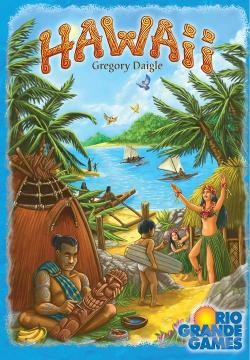
Hawaii
Players act as chieftains developing coastal villages and exploring nearby isles over five rounds. Movement around a modular board lets chieftains buy new village tiles, manage three separate currencies to pay for trips, and grow their settlements. Income declines as the game progresses, so players must balance short-term purchases that please their people with longer-term tile placement and island exploration to score points. The game emphasizes resource management, spatial planning of village tiles, and timing of actions to outmaneuver opponents for the best deals.
- Players
- 2–5 best 3
- Playing time
- 60 min
- Age
- 13+
- Complexity
- 2.9 / 5
About the game
- Design
- Publisher


Expansions
See them in Ludoya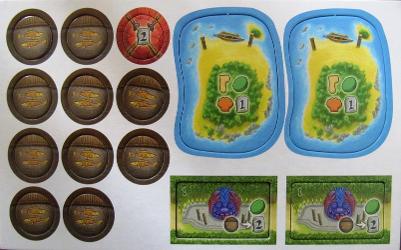
On Ludoya's tables
Full stats in Ludoya- 40
- Plays logged
- 50
- Players
- 1h 32m
- Average play
- 17
- In collections
- 3
- On wishlists
5.2/10
from 15 Ludoya reviews
Evan4.6 At the start of each round, action tokens are distributed from a bag to the spaces in the action areas. Each token has a number representing the cost of that action in shell tokens. This process is a little fiddly, since first you fill some spaces, then come back and start from the top filling the rest so long as a math equation comparing the sums of tokens lines up. It's mildly annoying to have to start each round this way. Then players in turn order can spend feet tokens to walk their action pawn to a space with an action token. Claim that token, pay the cost, and resolve the action. The cost is one foot per tile. They can also pay twice as much as the cost token to gain an extra effect. Claimed tokens go in front of you, and at the end of the round there's a check to see if players picked up enough tokens so the sum at least hits the stated amount on the round indicator, and then there's a majority scoring for who got the highest sum of tokens. The intent being that there's some tension between wanting to spend double for the extra effect, but then that will hurt your end of round majority chances. Really though, the game is restrictive to the point of feeling a little dull. To make the end of round scoring you are pressured to overspend. Action tokens are very limited, with randomly determined boom and bust rounds depending on what price ends ups where and how many tokens make it into any given space. Most of the actions get you a tile to add to your board. Generally, the two paths through the game are to go for lots of tiles in the same row or trying to get something to score in all your rows to hit the maximum bonus threshold. It's fine, but feels needlessly limited in the face of similar games like Yokohama. :star: Art, Iconography and components functional :star: Clever or interesting mechanisms :star: Reasonably low downtime between turns with mildly AP players :star: Multiple plays stay interesting :star: Low or mitigatable luck elements :star::star::nostar::nostar::nostar: Raw enjoyment
Rules questions
Answered from the rulebook by Ludoya's rules assistant.
Do I have to pay movement cost every time my chieftain moves, and what pays for it?
Yes — when you move a chieftain you pay the printed movement cost using the movement currency (feet/shells) as explained in the movement rules and examples (see pp. 5–6).
When I buy a place tile, do I pay the printed price or the price token, and where do I place the tile?
You pay the current price shown for that place (follow the rules for price tokens vs. printed numbers) and then place the purchased place tile according to the placement rules in the buy/place section (see pp. 4, 6–7).
How do Fishing Cove and the Island Dock work — do I have to pay feet to take fish, and how do boats affect this?
Visits to the Fishing Cove and Island Dock follow their specific rules: you take fish or use boat effects as described and pay any required feet when indicated; boat usage, scoring, and island-stack handling are covered with examples (see p. 8).
Why do we put chieftains on the player sequence track and how does that affect end-of-round scoring?
Placing chieftains on the sequence track sets turn order and determines positions used for end-of-round scoring; the rulebook gives the placement procedure and scoring examples so you resolve ties and scoring correctly at round end (see p. 9).
What happens between rounds — are resources refilled and how are place tiles/islands reset?
At round preparation you distribute shells/feet/fruits, handle place-tile replenishment, replace the round indicator, reset tokens and islands, and then start the next round as detailed in the round-prep steps (see p. 10).








Free, on web, Android and iOS
Play Hawaii with Ludoya
- Keep it in your collectionTrack your copy and its expansions, lend it to friends, or put it on your wishlist and get told when the price drops.Add it to your collection
- Log every playScores, winners, timers and photos, then your stats: win rate, favourite player count, best score.Log a play
- Settle rules questionsAsk anything about the rules and get an answer from the rulebook, with the page to check it on.Ask the rules assistant
- Find people to play it withClubs, game nights and events near you that bring this game to the table.See events
Game facts (players, playing time, age, credits) from BoardGameGeek.