
2019 · Exploration
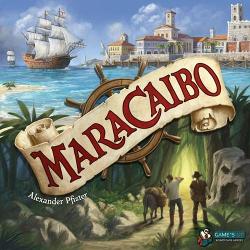
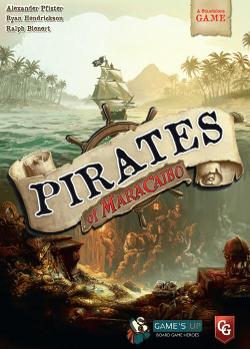
Maracaibo
Players take the role of 17th-century captains sailing a course through the Caribbean to build wealth and influence over four rounds. Movement and actions are driven by a hand of cards; stopping at city tiles allows trading, delivering goods, and taking local actions that affect resources and reputation. Influence is tracked with three colonial powers and advances on those tracks grant benefits and scoring. Quests provide narrative objectives across varying tiles, and an optional mini-expansion integrates a naval component into the base campaign. Plays 1–4 players with a typical session length scaling to about 40 minutes per player.
- Players
- 1–4 best 3
- Playing time
- 30–120 min
- Age
- 12+
- Complexity
- 3.9 / 5
About the game
- Design
- Publisher




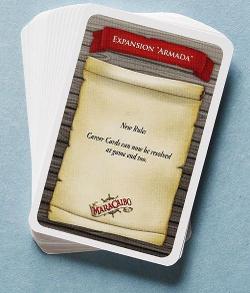
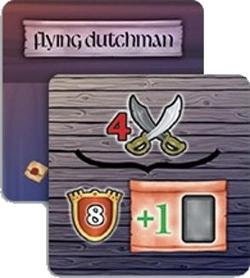
Expansions
See them in Ludoya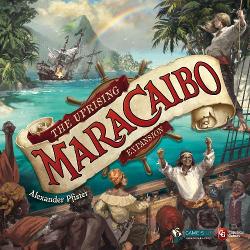
Where to buy it
Shop prices and second-hand copies, checked every day.
On Ludoya's tables
Full stats in Ludoya- 1,105
- Plays logged
- 718
- Players
- 2h 3m
- Average play
- 215
- In collections
- 37
- On wishlists
7.8/10
from 131 Ludoya reviews
Mestremuten9.0 Rating: 5/5 Production value: 3/4 Is the game in my collection/Love to have?: 1/1
Terumo8.0 solo

Rules questions
Answered from the rulebook by Ludoya's rules assistant.
Do I have to move every turn, and can I choose how many spaces to move?
You must move at least one space and may spend up to 7 movement points on Phase A, choosing how many to use (unused points are lost); however, locations marked with the "cannot be skipped" symbol force you to end your movement when you reach them (you may otherwise skip unmarked spaces if you have the movement points). (page 4)
If I'm at a city with one of my assistants there, can I both deliver, do the city action, and use the assistant on the same turn?
No — a city action consists of two parts (deliver a good, then perform the city's effect) which you may do together, but assistant actions are a separate main action and you can only perform one main action per turn, so you must choose between the city action (including its delivery) or the assistant action. (pages 4, 5)
How many village actions do I get and can I buy multiple cards with them?
You get one village action normally, two if you spent 4–6 movement points, or three if you spent all 7; for each village action you may choose option A (discard hand for doubloons), B (take 1 doubloon) or C (buy a card), and you may repeat options across multiple village actions (so you can buy multiple cards if you have multiple village actions). (pages 4, 8)
Can I take face-up cards for free during the draw phase?
By default face-up cards cost 1 doubloon each when taken during Phase C; only if you have completed the specific ship upgrade shown on your board may you take face-up cards without paying. (page 5)
When resolving combat, how do combat points and returning figures affect the combat value and are there limits?
Each combat point you spend or each figure you return to the supply increases the current combat value by 1 (letting you perform more combat actions), but combat actions reduce that combat value and you may never reduce it below 0; also you can never have more than 8 combat points on your combat track (excess is not gained). (page 6)
What happens when a ship lands on the homeward bound spaces — does the round end or the game end immediately?
Homeward bound spaces cannot be skipped and have specific effects: space 20 lets you fight or move the explorer, space 21a/21b scores 3 VP and triggers interim scoring at the end of that turn in rounds I–III, and space 22 scores 5 VP and triggers final scoring (game end) at the end of that turn. (pages 10–11)













Free, on web, Android and iOS
Play Maracaibo with Ludoya
- Keep it in your collectionTrack your copy and its expansions, lend it to friends, or put it on your wishlist and get told when the price drops.Add it to your collection
- Log every playScores, winners, timers and photos, then your stats: win rate, favourite player count, best score.Log a play
- Settle rules questionsAsk anything about the rules and get an answer from the rulebook, with the page to check it on.Ask the rules assistant
- Find people to play it withClubs, game nights and events near you that bring this game to the table.See events
Game facts (players, playing time, age, credits) from BoardGameGeek.