
2024 · Transportation
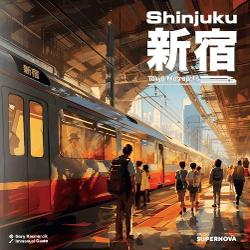
Shinjuku
Players develop a retail-and-rail network across Tokyo, building stores and laying rail lines to connect them while competing to satisfy arriving customers. Each turn a new set of customers appears demanding one of four goods; players then take two different actions such as building a store, expanding rail, upgrading to a department store, drawing income cards, or moving customers along the rails to stores. Actions that place or upgrade locations require playing a matching location card from hand; cards matching existing store locations act as wilds. The game ends after the final customer round, and scoring awards points for collected customer sets.
- Players
- 2–4 best 4
- Playing time
- 60 min
- Age
- 10+
- Complexity
- 2.5 / 5
About the game
- Design
- Publishers



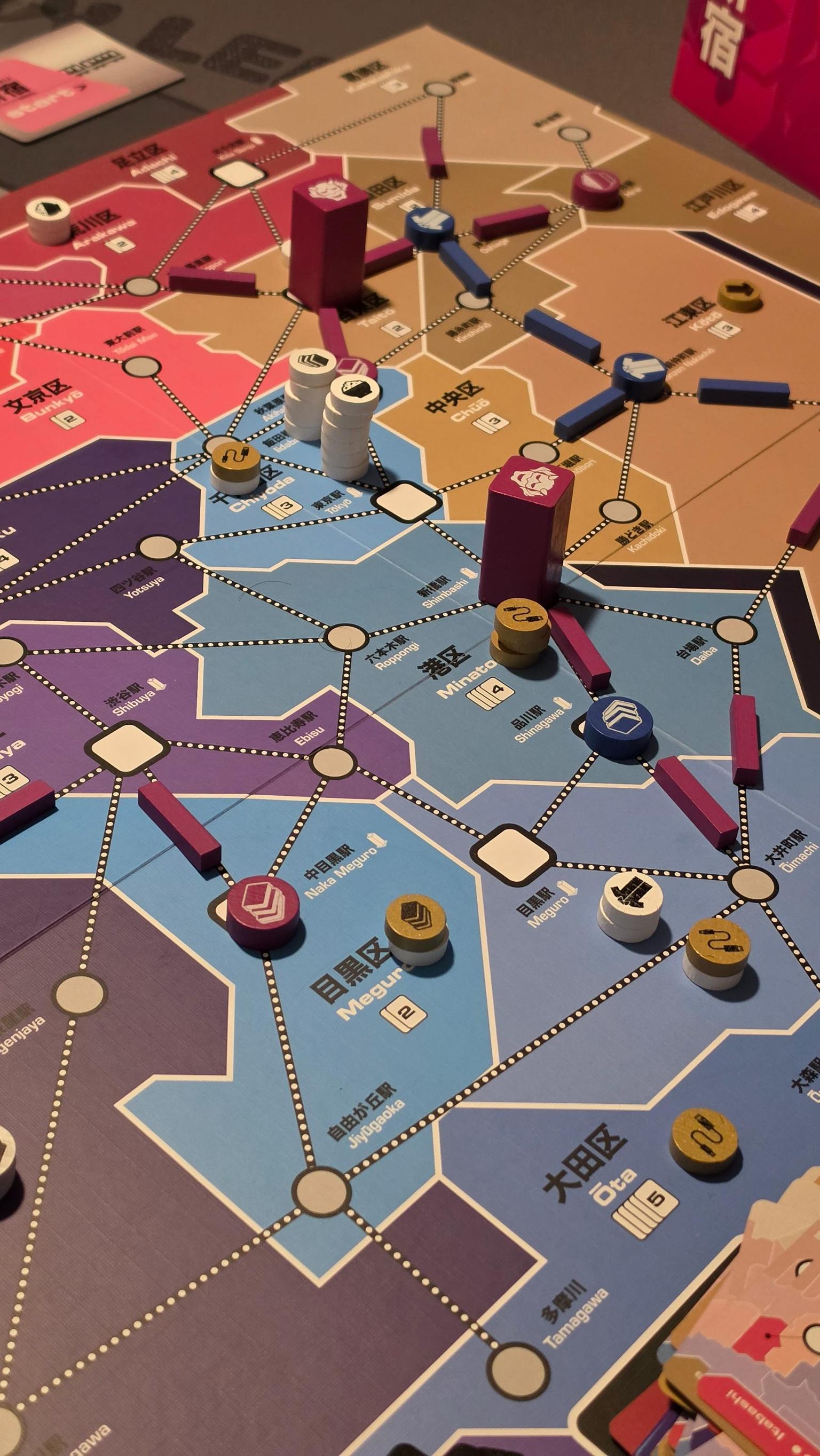
Photos from Ludoya tables
All photos in Ludoya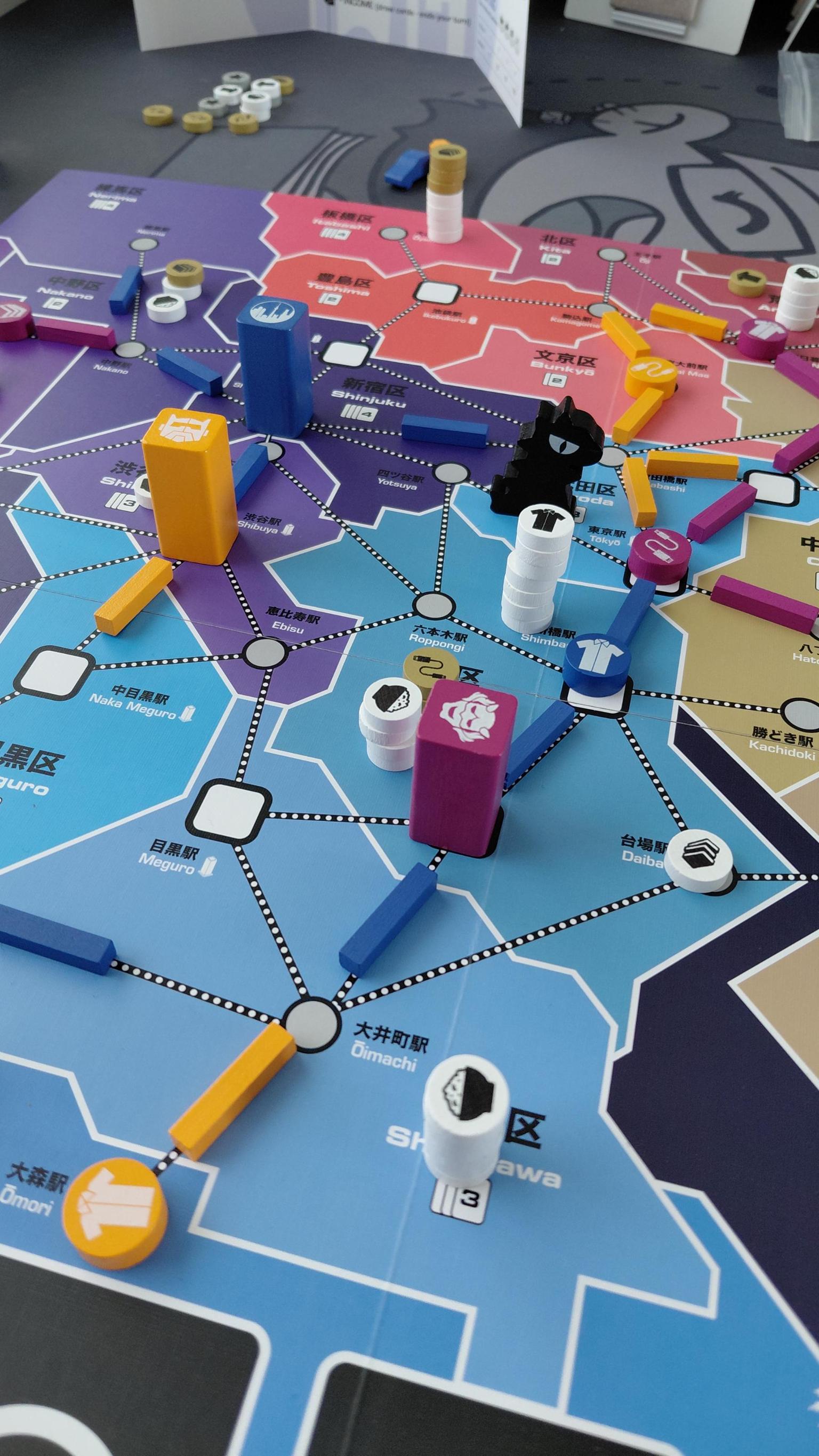
Where to buy it
Shop prices and second-hand copies, checked every day.
On Ludoya's tables
Full stats in Ludoya- 13
- Plays logged
- 27
- Players
- 1h 39m
- Average play
- 7
- In collections
- 2
- On wishlists
6.0/10
from 6 Ludoya reviews
andycted6.0 After playing at 4p, our head hurt from parsing nightmare due to cards randomness, the stacking of 4-5 dynamics interacting with each other on the board and in perpetual change and finally the heavy player interaction and balancing. No thanks. Too much stuff and obstacles and randomness tossed over a relatively good and semi-original concept. Which is actually good for today's standards Way better with 3 players, but still has too much fiddliness and effort for the little satisfaction it gives and this is due to randomness and parsing hell. For example: I never got a Shinjuku card last game and I got tons of light blue cards. Nobody else built there and not many customers came in in that area. Could I prevent it ? No. Could I play it differently ? Of course, if I saw the future. You really need to fit where the other players go, and leader bashing can be extreme. But you're so limited by cards that you can't do any of these most of the time. Here is a rundown of your strategic choices. Leaving aside the store upgrade mechanic, which is nice but plays like a secondary attached mechanic, the core decisions will be split in two: A: build rails -1 : where there's already infrastructure -2 : where you expect infrastructures to be built And B: build shops -1: where there's already infrastructure -2 : where you expect infrastructures to be built In both cases, n.1 can suffer from players moving to build in other places/players choosing other routes And n.2 in just people not building there Then there's the very heavy randomness of cards impacting your and the table play, that will dictate where to play and what to move, hence ruin any 1 or 2 Then there's the complete randomness of where people will spawn, which can further hurt and invalidate the A and B choices made above. Finally, were it not enough, there's the semi blind choice of what kind of shop to open, given the total randomness of which token will end where on the map. Add to this that players can basically cut you off, move all customers away from you, and decide each turn who to give points to, and you understand why trying to play this game strategically can induce hopeless and probably useless AP. You are better off playing so rapidly that the game ends in half an hour and you enjoy the map growth and emerging story Just like Rise & Fall, an inelegant optimisation euro which looks elegant at first sight because of rules simplicity, however the stacking of many interacting, but jarring, mechanics make it for an overwrought game. And just like R&F the game lets you perceive there's a great mechanic, idea and game somewhere, waiting to come out, but it's buried deep down
Xavi Torras6.0 It’s simple and straightforward. There’s no language dependence, since it’s in English or Italian. The original game is in Japanese (an older version). There’s a high luck factor, although you can reduce it by adding the two variants that come in the box, which makes the game a bit more chaotic, but also simpler and with a bit more strategy behind it. Broadly speaking, it’s a sort of Ticket to Ride where you have to keep expanding across the board as fast as possible. This one represents the city of Tokyo and its subway stations. You’ll have to build shops or even shopping centers in order to attract customers to your businesses through the network of subway lines that everyone will be building together. The goal is to score the most points through a set collection, which you’ll complete thanks to the different customers who have entered your shops. It’s a game that scales well with both 2 and 4 players. For me, the ideal number of players is 3. More experienced players will probably find it a little shallow, while newcomers may find it a bit complicated, to the point of blowing their minds. In conclusion, it’s a decent game and it works well, but it doesn’t have a lot of depth. It has a certain strategic component, but also a fairly high luck factor. My recommendation is that if you’re an experienced player with a long history in board games, this one will feel a bit light. It’s the typical game you can enjoy as a parent together with your kids: you have a good time and so do they






Free, on web, Android and iOS
Play Shinjuku with Ludoya
- Keep it in your collectionTrack your copy and its expansions, lend it to friends, or put it on your wishlist and get told when the price drops.Add it to your collection
- Log every playScores, winners, timers and photos, then your stats: win rate, favourite player count, best score.Log a play
- Score it without paperUse the community's score sheets and play helpers, and let Ludoya add up the points.Find score sheets
- Find people to play it withClubs, game nights and events near you that bring this game to the table.See events
Game facts (players, playing time, age, credits) from BoardGameGeek.