
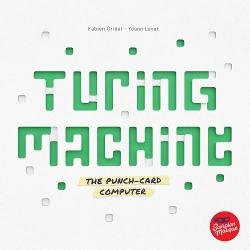
2022 · Deduction
Turing Machine
Question a mechanical, non‑electronic device to deduce a hidden code before the other players. The game simulates a rudimentary computer built from perforated cards and simple components; players pose constrained queries and interpret the machine’s outputs to narrow candidate codes. Play supports competitive head‑to‑head deduction, cooperative team play, and solo challenge modes. Puzzles range from easy to very complex, with millions of possible problems generated by different card and component configurations.
- Players
- 1–4 best 1
- Playing time
- 20 min
- Age
- 14+
- Complexity
- 2.5 / 5
About the game
- Design
- Publisher



Photos from Ludoya tables
All photos in Ludoya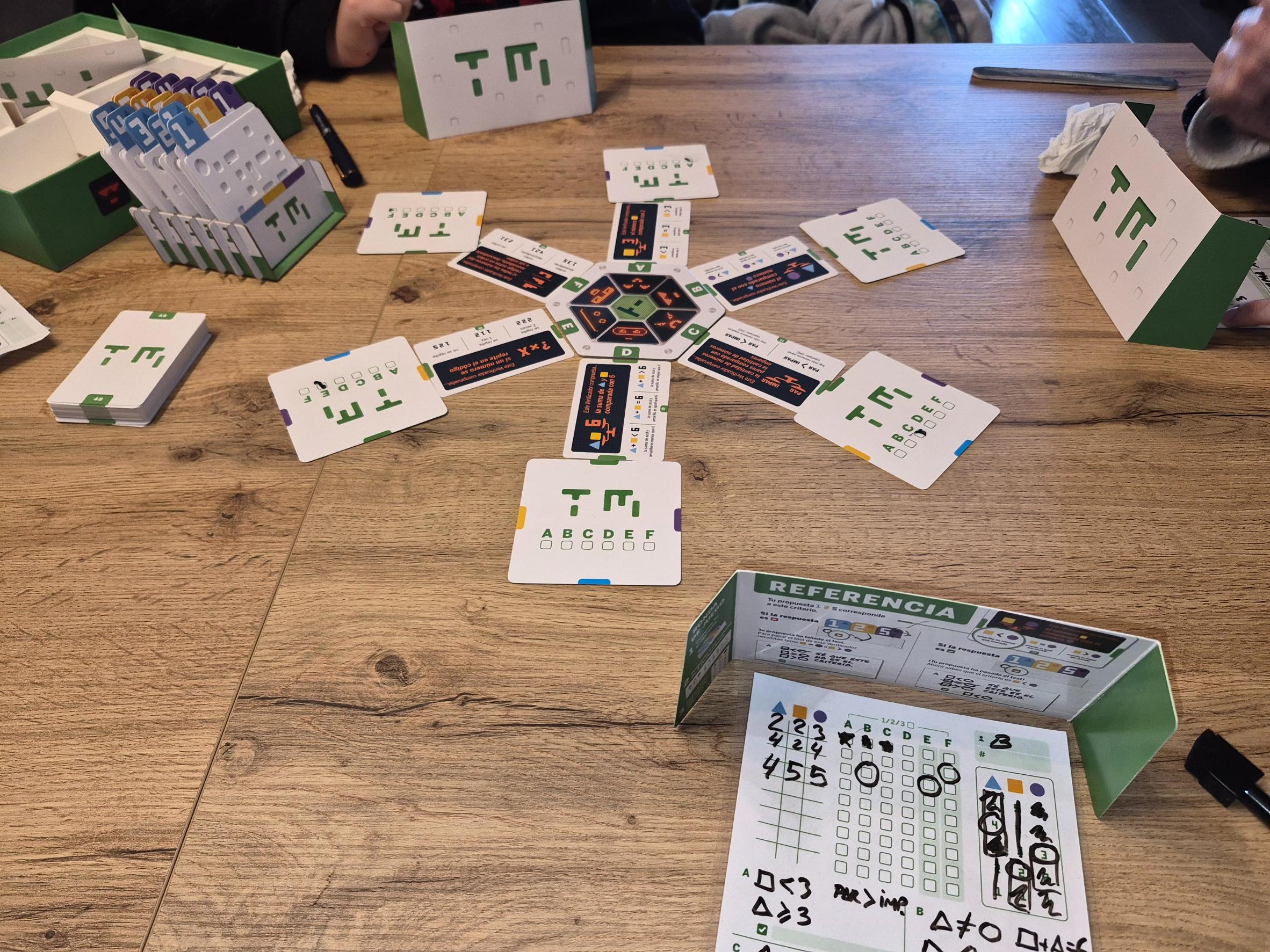
Where to buy it
Shop prices and second-hand copies, checked every day.
On Ludoya's tables
Full stats in Ludoya- 1,781
- Plays logged
- 669
- Players
- 17m 13s
- Average play
- 211
- In collections
- 49
- On wishlists
7.5/10
from 82 Ludoya reviews
Rules questions
Answered from the rulebook by Ludoya's rules assistant.
Can I change my 3-card proposal between asking different Verifiers in the same round?
No — you must keep the same proposal for the entire round while you question up to three Verifiers, and record that proposal and all answers on your note sheet (p. 3–4).
How many Verifiers can I question each round — do I have to ask three?
You may question a maximum of three Verifiers per round but you can ask fewer if you wish; you must record the answers you do get as they count toward tie-breaking (p. 3–4).
If a Verifier gives me a ✓, does that mean the revealed number equals the value I showed (e.g., 'it's 3')?
No — a ✓ only means your proposal satisfies the Verifier's hidden criterion (for example, “greater than 1”); it does not reveal the exact value shown in your proposal (p. 3–4).
What happens when someone says they’ve found the code — how do we verify and decide the winner?
Players who think they found the code write it secretly and check the Solutions section or the app; if multiple players are correct the one who asked the fewest questions wins (ties share the win), and incorrect guessers are eliminated while the game continues for remaining players (p. 3).
Do I need to identify every Verifier’s criterion to solve the puzzle, or are some criteria optional?
All Verifiers are essential and none repeat another's information, so you will need the criteria of every Verifier to determine the unique code (p. 3–4).








Free, on web, Android and iOS
Play Turing Machine with Ludoya
- Keep it in your collectionTrack your copy and its expansions, lend it to friends, or put it on your wishlist and get told when the price drops.Add it to your collection
- Log every playScores, winners, timers and photos, then your stats: win rate, favourite player count, best score.Log a play
- Settle rules questionsAsk anything about the rules and get an answer from the rulebook, with the page to check it on.Ask the rules assistant
- Find people to play it withClubs, game nights and events near you that bring this game to the table.See events
Game facts (players, playing time, age, credits) from BoardGameGeek.