
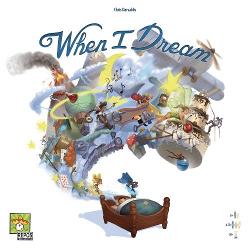
2016 · Word Game
When I Dream
Players take turns as the Dreamer who closes their eyes and wears a mask while the other players are secretly assigned roles: helpful spirits, naughty spirits, or tricksters. Over a timed round, spirits draw cards showing dream elements and give one-word clues to the Dreamer; the Dreamer may guess items at any time. Correct guesses score for the helpful spirits and the Dreamer, incorrect guesses score for the naughty spirits, and tricksters score for balancing the two piles. After the timer, the Dreamer narrates a short story using the guessed words for bonus points, then roles rotate and a new round begins.
- Players
- 4–10 best 6
- Playing time
- 20–40 min
- Age
- 8+
- Complexity
- 1.2 / 5









Where to buy it
Shop prices and second-hand copies, checked every day.
On Ludoya's tables
Full stats in Ludoya- 235
- Plays logged
- 457
- Players
- 35m 40s
- Average play
- 73
- In collections
- 9
- On wishlists
6.6/10
from 43 Ludoya reviews
Mestremuten5.0 Rating: 2/5 Production value: 3/4 Is the game in my collection/Love to have?: 0/1
Fernando8.0 1 partida. Un jugador se pone el antifaz y el resto de jugadores, por orden, van diciendo una palabra para intentar que adivine (si tienen el rol del "hada") o falle (si tienen el rol de "el hombre del saco") la palabra que sale en la carta. Cuando termina el tiempo, el que tiene el antifaz (simbolizando que estaba soñando), deberá tratar de contar una historia en la que aparezcan todas las palabras (cuentan solo las que ha acertado, pero claro, no sabe cuáles son) que ha ido diciendo (simbolizando que recuerda bien o no el sueño). Las "hadas" puntuarán por cada acierto, "el hombre del saco" por cada error", etc. Aunque hacer de "soñador" puede resultar un poco estresante y complicado para algunas personas, a todos nos pareció muy divertido.
Javo7.0 Juego para jugar en grupos grandes. Divertido y entretenido. Cumple la función.


Rules questions
Answered from the rulebook by Ludoya's rules assistant.
Can we give clues that are just part of the word, sound like it, or are translations?
No — players cannot give clues that are derived from the Element, sound similar to it, or translate it into another language (see page 2).
What happens if someone gives an improper clue?
The current Dream card is placed in front of that player as a penalty and that player will lose 1 point at the end of the game; continue with the newly revealed card and make sure the Dreamer knows the card changed (see page 2).
Can the Dreamer be told whether their guess was correct or not?
No — the Dreamer must not be told if an answer was right or wrong; players must remain discreet (see page 2).
How many times can the Dreamer guess each card?
The Dreamer may interrupt and give one, and only one, guess per card; correct guesses place the card on the Yellow side and incorrect ones on the Blue side (see page 2).
What happens when the 2‑minute sand timer runs out?
When time is up the Dreamer may give one last answer (optional); if they decline, the last card remains on top of the deck with no effect (see page 2).
How do Sandmen score points?
Sandmen compare the number of cards on each side: if equal they score 1 point per Yellow card plus 2 extra points; if there's a one‑card difference they score the greater of the two numbers; if the difference is two or more they score the smaller of the two numbers (see page 3).



Free, on web, Android and iOS
Play When I Dream with Ludoya
- Keep it in your collectionTrack your copy and its expansions, lend it to friends, or put it on your wishlist and get told when the price drops.Add it to your collection
- Log every playScores, winners, timers and photos, then your stats: win rate, favourite player count, best score.Log a play
- Settle rules questionsAsk anything about the rules and get an answer from the rulebook, with the page to check it on.Ask the rules assistant
- Find people to play it withClubs, game nights and events near you that bring this game to the table.See events
Game facts (players, playing time, age, credits) from BoardGameGeek.