
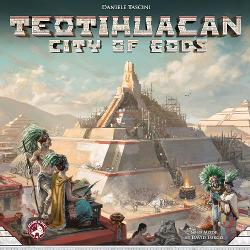
2018 · Изграждане на градове
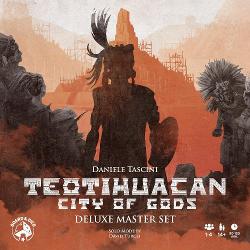
Teotihuacan: City of Gods
Играчите управляват зарове-работници, които стават по-силни с всяко действие, като местят един зар по модулно градско табло и изпълняват действието на едно от двете места на всяко поле. На ход играчите избират между изпълнение на действие и подобряване на съответния работник или получаване на незабавен бонус без подобрение, като същевременно управляват ресурсите си и необходимостта да изхранват работната си сила. Действията включват развиване на технологии, строеж на жилища, напредване в трите основни храма и принос към централната стъпаловидна пирамида в рамките на три последователни епохи. Победителят се определя от натрупаната слава след периодичното отбелязване на точки.
- Играчи
- 1–4 най-добре 4
- Времетраене
- 90–120 мин
- Възраст
- 14+
- Сложност
- 3,8 / 5
За играта
- Дизайн
- Илюстрации
- Издател



Разширения
Виж ги в Ludoya Teotihuacan: Late Preclassic Period2019
 Teotihuacan: Shadow of Xitle2020
 Teotihuacan: Expansion Period2021
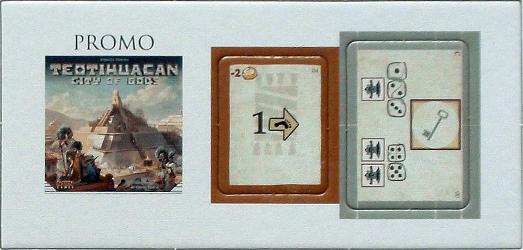 Teotihuacan: Dice Settlers Promo2018
 Teotihuacan: City of Gods – Pyramid Tile Promo, Red Temple2019
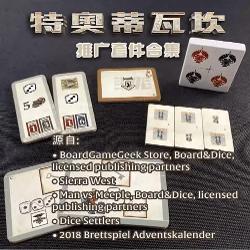 Teotihuacan: City of Gods – Promo Bundle2020
 Teotihuacan: City of Gods – 5th Player Expansion2020
 Teotihuacan: City of Gods – Decoration Tiles2019
 Teotihuacan: Brettspiel Adventskalender 2018 Promo2018
 Loot Box #12022
 Teotihuacan: City of Gods – Man vs Meeple Promo2019
 Brettspiel Adventskalender 20182018
 Teotihuacan: Expert Challenges – Book 12021
 Teotihuacan: Expert Challenges – Book 22021
 Teotihuacan: Expert Challenges – Book 32022
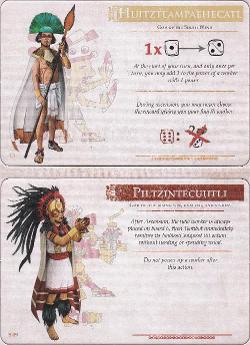 Teotihuacan: New Priests2024
 Teotihuacan: City of Gods – 5th Player Expansion2024
Снимки от масите в Ludoya
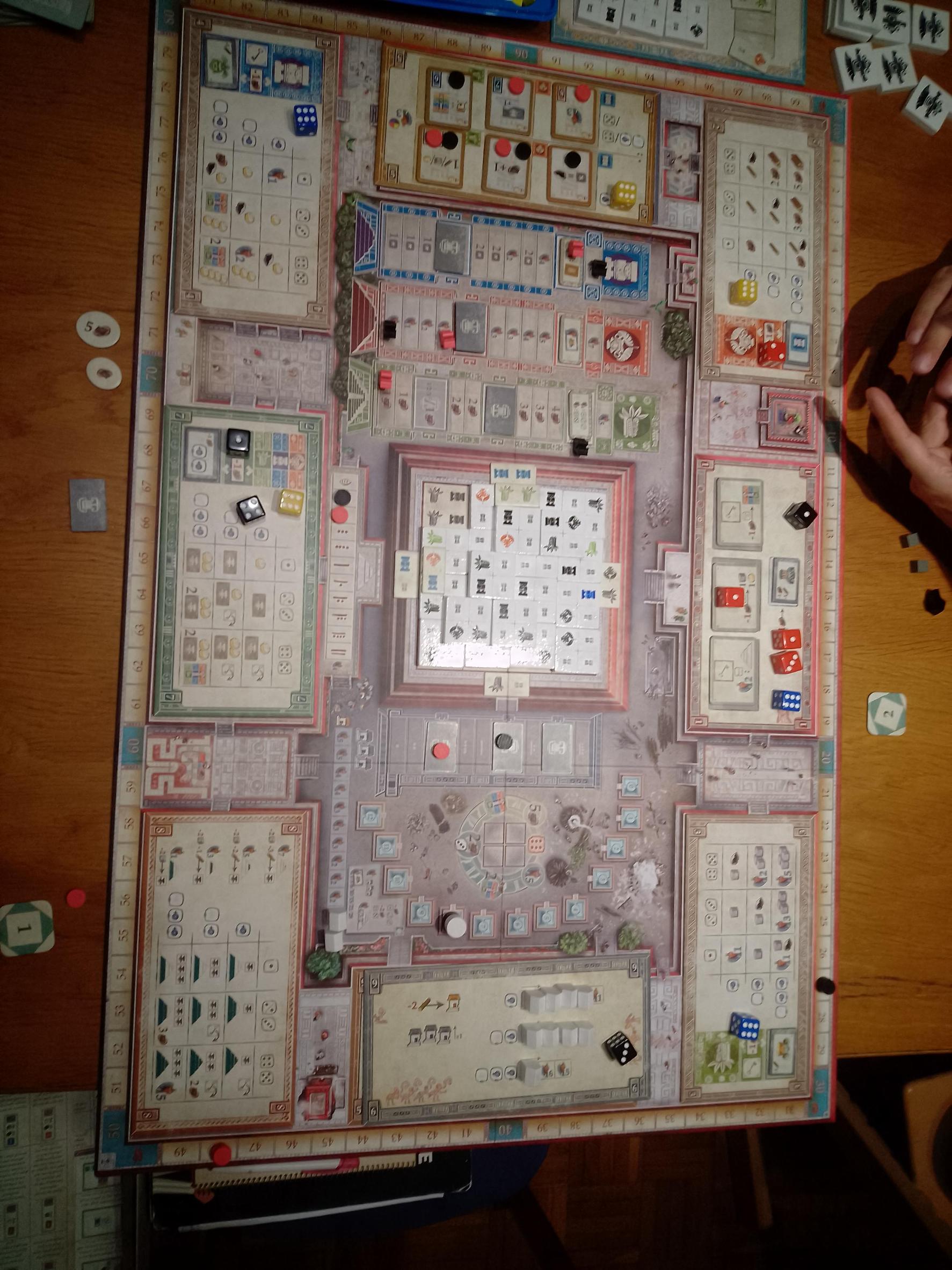
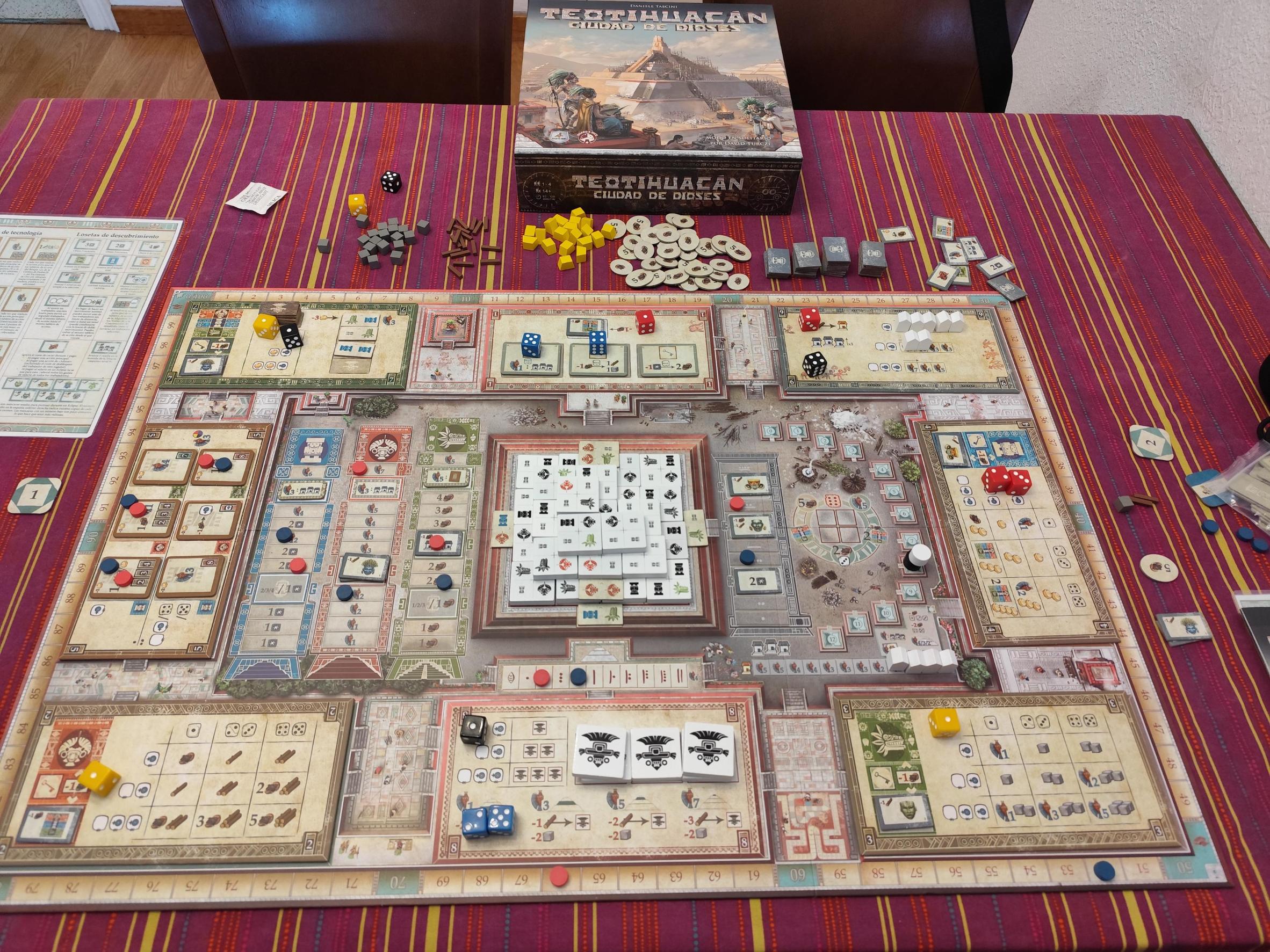
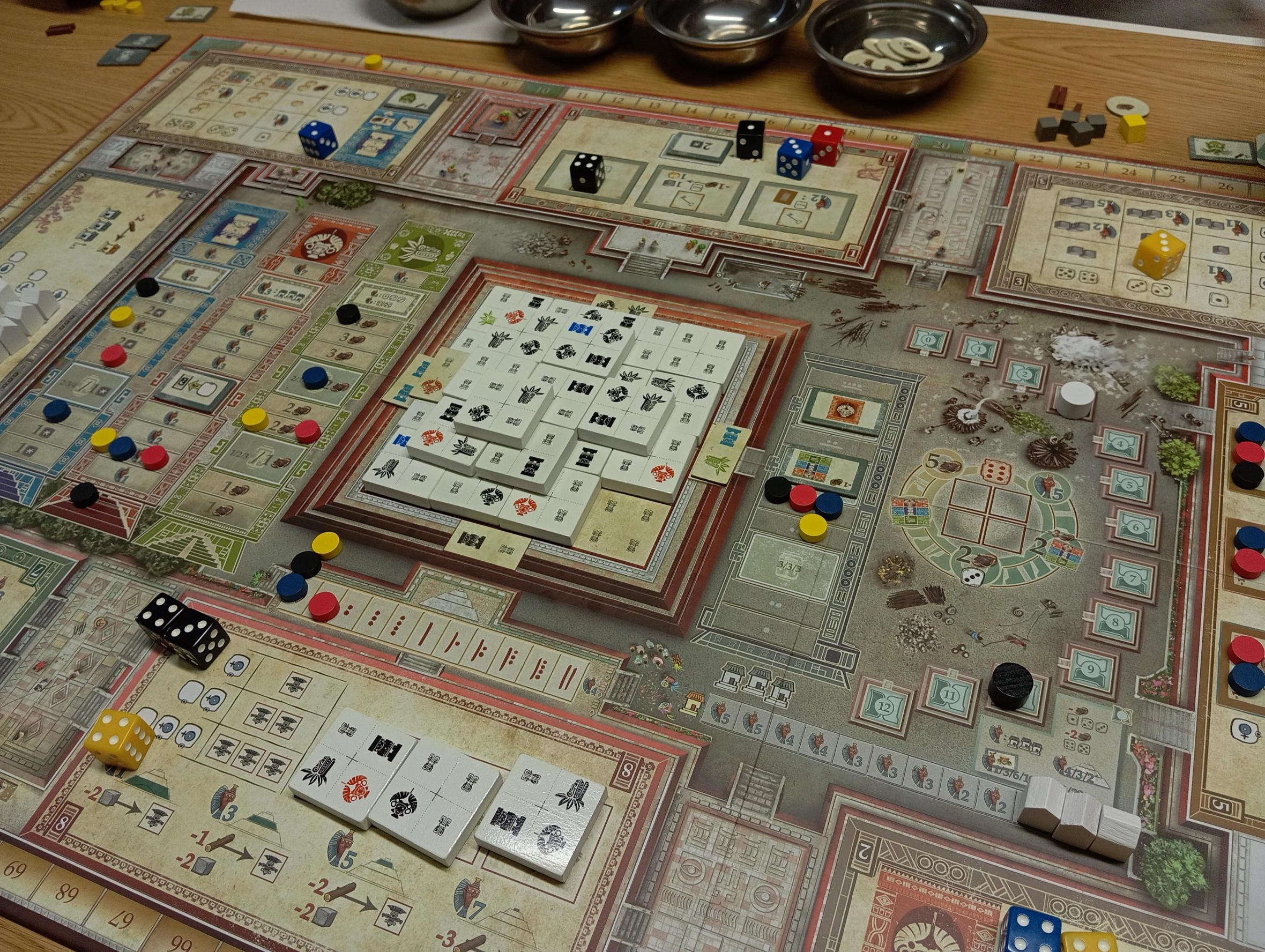
Всички снимки в Ludoya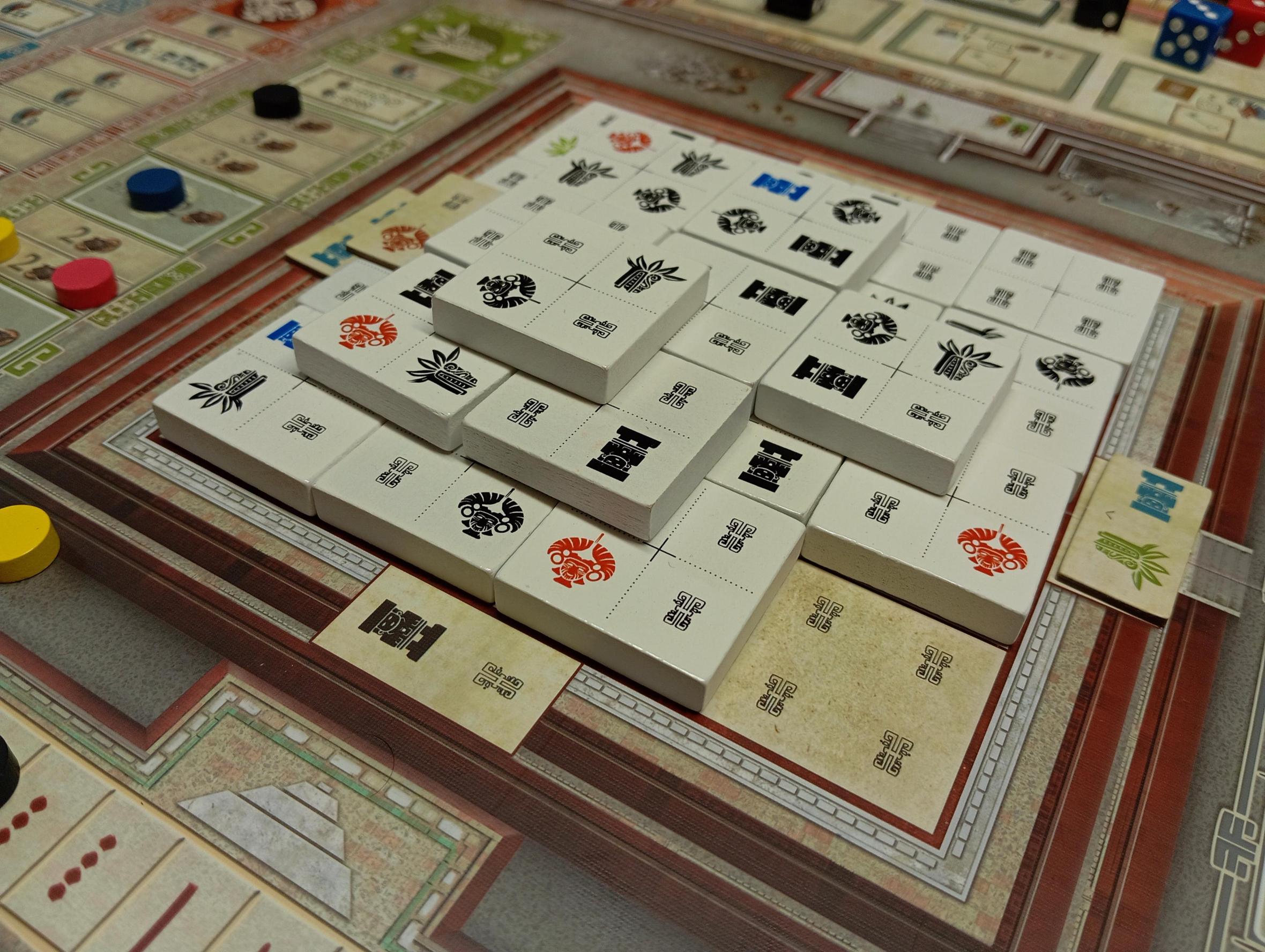
Откъде да я купиш
Цени в магазини и копия втора ръка, проверявани всеки ден.
- BoardGames.BGИзчерпано40.5 €
- Miniature MarketИзчерпано35.99 $
- Cardhaus GamesВ наличност42.99 $
- Zatu GamesПредварителна поръчка40.15 £
- AlphaspelВ наличност529 kr
- GameplayПровери наличността54.95 €
- ReflexshopВ наличност21590 Ft
- Get Your FunВ наличност59.99 €
На масите в Ludoya
Пълна статистика в Ludoya- 823
- Записани партии
- 634
- Играчи
- 1h 53m
- Средна продължителност
- 183
- В колекции
- 33
- В списъци с желания
- 1
- Предварително поръчана
6,3/10
от 117 рецензии в Ludoya
Jan Solo8,0 Gran juego de gestión de recursos y construcción de la pirámide. Modo solitario interesante, pero a mi gusto excesivamente farragoso y lento.
Evan2,5 In this game you move one of your player markers around a roundel 1-3 spaces then resolve the action in the space you end at. Your makers are dice, and the effect of the action spaces is based on a table that looks for how many of your dice are in the space, then also what the pip value of your lowest die is. Often the effect of the space will then add pips to one or two of your dice. When a die hits 6, it resets to 1, and you gain a step on a track that produces points at the end of the round per step you have. Then you also gain a reward from a small wheel of options next to that track. Mostly what you are doing is collecting bricks and wood, then spending the bricks and wood to build the structure at the center of the board. There are extremely important technology tiles you can invest in to make your actions better. Another key thing to manage is the need to spend cacao tokens equal to the number of players in an action space to resolve the action. If you can't pay it, then you wind up skipping your action and instead getting the cacao tokens plus 1 instead. You can avoid this by taking gather actions more often, but since there's very little if any engine building in the game, it does feel like a large portion of your actions in the game work out to similar feeling gather then spend cycles. When you take the action to build the central structure, some but not all of the tiles have colored icons that give you a free step on the matching temple track in addition to the large number of points produced by the action normally. Ability to build is dependent on a substantial number of turns setup, getting the resouces and lining your dice up. Temple track steps are somewhat hard to come by and each step produces points, resources or cacao in addition to having high value endgame scoring criteria at the top, so when you are ready to build and all the pieces are totally colorless, and then you flip up colored pieces for the next person so they can spend exactly what you did only they get a substantial additional return doesn't feel great. Temple builds additionally come with steps on a track that gives bonus 4 points each round to the player who built the most. The track rests right next to the building space and is clearly tied to it. The problem here is that there is a second space that adds stair tokens to the temple, with a different cost, and a different place on the roundel, which makes it needlessly hard to see who has the potential to gain a step and when. Additionally, the stair tokens have a pointlessly specific orientation they need to be placed at because there is a tiny hard to see arrow on the tile that has to point inward. This is there to make matching the icons when you place the stair token more luck driven for no reason I can understand. Additionally these tiles can have either one or two bonus colored icon payouts that again, depend on luck of what's available, again rewarding players for lucking into situations they had no control over establishing. There's also a confusing action space that we rarely saw used. It awards some points, gives you a step on the death track, and then reduces the value of being on that track for everyone. Why have a space that invests in a track, and then simultaneously reduces the value of that same track? When a player's marker goes from 1 to 6, you also click ahead the round timer, which additionally moves after each player has had an action. The game has two modes, one where the round ends the moment the marker hits the end of the track producing uneven turns, or when it hits the end of the track each player gets one more turn. Neither of these is great, because if you age out one of your markers in the final round it effectively doesn't change the pace of the game. Why not just have even turns without playing a whole additional round? I suppose it's due to the fact that when a player is about to age out a die is very unpredictable, since when you resolve a space with two age icons, you can age the same die twice, rather than having to spread it across two dice. What this means is that it's vastly more influential to the flow of the game to age out early in the round than later in the round. More unevenness to the feel and flow of the game. I additionally was confused by one special reward tile that you can spend to ignore paying a food cost, even the totality of food required at the end of the round to feed your people. So, spend it now to avoid paying 3 or 4 food for a crowded action space, or spend it at the end of the round to avoid paying up to 8. There's a massive point hit for not feeding your people, it seems like a pretty core 'watch yourself' mechanism, that you can just ignore for a round by virtue of taking this tile. Very odd. I don't know, this is an ok game were everything feels just a little off. A few minor changes and I think this could have been great, it just doesn't feel very interesting or cohesive. Any of the little things I'm complaining about could probably be forgiven if the core mechanism was more interesting. ★ Art, Iconography and components functional ☆ Clever or interesting mechanisms ★ Reasonably low downtime between turns with mildly AP players ★ Multiple plays stay interesting ☆ Low or mitigatable luck elements ★☆☆☆☆ Raw enjoyment
Garfield8,0 #50 [c] Theme: ★★★★☆ <!-- size 7]The pyramide is great --> Gameplay: ★★★★★ <!-- size 7]Lots of meaningful decisions --> Interaction: ★★★☆☆ <!-- size 7]Where are the other dice placed --> Artwork: ★★★☆☆ <!-- size 7]Ok --> Luck: ★★☆☆☆ <!-- size 7]Pyramid tiles available at your turn --> Strategy: ★★★★☆ <!-- size 7]Different strategies possible --> Components: ★★★★☆ <!-- size 7]Pyramide tiles are great --> Play duration: ★★★☆☆ <!-- size 7]Ok --> Easy to teach: ★★★☆☆ <!-- size 7]Ok --> Rules quality: <!-- size 7]not read --> Setup time: ★★☆☆☆ <!-- size 7]A lot to setup --> No downtime: ★★★☆☆ <!-- size 7]Ok --> Replay value: ★★★★★ <!-- size 7]Modular board, different strategies --> [/c]

Въпроси за правилата
Отговори от книжката с правила от помощника за правила на Ludoya.
Когато извършвам основно действие, как броя работниците и колко какао трябва да платя? Броят ли се блокираните работници или работникът, когото току-що преместих?
За да определите цената в какао, първо пребройте броя на различно оцветените отключени работници, които вече са на дъската (игнорирайте пристигащия работник и всички работници на заключени места за поклонение), и платете толкова какао (стр. 7). При разрешаването на ефектите от основното действие след това пребройте собствените си отключени работници на тази дъска, включително току-що поставения работник, но за целите на ефектите никога не броите повече от 3 (стр. 7).
Когато взема „Събиране на какао“, кои работници се броят — пристигащият работник или заключените работници?
За „Събиране на какао“ пребройте броя на вече присъстващите на Дъската с действия отключени работници с различен цвят (не броете пристигащия работник или заключен работник в пространство за поклонение) и получавате този брой плюс 1 какао; след това поставете преместения си работник в общата зона (стр. 6).
Какво точно се случва, когато работник достигне сила 6 (Възнесение)? Задействам ли незабавно Затъмнение?
Възнесението се задейства незабавно, когато работник бъде захранен до 6: напреднете по Алеята на мъртвите, преместете това зарче в общата зона на Двореца и го върнете на сила 1, изберете една награда за Възнесение, след което придвижете светлия диск по пистата на Календара (което може да задейства Затъмнение) — завършете напълно всяко възнесение и задействайте Затъмнението едва след хода, ако е приложимо (стр. 9).
Как работят ограниченията за поставяне на Пирамидата и Декорациите и кога завършването на Пирамидата приключва играта?
Плочките за декорация трябва да се поставят само на разрешени места, когато са налични необходимите лежащи отдолу слоеве на пирамидата и предварително изискуемите декорации; получаваш точки за съвпадащите икони при покриване на плочки (стр. 8). Поставянето на най-горната плочка на пирамидата (четвърто ниво) изисква целият трети слой под нея да е завършен, носи посочените ПО и незабавно премества белия диск на календара до позицията на черния диск, което задейства последното затъмнение и слага край на играта (стр. 8).
Когато извърша действие „Поклонение“, мога ли да освободя работник на друг играч и да изпълня както способността за поклонение, така и да взема плочката „Откритие“? Трябва ли да платя нещо?
Ако работник на друг играч заема полето за поклонение, плащате 1 какао, за да освободите този работник (премествате го в общата зона), преди да поставите своя; не можете да освобождавате собствените си работници по този начин (стр. 6). След това избирате дали да активирате способността за поклонение, или да вземете плочката за откритие, или да платите още 1 какао, за да направите и двете (всички разходи за какао трябва да бъдат платени, преди да приложите каквито и да е ползи), а ако вземете плочка, плащате изписаната на нея цена (стр. 6).
Подобни игри










Безплатно, в уеб, Android и iOS
Играй Teotihuacan: City of Gods с Ludoya
- Пази я в колекцията сиСледи своето копие и разширенията му, заеми го на приятели или го добави в списъка с желания и получи известие, когато цената падне.Добави я в колекцията си
- Записвай всяка партияТочки, победители, таймери и снимки, а после статистиката ти: процент на победи, любим брой играчи, най-добър резултат.Запиши партия
- Реши споровете за правилатаПитай каквото искаш за правилата и получи отговор от книжката с правила, заедно със страницата, на която да го провериш.Питай помощника за правила
- Намери с кого да я играешКлубове, игрални вечери и събития близо до теб, където тази игра е на масата.Виж събитията
Данни за играта (играчи, времетраене, възраст, автори) от BoardGameGeek.