
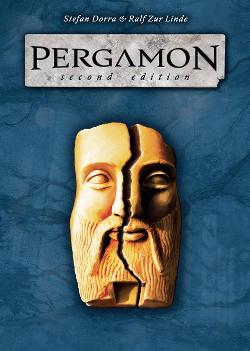
2011 · Ancient
Pergamon
Players act as 19th-century archaeologists funding and conducting excavations around ancient Pergamon to assemble museum-worthy exhibits. Each round players bid for federal research grants, allocate funds, and send expeditions to dig for artifact fragments, with a first-come, first-dig mechanic that favors early arrival and leaves fewer finds for later players. Recovered pieces are assembled into exhibition displays that grant glory points; gameplay spans a fixed number of rounds and requires balancing bidding, travel order, and resource management to maximize exhibited value.
- Players
- 2–4 best 3
- Playing time
- 45 min
- Age
- 10+
- Complexity
- 2.2 / 5
About the game



On Ludoya's tables
Full stats in Ludoya- 131
- Plays logged
- 108
- Players
- 1h 4m
- Average play
- 29
- In collections
- 5
- On wishlists
- 1
- Pre-ordered
5.1/10
from 24 Ludoya reviews
Evan1.6 This is a push your luck game, where each round you position your meeple in a space along a line. Then cards flip which determines how much money is available, and players claim money in line order, with players to the front getting less, but more reliable payouts, and players in the back risking the possibility of getting more but maybe getting nothing if players ahead of them take everything. Then starting from the front of the line you can buy a set of tiles. The tiles are arranged in rows, with different spaces along the money line giving you access to different rows. The tiles have two half-features on them of various artifacts, and after everyone is done buying, in turn order each player can put on a display by arranging a line of completed artifacts. They then total the value of what they made and place a display marker on the chart in that same position. This is where my biggest problem with the game happens. When a player claims a new display, it devalues all other displays of equal or lower value by bumping them one lower on the track. If a player's marker falls off the back of the track, their set is removed. This is a bit frustrating as certain pieces are older than others, which scores a few bonus points during specific scoring phases where you look to see who has the oldest of a single type of artifact. Of course, if your artifact has been pushed off the score board, then it no longer counts, yet this doesn't seem like something you can plan for or against. Just something that happens over the course of the game. Despite the game being relatively short, it still outstays it's welcome for what I see as being a little bit too luck heavy and a little bit too punishing a game. :star: Art, Iconography and components functional :star: Clever or interesting mechanisms :star: Reasonably low downtime between turns with mildly AP players :nostar: Multiple plays stay interesting :nostar: Low or mitigatable luck elements :nostar::nostar::nostar::nostar::nostar: Raw enjoyment
Good filler with interesting mechanics of set collection. Has clever decisions and it's very enjoyable.










Free, on web, Android and iOS
Play Pergamon with Ludoya
- Keep it in your collectionTrack your copy and its expansions, lend it to friends, or put it on your wishlist and get told when the price drops.Add it to your collection
- Log every playScores, winners, timers and photos, then your stats: win rate, favourite player count, best score.Log a play
- Score it without paperUse the community's score sheets and play helpers, and let Ludoya add up the points.Find score sheets
- Find people to play it withClubs, game nights and events near you that bring this game to the table.See events
Game facts (players, playing time, age, credits) from BoardGameGeek.