
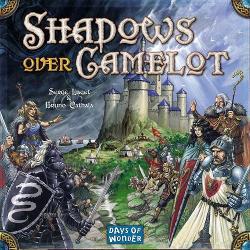
2005 · Medieval
Shadows over Camelot
Players take the roles of knights of the Round Table who cooperate to complete quests ranging from skirmishes with the Black Knight to the search for the Holy Grail. On each turn a player performs a heroic action—moving between quest locations, drawing or playing cards to advance quests and defend Camelot—and then must choose one of several evil actions that push the kingdom toward siege and defeat. Successful quests add white swords to the Round Table; failures add black swords or siege engines. One player may secretly be a traitor, working against the group while pretending to help, so discussion and deduction shape how decisions are made.
- Players
- 3–7 best 6
- Playing time
- 60–90 min
- Age
- 10+
- Complexity
- 2.6 / 5
About the game
- Design
- Publisher





Expansions
See them in Ludoya
Photos from Ludoya tables
All photos in Ludoya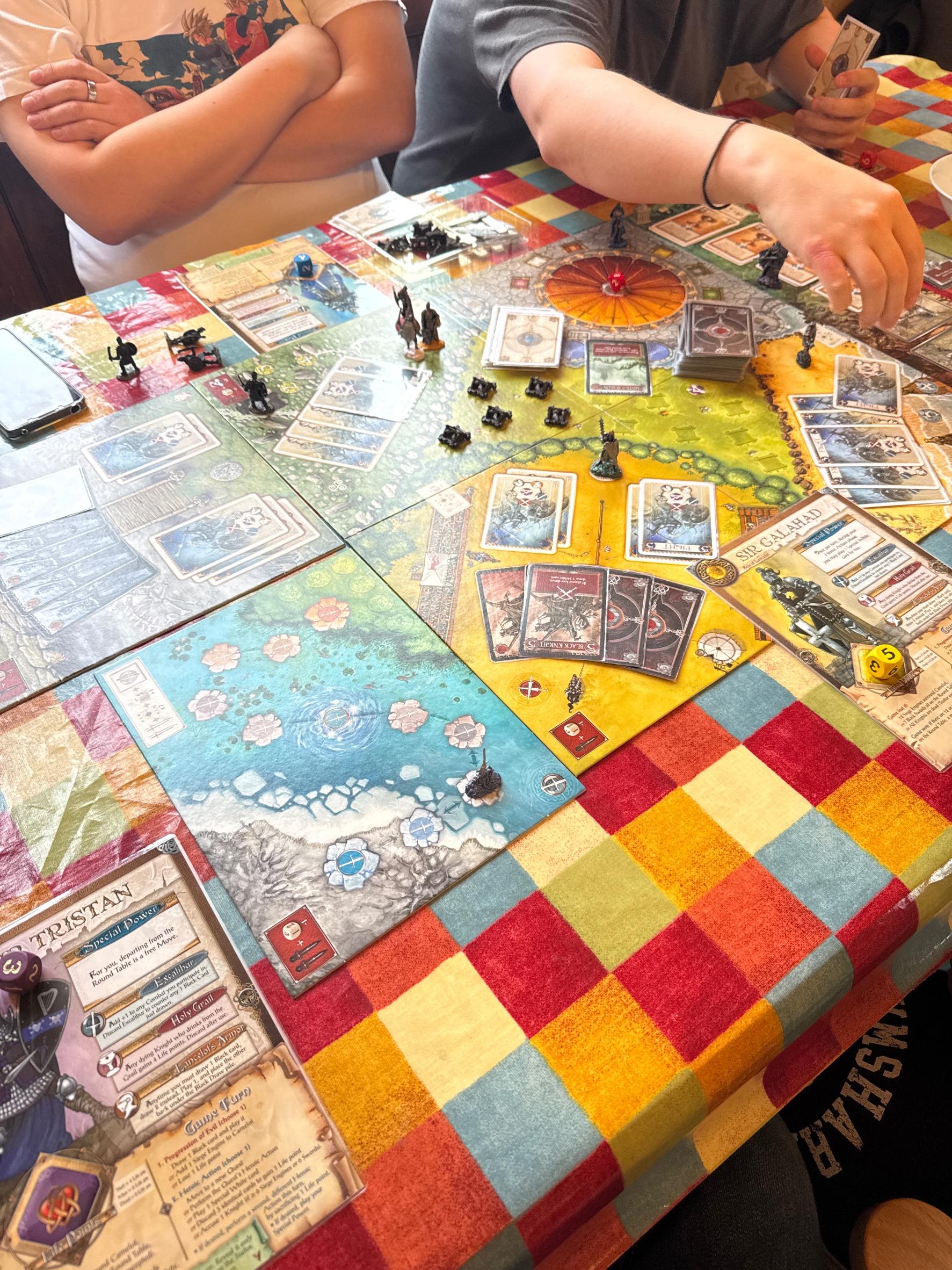
Where to buy it
Shop prices and second-hand copies, checked every day.
On Ludoya's tables
Full stats in Ludoya- 120
- Plays logged
- 214
- Players
- 1h 45m
- Average play
- 65
- In collections
- 11
- On wishlists
4.4/10
from 26 Ludoya reviews
Garfield2.0 Soooo boring. One action is to move from one location to the other, nothing more and then you have to wait for 5min or so till it's your turn again. Then your turn is to play a card, wait 5min again and then play a card again. Repeat this about 3-6 times, then maybe switch location. There is just nothing to do in this game except playing one card each turn. And if you find the traitor or not is not really important, you gonna lose anyway. I wanted to like it because of the theme, but it fells so flat on gameplay I never want to play this again. [c] Theme: ★★★☆☆ <!-- size 7]Ok, many stuff from the Saga --> Gameplay: ★☆☆☆☆ <!-- size 7]Play 1 card per turn, that's it --> Interaction: ★★★☆☆ <!-- size 7]Discussions with your teammates --> Artwork: ★★★☆☆ <!-- size 7]Ok --> Luck: ★★★★☆ <!-- size 7]A lot of random cards --> Strategy: ★★☆☆☆ <!-- size 7]Little --> Components: ★★★★☆ <!-- size 7]Nice miniatures --> Play duration: ★★★★★ <!-- size 7]Very good, you will lose quite fast --> Easy to teach: ★★★★☆ <!-- size 7]Easy (15min) --> Rules quality: <!-- size 7]not read --> Setup time: ★★★★☆ <!-- size 7]Very good --> No downtime: ★★★★☆ <!-- size 7]Plays fast --> Replay value: ★★☆☆☆ <!-- size 7]Till you win? --> [/c]
Mestremuten5.0 Rating: 3/5 Production value: 2/4 Is the game in my collection/Love to have?: 0/1
Rules questions
Answered from the rulebook by Ludoya's rules assistant.
When and how is the Traitor chosen — can I look at my Loyalty card during setup or later?
Each player is dealt one Loyalty card and secretly looks at it before sliding it face-down under their Coat of Arms (Traitor included); unused Loyalty cards are removed unseen (p.7). In a 3‑player game, players should not look at their Loyalty cards at setup and must wait until at least 6 Swords have been laid on the Round Table before peeking (p.19).
What happens when I draw a Black card — can we use Merlin to cancel it?
When you draw a Black card you read and apply its effect immediately; if the draw empties a pile you reshuffle discards into fresh draw piles (p.10). Special Black cards may be canceled immediately if the players collectively play 3 Merlin cards (but this cannot be applied retroactively), while Standard Black cards cannot be countered by 3 Merlins (pp.10–11).
How and when are Siege Engines placed, and how do we fight them?
You add a Siege Engine as your Progression of Evil action by placing one on any empty Siege spot; the 12th Siege Engine placed causes an immediate loss for all but the Traitor (p.11). To fight a Siege Engine (a Camelot Heroic Action) play any number of Fight cards, roll the 8‑sided die, and remove the Siege Engine if your Fight total is greater than the die result; if not, you lose 1 Life and the Siege remains (p.13).
If my Life points fall to zero, am I out forever — can the Holy Grail save me?
If your Life points reach zero you die and are removed from the game at the end of your turn; your White cards are discarded and any Excalibur/Lancelot's Armor you had are lost (p.12). If the Holy Grail has previously been won and its owner allows you to drink from it, you are restored to 4 Life once (the Grail is then removed from the game) (p.12; see Grail acquisition p.15).
When resolving a Combat Quest, how do we compare White and Black cards — what about face‑down Black cards?
A Combat Quest ends when all its spots are filled and you compare the sum of all White cards played there to the sum of all Black cards played (p.14). All Black cards played on the Quest must be shuffled together before revealing to compute their total, and Black Knight/Lancelot/Dragon cards may be played face down to hide their value (pp.11,14).
How does accusing someone of being the Traitor work — what happens if we're wrong?
Accusing forces the accused to reveal their Loyalty card immediately; this Action is available only after at least 6 Siege Engines are around Camelot or at least 6 Swords are on the Round Table, and each Knight may accuse only once (p.16). If the accused is Loyal, turn a White Sword on the Round Table to Black (if any exist); if the accused is the Traitor, add a White Sword and the Traitor is unmasked and follows the instructions on their Coat of Arms (p.16).
Similar games
 Obscurio2019
 Betrayal at Baldur's Gate2017
 Arena: The Contest2019
 The Fantasy Trip: Legacy Edition2019
 Return to Dark Tower2022
 Quest: Avalon Big Box Edition2021
 Betrayal at House on the Hill2004
 Valor & Villainy: Lludwik's Labyrinth2023
 Betrayal at House on the Hill: 3rd Edition2022
 Battlestar Galactica: The Board Game2008
 Room 25: Ultimate2016
 The Thing: The Boardgame2022










Free, on web, Android and iOS
Play Shadows over Camelot with Ludoya
- Keep it in your collectionTrack your copy and its expansions, lend it to friends, or put it on your wishlist and get told when the price drops.Add it to your collection
- Log every playScores, winners, timers and photos, then your stats: win rate, favourite player count, best score.Log a play
- Settle rules questionsAsk anything about the rules and get an answer from the rulebook, with the page to check it on.Ask the rules assistant
- Find people to play it withClubs, game nights and events near you that bring this game to the table.See events
Game facts (players, playing time, age, credits) from BoardGameGeek.