
2016 · Szám
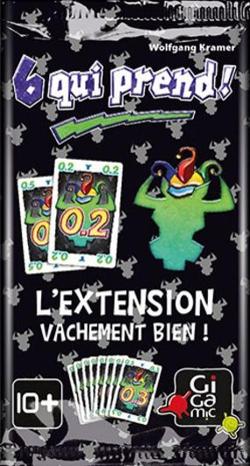
6 qui prend!: L'extension vachement bien
Adds ten new cards that introduce cowardice and twists to the base 6 nimmt! gameplay. Players still simultaneously play number cards to avoid taking rows, but the new cards change how ties, order, and special situations resolve, creating alternative outcomes and forcing different choices. Includes two rule variants that modify scoring and card interactions, offering increased unpredictability and tactical options while using the original components.
- Játékosok
- 2–10 legjobb: 4
- Játékidő
- 30 perc
- Kor
- 10+
- Bonyolultság
- 1 / 5
A játékról
- Tervezés
- Grafika

Kiegészítő ehhez:
Nézd meg őket a Ludoyában
A Ludoya asztalain
Teljes statisztika a Ludoyában- 2
- Gyűjteményekben
Szabálykérdések
A Ludoya szabályasszisztense válaszol a szabálykönyv alapján.
How does a Joker work, and where can I put it?
A Joker is always treated as the lowest card played that turn, so you may choose any row for it. It adds its decimal value to the last card in that row—for example, a 0.4 after a 17 makes that card’s value 17.4 (p. 1).
Can I put a Joker next to another Joker?
No. Jokers cannot be placed next to each other; if every row ends in a Joker, you must take a row and start a new one with your Joker (p. 2).
What if more than one Joker is played in the same turn?
Place the Joker with the lowest value first in a row—for example, 0.4 before 0.6 (pp. 1–2).
In “Pass It On!”, when do I look at the card passed to me?
First pass one card face down to the player on your left; only after you have passed your card may you look at the card you received. Then choose a card to play as usual. Don’t pass your last card—play it directly into a row (p. 2).
In the variable-length rows variant, what happens when a card with several bullheads is added to a row?
The first card with multiple bullheads placed in a row sets how many more cards can go after it: for example, after a 3-bullhead card, two more cards may be added, and the player adding the second must take the row. Only the first such card in a row has this effect; the other rules stay the same (pp. 3–4).
Does a bullhead card’s row-length effect still apply if it starts a new row?
Yes. If a card with an effect becomes the first card in a new row, its effect applies there; the player placing the specified final additional card must take the row (p. 4).
Ingyenes, weben, Androidon és iOS-en
Játszd a(z) 6 qui prend!: L'extension vachement bien játékot a Ludoyával
- Tartsd a gyűjteményedbenKövesd a példányodat és a kiegészítőit, add kölcsön a barátaidnak, vagy tedd fel a kívánságlistádra, és szólunk, ha csökken az ára.Add hozzá a gyűjteményedhez
- Rögzíts minden játszmátPontok, győztesek, időzítők és fotók, aztán a statisztikáid: győzelmi arány, kedvenc játékosszám, legjobb pontszám.Játszma rögzítése
- Döntsd el a szabályvitákatKérdezz bármit a szabályokról, és választ kapsz a szabálykönyvből, az oldallal együtt, ahol ellenőrizheted.Kérdezd a szabályasszisztenst
- Találj játszótársakat hozzáKlubok, játékestek és események a közeledben, ahol ez a játék asztalra kerül.Események megtekintése
Játékadatok (játékosok, játékidő, kor, alkotók) forrása: BoardGameGeek.