
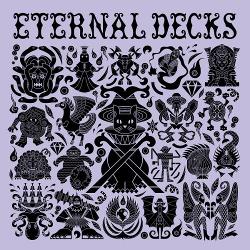
2025 · Card Game
Eternal Decks
Players cooperate with limited communication to complete a sequence of stages before any player can no longer take actions. Each player manages a personal deck and can spend a turn to play a card to the field or river, use a card ability, generate a jewel, or give a card to a teammate. Cards come from a shared pool of character decks with distinct eight-card profiles, and playing cards is subject to placement restrictions: adjacent cards in the three field rows cannot share color or number, and each stage imposes additional row-specific rules. Jewels counteract negative effects from the characters. The campaign runs six stages with differing objectives—scoring, survival, maze navigation, boss encounters, and similar challenges—requiring coordination of card play and resource use to succeed.
- Players
- 1–4 best 4
- Playing time
- 30–40 min
- Age
- 10+
- Complexity
- 2.8 / 5
About the game
- Design
- Art
- Publishers




Photos from Ludoya tables
All photos in Ludoya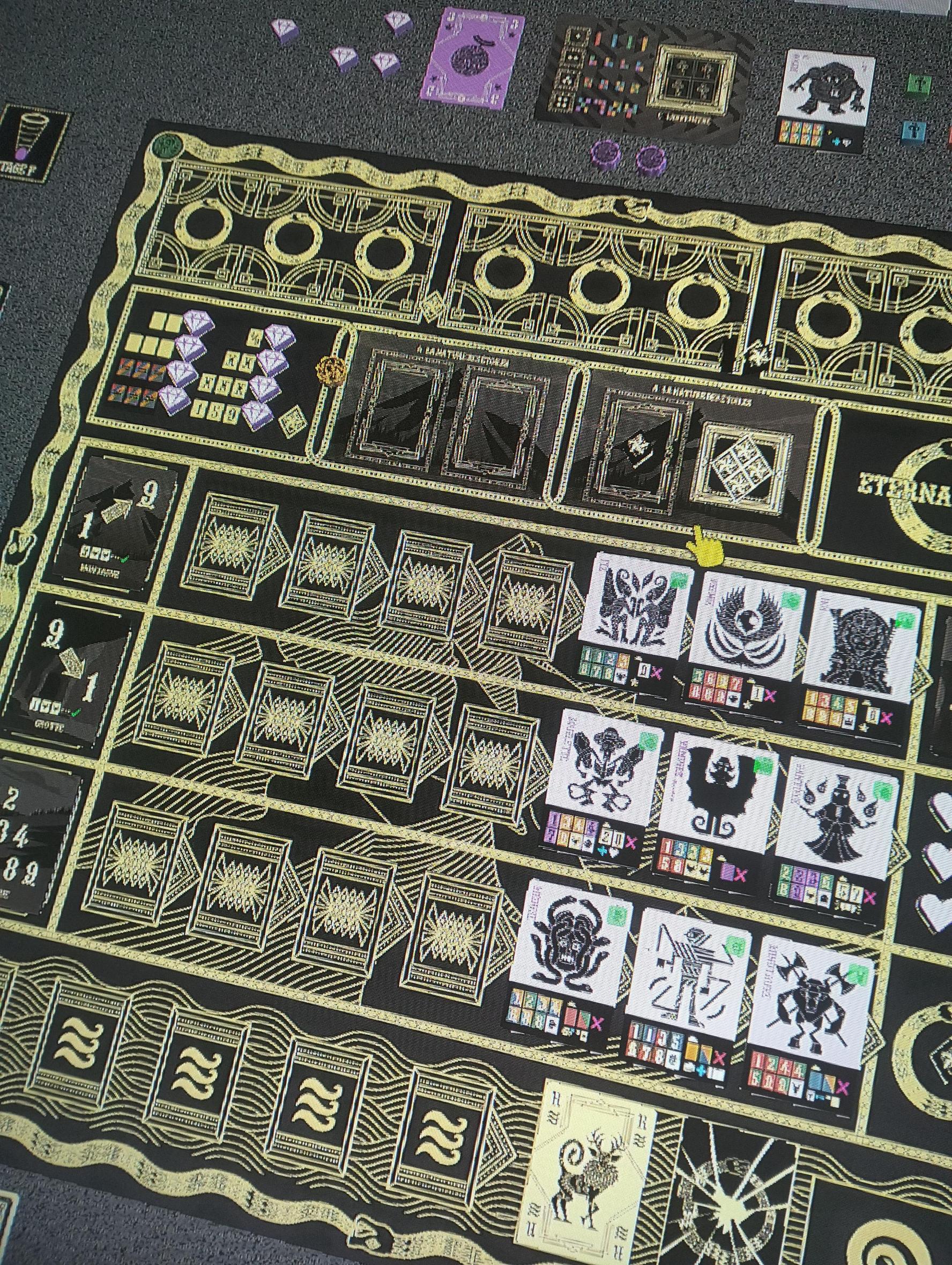
Where to buy it
Shop prices and second-hand copies, checked every day.
On Ludoya's tables
Full stats in Ludoya- 80
- Plays logged
- 68
- Players
- 44m 3s
- Average play
- 19
- In collections
- 49
- On wishlists
- 10
- Pre-ordered
8.0/10
from 10 Ludoya reviews
Rules questions
Answered from the rulebook by Ludoya's rules assistant.
Can I say "I have a 1" or "I have a yellow card" out loud to my team?
You cannot directly state the number or color of Number Cards in your hand, though you may talk about Rare/Ability cards or cards already played; indirect hints and Communication Discs are encouraged (page 20).
Where exactly can I place common, Field, Two‑Color and Rare cards on the rows?
Follow the Common Placement Rules (no same color or same number adjacent), then the specific Field card rule for that row (e.g., Mountain ascending, Cave descending); Two‑Color cards may be rotated but cannot be adjacent to the same color on either side when placed; Rare cards ignore both common and Field placement restrictions (see pages 10–11).
What happens when an Eternal is revived — do we move cards or get curses?
When a player completes a row next to the Eternals they flip one Eternal into the Revival Area and place that Eternal’s eight‑card mini‑deck under their Player Deck, then clear the row to the Discard Area; reviving an Eternal also activates its Curse which prevents playing certain cards to the Field until the Curse is removed (pages 12–13).
What does playing cards to the River do, and can the River end the game?
There are no placement rules for the River; when the 5th card is played you take a River Rare as the River Bonus and then move those cards to the Discard Area, but if there are no River Rare cards left the active player receives a Game Over and everyone immediately loses (page 15).
How do I generate Jewels and do the cards used for Jewels count toward the River?
You use hand cards to complete one of eight Jewel recipes (each recipe is used once) and give the produced Jewel to a Revived Eternal to cover its Curse; cards used for a Jewel are played to the River (they can trigger the River Bonus), and cursed cards, Two‑Color and Rare/Ability cards have specific rules for recipes (page 16).









Free, on web, Android and iOS
Play Eternal Decks with Ludoya
- Keep it in your collectionTrack your copy and its expansions, lend it to friends, or put it on your wishlist and get told when the price drops.Add it to your collection
- Log every playScores, winners, timers and photos, then your stats: win rate, favourite player count, best score.Log a play
- Settle rules questionsAsk anything about the rules and get an answer from the rulebook, with the page to check it on.Ask the rules assistant
- Find people to play it withClubs, game nights and events near you that bring this game to the table.See events
Game facts (players, playing time, age, credits) from BoardGameGeek.