
2007 · Medieval
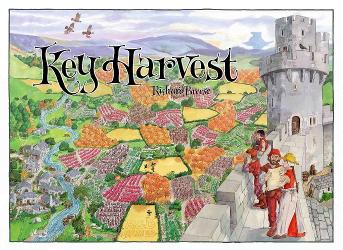
Key Harvest
Players build a personal country board by acquiring and placing field tiles, then score for connected groups of fields and for worker tiles placed on their board. On a turn a player takes two distinct actions from four options: place fields from their store onto their board, take fields from the registry into their store by bidding crop counters (other players may match the bid to buy the tile), place a worker (farmhand) adjacent to a required number of fields to trigger its special action, or harvest crops by flipping unharvested field tiles. Field tiles drawn from the bag refill the registry and may include event tiles that affect all players; the game ends after the tenth event plus two more rounds. Final scoring also awards points for majority holdings of each crop type.
- Players
- 2–4 best 3
- Playing time
- 90 min
- Age
- 10+
- Complexity
- 3 / 5
About the game
- Design
- Publisher



On Ludoya's tables
Full stats in Ludoya- 9
- Plays logged
- 5
- Players
- 7
- In collections
4.7/10
from 5 Ludoya reviews
Evan4.6 This is a tile laying game where each player has a symmetrical player board full of spaces that each have a unique unique row and column designation. Tiles get mixed in a bag and then six are placed on the central board. On each player's turn, they can do 2 actions, which could be place a worker tile and use it's special ability so long as the worker goes next to a number of other tiles at least equal to his printed victory point value, or take tiles from the central display placing them up for sale on your market area by setting their price with goods tokens, getting resource tokens from a connected blob of tiles on your player board thereby depleting the tiles, or buying tiles from player's market spaces which could be your own, or someone elses. The game ends when ten event tiles from the bag get drawn and resolved. Then, players score the printed values of the workers they have remaining on their board, plus 1 point for every tile in their largest blob, and 2 points for every tile in their second largest blob. Then there are a few mini points for having the most remaining of each type of good token. The game is very tight, with difficult decisions throughout. The mechanism where tiles taken from the central board need to go into your market where someone else might buy it from you is interesting but at times difficult to manage. You need to have an eye on the tiles you need, but also the tiles other people need so you can set them up to have to pay you, but then setting the price is tricky. Tiles can only go in the specific grid spot printed on them, which makes it tough if someone buys out a tile you needed to connect your stuff. On the other hand if you want someone to pay you for a tile, you have to set the price at a level they can afford using colors they have, and resources in hand are kept secret, so tracking who spent what when is another mental effort in addition to tracking what tile is good for who. Under-price the tile and you feel like a chump. Overprice the tile, and it just sits there until someone buys it, and your resources you used to set the price stay with the tile, and you again feel like a chump. The graphic design is very busy. The player workers are clear to see, but the neutral workers players are in competition for look very similar in color and pattern to the farm tiles, which makes being able to clearly see other player's board states more difficult than it needs to be. The tiles also can be a little misleading as to what their effects are. You really have to check the book before the game to clarify how they work. With some graphic design improvements, this could be a fantastic game. As it stands, I very much enjoy the puzzle. Particularly the mechanism where you can get extra activations from your workers if you place a field tile on them and bump them to another space they can legally go. It's irritating that while the worker and event tiles have english text on them, the text is misleading and you have to check the rulebook to see what they do each time. It would be better if all they had was a letter on them and then you reply entirely on a player aid to look up their ability. It would also be good if they included some kind of marker that would visually track who had which tiles so you aren't waiting for something that will never be available as each tile is unique. When I play I often use a sets of colored glass counters for this purpose
Mestremuten4.5 Rating: 2/5 Production value: 2/4 Is the game in my collection/Love to have?: 0.5/1
Tom4.1 The game works well, but it feels too "gamey" to be fun. I don't know how to put it better, but it doesn't have the sheer fun that Reef Encounter and Keythedral have.

Free, on web, Android and iOS
Play Key Harvest with Ludoya
- Keep it in your collectionTrack your copy and its expansions, lend it to friends, or put it on your wishlist and get told when the price drops.Add it to your collection
- Log every playScores, winners, timers and photos, then your stats: win rate, favourite player count, best score.Log a play
- Score it without paperUse the community's score sheets and play helpers, and let Ludoya add up the points.Find score sheets
- Find people to play it withClubs, game nights and events near you that bring this game to the table.See events
Game facts (players, playing time, age, credits) from BoardGameGeek.