
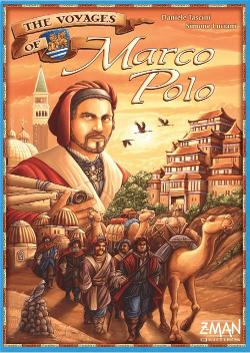
2015 · Medieval
The Voyages of Marco Polo
Players assume different historical characters and recreate a caravan journey from Venice to the court of Kublai Khan. Each player has a unique ability and rolls five personal dice each round to perform actions by placing dice on action spaces. Actions include gathering resources or money, acquiring and fulfilling contracts, traveling along multiple routes to place trading posts in cities, and using city-specific special actions. Higher-value dice unlock stronger options but can incur costs if opponents already occupy the same action. The game runs five rounds and scores points for fulfilled contracts, trading posts (notably in Beijing), and secret city goals.
- Players
- 2–4 best 4
- Playing time
- 40–100 min
- Age
- 12+
- Complexity
- 3.2 / 5
About the game
- Publisher




Expansions
See them in Ludoya
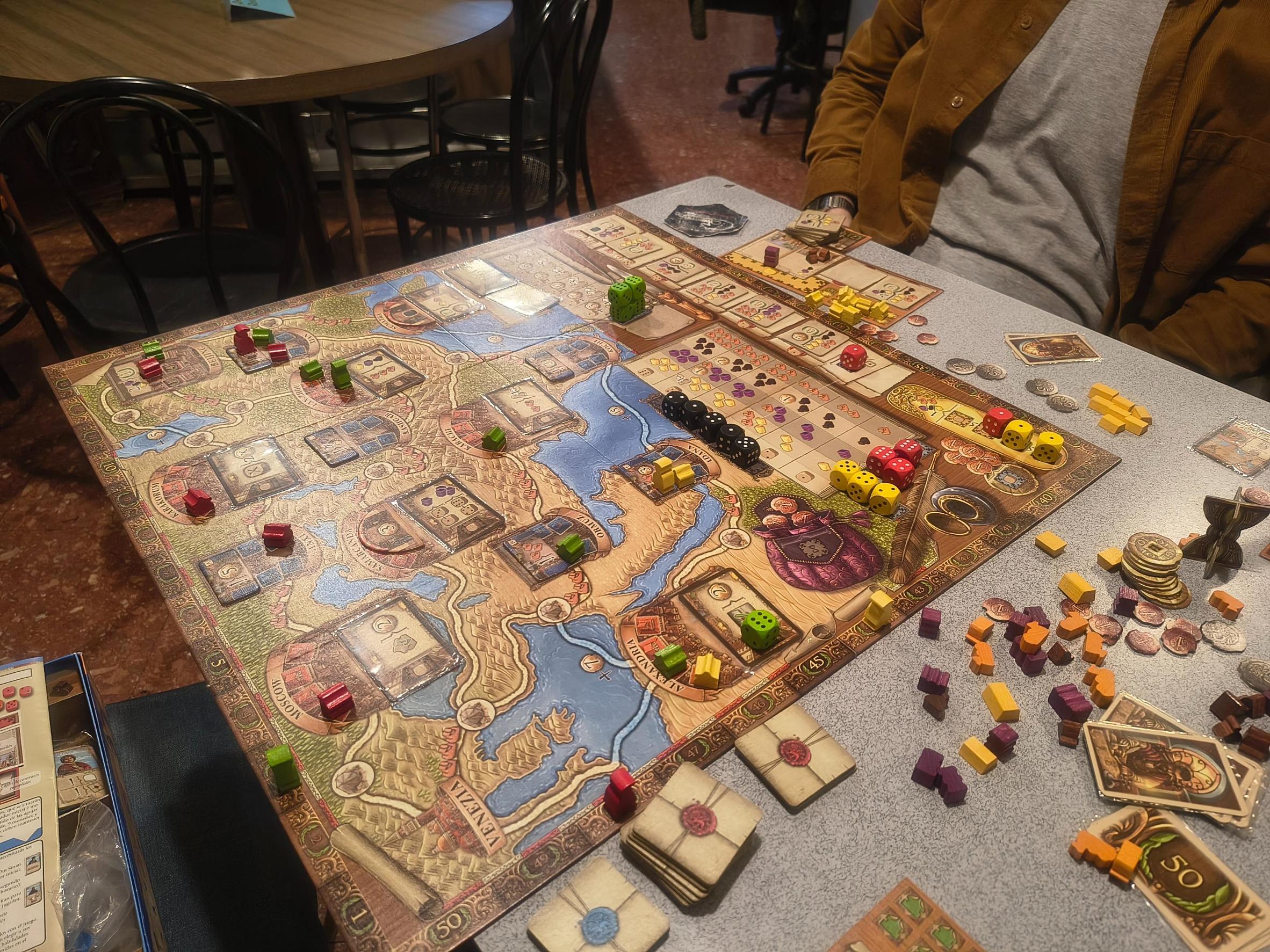
Photos from Ludoya tables
All photos in Ludoya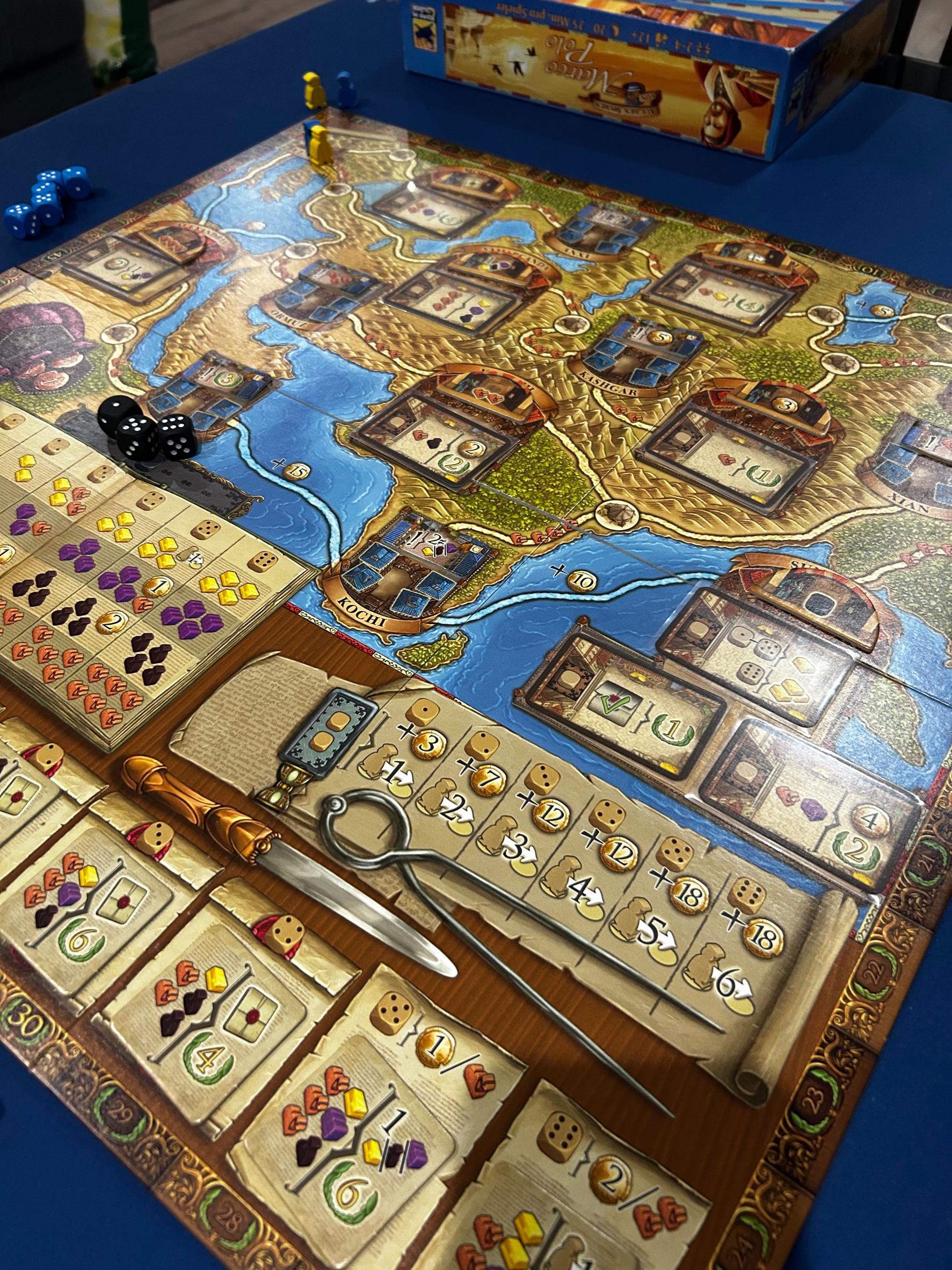
Where to buy it
Shop prices and second-hand copies, checked every day.
On Ludoya's tables
Full stats in Ludoya- 1,305
- Plays logged
- 711
- Players
- 1h 23m
- Average play
- 175
- In collections
- 24
- On wishlists
- 1
- Pre-ordered
7.3/10
from 123 Ludoya reviews
Evan4.6 At the start of this game, you are assigned an incredibly strong player power with the intention that everyone's asymmetric power looks and feels too good, yet with everyone getting an overpowered ability that theoretically the game remains balanced. The tightness of resources and the shortage of rounds will make accomplishing even modest goals, very difficult. Your plans will not work, as your poor dice results and other players beating you to actions you need will inevitably end you one short of whatever it is you needed, be it gold, camels or money. When you take an action needing multiple dice, you resolve for the lowest value in the lot. Then, in order to resolve an action that someone else has chosen before you, you have to pay money equal to the lowest value in your lot of dice. This means that higher values rolled get you bigger results, but you might wind up not being able to afford those results, so having lower values makes your actions cheaper. The game has an extremely high amount of variation. There are lots of player powers, all different, the city spaces get populated with randomize cards and there are enough of those that you might not see the same card for many games, and you can randomize the positions of the different income city abilities, to make it so that no path is quite the same twice. The game is an intriguing, but also often frustrating puzzle that I can't decide if I love or hate. :star: Art, Iconography and components functional :star: Clever or interesting mechanisms :star: Reasonably low downtime between turns with mildly AP players :star: Multiple plays stay interesting :nostar: Low or mitigatable luck elements :star::star::star::nostar::nostar: Raw enjoyment
Great game. Bought Marco Polo 2 because after a few games I noticed some flaws in it. Still one of the best Luciani's games by farr
Daniel7.0 4


Rules questions
Answered from the rulebook by Ludoya's rules assistant.
Do I place one or two dice when I take the Travel action, and how far can I move?
You place two dice for Travel and your movement distance equals the lower of the two dice; you then pay the cost per space (coins or camels) and place/relocate a trading post as required (pp.9–11).
When I take goods from the Grand Bazaar, do I have to take the exact number shown or can I take fewer?
The number of goods you gain is determined by the die you use, and you may take the amount shown by that die (lower dice are allowed in lower-value slots) — follow the Bazaar slot values and the die you place (p.7).
How many contracts can I take with one die and how are they scored?
You place one die on the contract action to take one or two contract cards (depending on slot/availability); completed contracts are scored when you fulfill their requirements, and higher-value dice can give extra contract bonuses (p.8).
If I spend a die to use a city card, can I use the city action multiple times?
Yes — spending one die on a city card lets you use that city's action a number of times equal to the die's value (p.11).
What bonus actions are available (rerolls, adjustments, black die) and are there limits?
Bonus actions include a reroll (cost 1), adjusting a die by ±1 (cost 2), and taking the black die (cost 3) with the restriction that you may take the black die only once per turn; occupied action spaces can be used by paying the required coin cost shown (pp.12–13).
Similar games














Free, on web, Android and iOS
Play The Voyages of Marco Polo with Ludoya
- Keep it in your collectionTrack your copy and its expansions, lend it to friends, or put it on your wishlist and get told when the price drops.Add it to your collection
- Log every playScores, winners, timers and photos, then your stats: win rate, favourite player count, best score.Log a play
- Settle rules questionsAsk anything about the rules and get an answer from the rulebook, with the page to check it on.Ask the rules assistant
- Find people to play it withClubs, game nights and events near you that bring this game to the table.See events
Game facts (players, playing time, age, credits) from BoardGameGeek.