
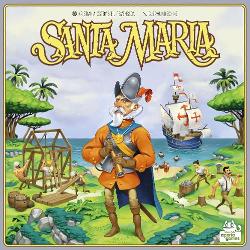
2017 · Civilization
Santa Maria
Players establish and develop a colony in a medium-weight Eurogame of engine building and dice drafting. Polyomino building tiles are placed on a personal colony board and dice (migrant workers) activate entire rows or columns of buildings; activated buildings trigger production and effects in a strict order, and the activating die then blocks the last activated space. Placement and activation order are central to planning. Over three rounds players produce resources, establish shipping routes, send conquistadors, and expand religious influence to recruit specialists who become scholars, missionaries, or bishops with differing benefits. Variable buildings, specialists, and end-game bonuses change each session, with minimal direct conflict and low randomness.
- Players
- 1–4 best 3
- Playing time
- 45–90 min
- Age
- 12+
- Complexity
- 3 / 5



Where to buy it
Shop prices and second-hand copies, checked every day.
On Ludoya's tables
Full stats in Ludoya- 231
- Plays logged
- 245
- Players
- 1h 28m
- Average play
- 79
- In collections
- 7
- On wishlists
7.2/10
from 50 Ludoya reviews
Garfield2.0 Very abstract, ugly board game. [c] Theme: ★☆☆☆☆ <!-- size 7]No --> Gameplay: ★★★☆☆ <!-- size 7]Ok --> Interaction: ★★☆☆☆ <!-- size 7]Very little --> Artwork: ★★☆☆☆ <!-- size 7]Not very good --> Luck: ★★★☆☆ <!-- size 7]Dice rolling, random marker revealing --> Strategy: ★★☆☆☆ <!-- size 7]Very little --> Components: ★★☆☆☆ <!-- size 7]The board, the laughing faces --> Play duration: ★★★★☆ <!-- size 7]Very good --> Easy to teach: ★★★☆☆ <!-- size 7]Ok --> Rules quality: <!-- size 7]not read --> Setup time: ★★★☆☆ <!-- size 7]Ok --> No downtime: ★★★☆☆ <!-- size 7]Ok --> Replay value: ★★☆☆☆ <!-- size 7]A little bit of random stuff --> [/c]
Evan10.0 Santa Maria is a fantastic game where in each of three rounds you can buy a tile and add it to your player board, or spend money to activate one of your buildings on the tiles, or draft and place a die and then activate each building in the column that matches the pip value on the die drafted. Buildings you activated with money don't activate again, and the die used covers the last building activated so you have to plan your board layout carefully. Each player also gets a few dice that are unique to them that activate the row with matching pips. The game only goes three rounds but it is an intense three rounds. People always beat you to the die you want and to grabbing the tile you need because it has the building you want printed on it. There are other game features you have to consider as well such as valuable boat tiles that want specific resources delivered to them, and competing to be first on a track that generates points each round. The gameplay is tense throughout and no matter how good you might be doing you still feel like all your choices were probably bad. Even passing is tense, as when players pass they get to choose amongst a series of important bonus actions to resolve. The component quality is not great. The boards are somewhat dull in color, and the components, even the nice wooden ones feel a bit thin. Oddly the resources in this game line up perfectly with the Stonemaier Games upgraded resource chests, so I'll be using those for future games. One troublesome thing is that the VP tokens have big smiling pink happy faces on them, which feels at odds with a conquistador theme, although that theme is super pasted on. Regardless, I highly recommend checking this game out. ★ Art, Iconography and components functional ★ Clever or interesting mechanisms ★ Reasonably low downtime between turns with mildly AP players ★ Multiple plays stay interesting ★ Low or mitigatable luck elements ★★★★★ Raw enjoyment
- Base -

Rules questions
Answered from the rulebook by Ludoya's rules assistant.
Do I have to use the exact die value to activate a row/column, or can I change the die first?
You may pay 1 coin per pip to increase or decrease the chosen die’s value (no wrap‑around) and then activate the matching column (white die) or row (blue die); the buildings are activated in order and the die is placed on the last vacant building (pages 3, 5).
If a building already has coins on it (or a die), is it activated when I use a row/column or single‑building action?
No — only vacant buildings are activated; buildings covered with a die or coins are skipped (page 5).
Can I hold more than three of the same resource in storage, or do I lose extras?
Your storage can never hold more than 3 identical resources; any excess resources are converted to coins at the selling price (1 coin for a basic resource, 2 coins for an advanced resource) (page 4).
When I place a monk on a common space, do I always have to pay other players 2 coins?
If you are the first to place a monk on that specific space it’s free; otherwise you must pay 2 coins to each player who already has a monk on that space (and you may not place a monk where you already have one) (page 5).
If I retire, can I still use free actions that turn, and can I use a blue die I just unlocked?
You may use free actions (and scholar abilities) on the turn you retire, but any blue die you unlock during the year (for example by passing monk symbols) cannot be used until the next year (pages 5–6).
How do shipment tiles get refilled and when do I get their income/points?
When you take a shipment tile from a dock you immediately pay its cost, place it face down in your harbour, and draw a replacement from the stack to refill that dock; shipment tiles give income when you retire (applied top to bottom) and their printed points are scored at game end (pages 4, 6).






Free, on web, Android and iOS
Play Santa Maria with Ludoya
- Keep it in your collectionTrack your copy and its expansions, lend it to friends, or put it on your wishlist and get told when the price drops.Add it to your collection
- Log every playScores, winners, timers and photos, then your stats: win rate, favourite player count, best score.Log a play
- Settle rules questionsAsk anything about the rules and get an answer from the rulebook, with the page to check it on.Ask the rules assistant
- Find people to play it withClubs, game nights and events near you that bring this game to the table.See events
Game facts (players, playing time, age, credits) from BoardGameGeek.