

2016 · Renaissance
Lorenzo il Magnifico
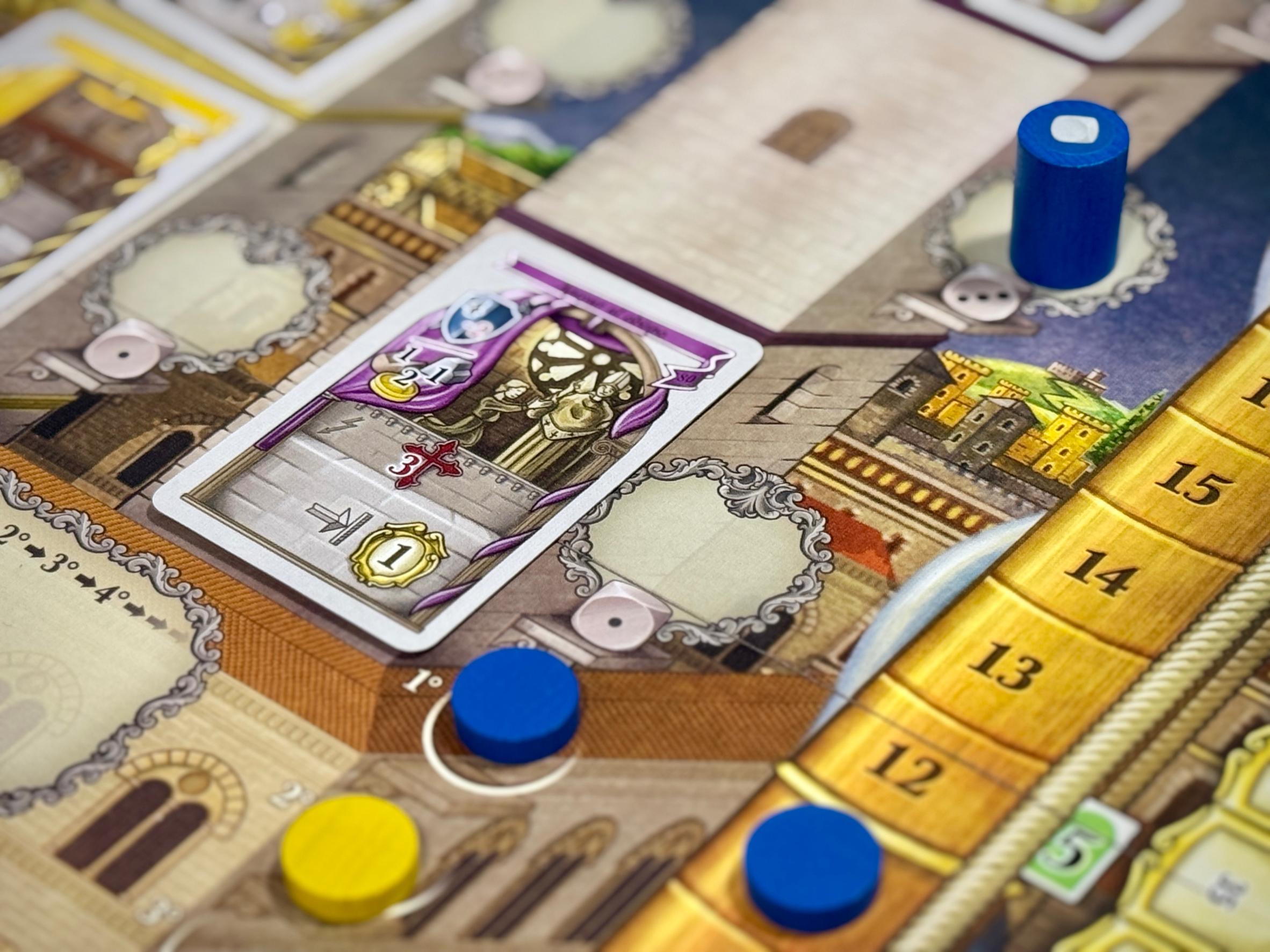
Players act as heads of noble families in an Italian Renaissance city, sending family members to different areas of town to collect resources, acquire development cards, and trigger card effects. Each round uses three dice to set the value of family members, and players place them on action spaces whose effectiveness depends on those values and on occupied bonuses. Development cards represent territories, buildings, characters, and ventures that provide abilities, resources, and victory points. Play proceeds over three periods with two rounds each; at the end of each period players must meet faith requirements or suffer penalties. Victory points come from cards, resources, and objectives after six rounds.
- Players
- 2–4 best 4
- Playing time
- 60–120 min
- Age
- 12+
- Complexity
- 3.3 / 5
About the game
- Publisher






Expansions
See them in Ludoya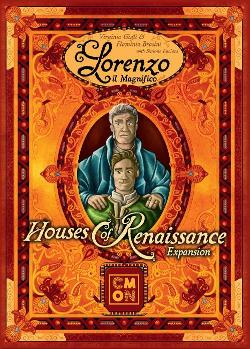 Lorenzo il Magnifico: Houses of Renaissance2017
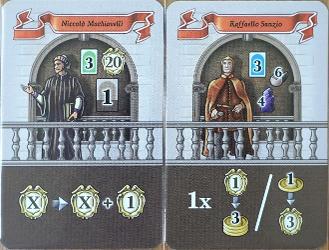 Lorenzo il Magnifico: New Leaders2016
 Lorenzo il Magnifico: The Pazzi Conspiracy Kickstarter Edition2019
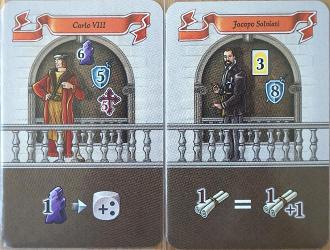 Lorenzo il Magnifico: New Leaders #22017
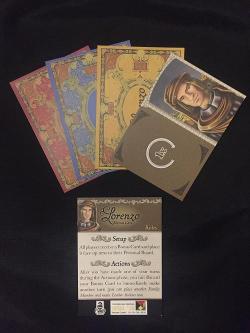 Lorenzo il Magnifico: Bonus Card expansion2016
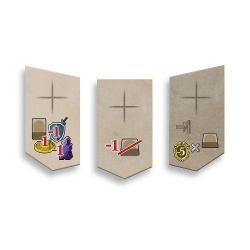 Lorenzo il Magnifico: New Excommunications2022
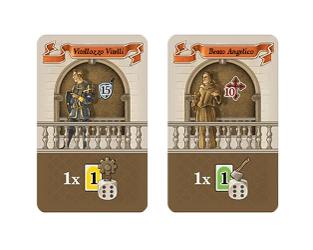 Lorenzo il Magnifico: New Leaders #32022
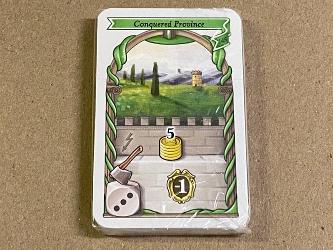 Lorenzo il Magnifico: The Pazzi Conspiracy2019
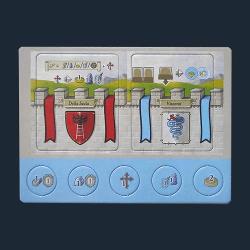 Lorenzo Il Magnifico: Promo Visconti/Della Scala2021
Photos from Ludoya tables
All photos in Ludoya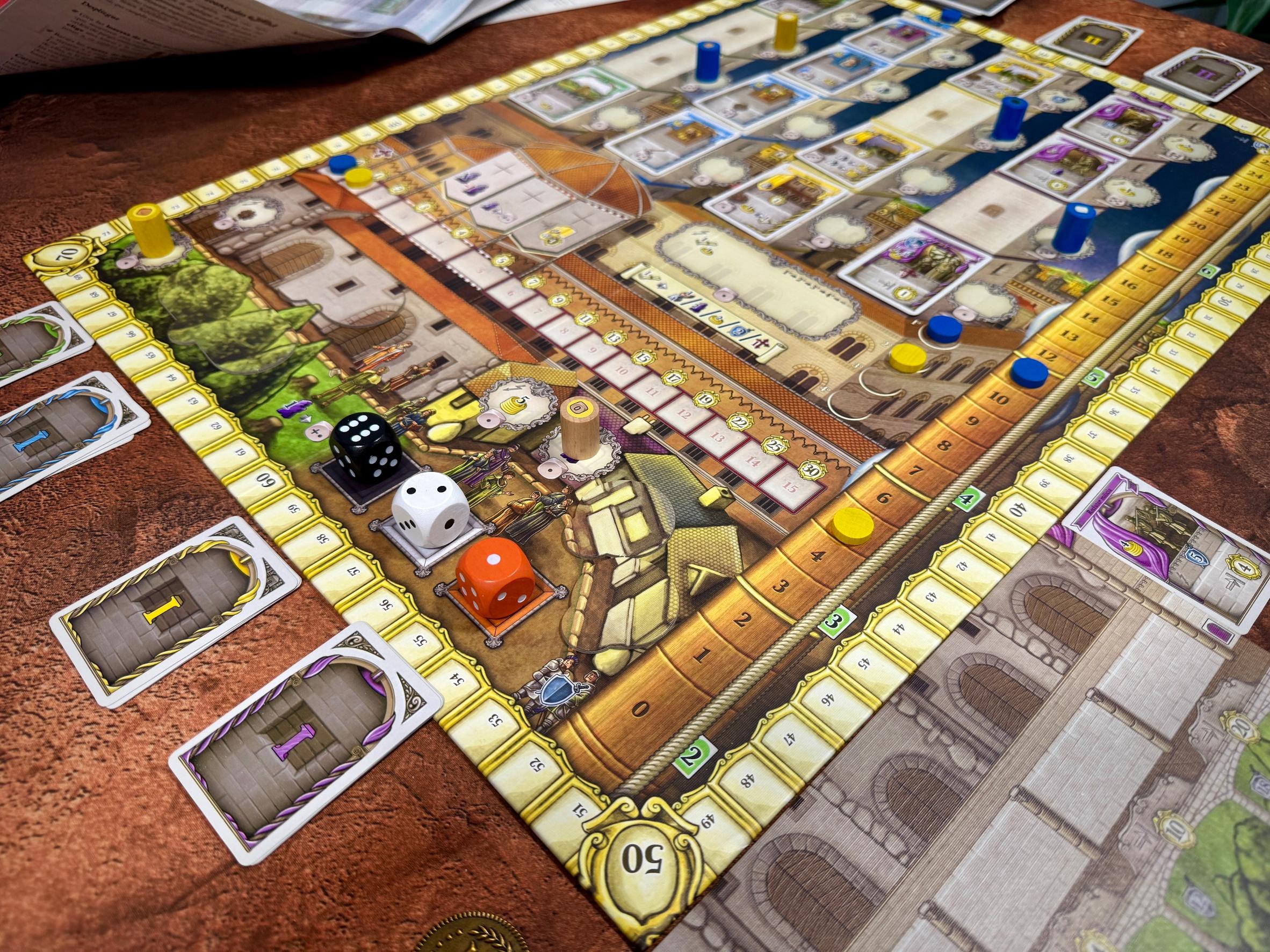
Where to buy it
Shop prices and second-hand copies, checked every day.
On Ludoya's tables
Full stats in Ludoya- 578
- Plays logged
- 543
- Players
- 1h 40m
- Average play
- 108
- In collections
- 32
- On wishlists
8.2/10
from 86 Ludoya reviews
Daniel9.0 Con Expansiones: Lorenzo il Magnifico: Houses of Renaissance
Mestremuten10.0 Rating: 5/5 Production value: 4/4 Is the game in my collection/Love to have?: 1/1
Great Worker Placement Eurogame with some clever mechanics. Similar to Marco Polo or Grand Austria Hotel but harder, and for me, more rewarding. Not so difficult to catch but as the game goes by things got each time more interesting.


Rules questions
Answered from the rulebook by Ludoya's rules assistant.
Can I place two of my colored family members in the same tower in one round?
No — you may not have two Family Members of the same color in the same tower; you can only take two cards from the same tower in the same round by using your neutral (uncolored) Family Member or a card effect. (See page 7.)
How do servants change a family member’s value — is there a limit?
You may spend servants 1:1 to increase a Family Member’s value before placing it, and there is no limit to how many servants you can spend to raise that value. (See page 4.)
When I do a Harvest or Production, which cards activate and can I use resources I just gained to pay other activations?
Harvest activates only Territory cards with activation value less than or equal to your Harvest action value, and Production activates only Building cards with activation value less than or equal to your Production action value; resources gained during activation cannot be used to pay for other cards’ exchanging effects — those resources must be present beforehand. (See page 8.)
If a tower already has family members, do I have to pay extra coins and can I use the floor bonus to pay that cost?
Yes — if there are Family Members already in the same tower you must pay 3 coins to the supply before placing; any coin bonus from the floor cannot be used to pay that 3-coin fee. (See page 7.)
What does placing in the Council Palace do, and how does it affect next round’s turn order?
Placing in the Council Palace immediately gives you 1 Council Privilege and 1 coin, and at the end of the round Turn Order is replaced following the left-to-right order of Family Members placed there (first placed becomes first player next round). (See pages 9 and 11.)
At a Vatican Report, do I have to spend all my Faith to avoid excommunication, and what happens if I choose not to support the Church?
If you meet the Faith threshold you may choose to support the Church by spending all your Faith and receiving the Victory Points shown on your Faith track step (then moving back to the first step); if you don’t support or don’t meet the threshold, you suffer the period’s Excommunication and place a cube on that Excommunication Tile. (See page 10.)








Free, on web, Android and iOS
Play Lorenzo il Magnifico with Ludoya
- Keep it in your collectionTrack your copy and its expansions, lend it to friends, or put it on your wishlist and get told when the price drops.Add it to your collection
- Log every playScores, winners, timers and photos, then your stats: win rate, favourite player count, best score.Log a play
- Settle rules questionsAsk anything about the rules and get an answer from the rulebook, with the page to check it on.Ask the rules assistant
- Find people to play it withClubs, game nights and events near you that bring this game to the table.See events
Game facts (players, playing time, age, credits) from BoardGameGeek.