
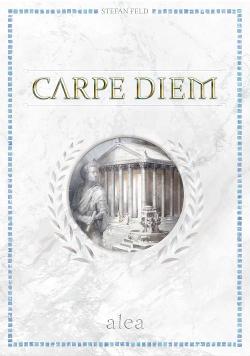
2018 · Ancient
Carpe Diem
Players take the role of wealthy patricians in ancient Rome, drafting tiles to build a city district of villas, gardens and public buildings. On each turn, players select actions from a shared pattern-builder board to place tiles, expand neighborhoods and claim scoring cards that set personal objectives. Resource management is abstracted through placement and the arrangement of tiles, with multiple scoring routes and tactical choices shaping different strategies. The game emphasizes spatial planning and timing as players race to fulfill scoring cards and maximize prestige points by the end of the game.
- Players
- 2–4 best 3
- Playing time
- 45–75 min
- Age
- 10+
- Complexity
- 2.5 / 5
About the game
- Design


Expansions
See them in Ludoya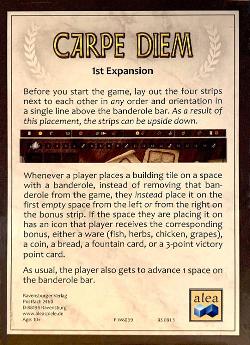
Where to buy it
Shop prices and second-hand copies, checked every day.
On Ludoya's tables
Full stats in Ludoya- 409
- Plays logged
- 377
- Players
- 1h 5m
- Average play
- 137
- In collections
- 14
- On wishlists
- 1
- Pre-ordered
6.3/10
from 72 Ludoya reviews
Garfield2.0 Puzzle game, where you can get really frustrated because someone takes exactly the tile you need, and this can happen several times. No theme at all. And I really don't like the mechanism where the first one on a specific track can choose first what goals he can fulfill and the last one has to take what remains. Another Feld I don't like... [c] Theme: :star::nostar::nostar::nostar::nostar: <!-- size 7]No --> Gameplay: :star::star::nostar::nostar::nostar: <!-- size 7]Move, get tiles, place them, nothing else --> Interaction: :star::star::nostar::nostar::nostar: <!-- size 7]Just that others taking tiles you wanted --> Artwork: :star::nostar::nostar::nostar::nostar: <!-- size 7]Very ugly --> Luck: :star::star::nostar::nostar::nostar: <!-- size 7]Very little --> Strategy: :star::star::star::nostar::nostar: <!-- size 7]Try to fulfill target cards, nothing more --> Components: :star::star::nostar::nostar::nostar: <!-- size 7]Nothing special --> Play duration: :star::star::star::star::nostar: <!-- size 7]At least it's over very fast --> Easy to teach: :star::star::star::nostar::nostar: <!-- size 7]Ok (25min) --> Rules quality: <!-- size 7]not read --> Setup time: :star::star::star::star::nostar: <!-- size 7]Quite fast --> No downtime: :star::star::star::star::nostar: <!-- size 7]Plays quite fast --> Replay value: :star::star::nostar::nostar::nostar: <!-- size 7]Random placement of tiles --> [/c]
Evan4.6 In this game players zip around the central board following the lines to collect tiles that get added to your personal board. Completing features produce bonuses, then at the end of the round you place a score marker in an empty space between two cards, and score both cards. If for some reason you don't meet their requirement, you suffer a point penalty instead. At the end of the game you also score points if your features straddle certain row or column lines as dictated by the printed spaces on your starting setup border tiles. There's a little more luck in this game than I'd like. There's a degree of luck in terms of which tiles flip to what sections. Then more in terms with how that lines up with the victory card requirements on display. Then more when you place the secret goal card building, and draw 2 discard 1. There's mitigation in that some buildings produce gold which is a wild resource, and bread, which when you have enough of it, you can just pretend to meet the requirements of a card that you don't meet. It's just that tiles get snatched up so quickly from the pools that it can be difficult to have and then carry out any specific plans. This gets tough additionally when it's often enough penalty to not complete your feature, but then it can also cause you to have to place your scoring marker where suddenly you're getting a penalty because you relied on getting a single chicken tile for example, and none came up in that round. It also can feel a little harsh since scoring order is reliant on a victory points track at the bottom of the board, where the player with the most points gets first pick of scoring space. If someone ahead of you on that track is going for the same space you need, you might just be out of luck in that right as well. Overall I liked the experience of playing the game, it just felt a little too harsh for the kind of experience I look for. The kind of punchyness where there's no ability to really respond to counter-move your opponents, where it can feel like you get slapped twice for each setback. :nostar: Art, Iconography and components functional :star: Clever or interesting mechanisms :star: Reasonably low downtime between turns with mildly AP players :star: Multiple plays stay interesting :star: Low or mitigatable luck elements :star::star::nostar::nostar::nostar: Raw enjoyment
Review incoming. We love this one, a light salad point game, playable within 30 minutes (2p) or 40min (3p) once rules ok for all players. And with a really challenging deep proposal. 1 point less for the box artwork that tastes really oldy !

Rules questions
Answered from the rulebook by Ludoya's rules assistant.
Do I have to move my meeple every turn, or can I stay put?
You must move your meeple every turn — you cannot stay where you are (exception noted on page 7). The only way to remain (or move to any space) is to pay 1 bread at the start of your turn via the Baker ability (page 4; Baker, page 7).
What happens if I move to a space that has no building tiles next to it?
If you move onto a semi‑circular space without any adjacent building tiles, you immediately move again (following the movement rules) until you land on a space with at least one tile next to it (page 4).
How must I place building tiles — can I rotate them or place them diagonally?
The first tile must go on the shovel space and all later tiles must be placed orthogonally adjacent (not diagonally) to an existing tile; you may rotate tiles freely but every touching side must match (pond to pond, grass to grass, etc.), and the frame counts as 'grass' (page 5).
In a 2‑ or 3‑player game, when are tiles removed from the board and not used?
In the 2‑player game the last two tiles on a space are removed as soon as the second tile is picked; in the 3‑player game the final remaining tile on a space is removed as soon as the penultimate tile is taken — return removed tiles to the box (page 5).
Can I use bread to avoid or satisfy scoring requirements?
Yes — bread has two uses: spend 1 bread at the start of your turn to move (or stay) anywhere via the Baker, and spend 3 bread during scoring to fulfill one scoring card’s requirement (it works for both green 'own' and red 'pay' cards) so you receive that card’s rewards without meeting the printed requirement (page 7; scoring cards, page 9).
What if I can’t fully meet a scoring card’s requirements — do I get partial points?
If you cannot fully meet a scoring card’s requirements you get no points from that card and instead lose 4 victory points (so you can lose up to 8 VPs in a scoring period if both cards fail); you choose the order in which to resolve your two cards (page 10).

















Free, on web, Android and iOS
Play Carpe Diem with Ludoya
- Keep it in your collectionTrack your copy and its expansions, lend it to friends, or put it on your wishlist and get told when the price drops.Add it to your collection
- Log every playScores, winners, timers and photos, then your stats: win rate, favourite player count, best score.Log a play
- Settle rules questionsAsk anything about the rules and get an answer from the rulebook, with the page to check it on.Ask the rules assistant
- Find people to play it withClubs, game nights and events near you that bring this game to the table.See events
Game facts (players, playing time, age, credits) from BoardGameGeek.