

2018 · Territory Building
Yellow & Yangtze
Players guide rival Warring States through the late Zhou period by placing tiles to build cities, farms, markets, temples and rivers across the board. Each turn uses one of five leader types—Governor, Soldier, Farmer, Trader and Artisan—to develop corresponding domains and score points in those five categories, but final score equals the player’s weakest category. Civilizations clash when tiles connect, triggering wars and revolts that are resolved with leader strength and tactical placement; stable regions can later erect pagodas for additional security and benefits.
- Players
- 2–4 best 4
- Playing time
- 90 min
- Age
- 14+
- Complexity
- 3.1 / 5
About the game
- Design
- Publisher



Expansions
See them in Ludoya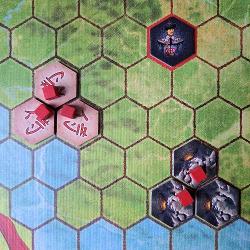
Where to buy it
Shop prices and second-hand copies, checked every day.
On Ludoya's tables
Full stats in Ludoya- 64
- Plays logged
- 107
- Players
- 1h 22m
- Average play
- 49
- In collections
- 16
- On wishlists
7.6/10
from 27 Ludoya reviews
andycted8.8 Big points for creating a game on such a template like T&E, but which plays extremely differently, but maintains the same basic flavour. Smoother and more incremental than T&E, has also less ways to catch up someone and big swingy wars. However it makes up for it with a little explicit diplomacy and some interesting powers that help players find something useful every time. Surely less opaque than T&E, it manages to do so while not losing so much depth and richness. A more than decent evolution, doesn't reach T&E highs, but has a place in your shelf.
- Base -

Rules questions
Answered from the rulebook by Ludoya's rules assistant.
Can I move a leader that's already on the board or only place new ones?
You may place a leader from off the board, reposition a leader from another space on the board, or withdraw a leader as the Position action; placements must be on an empty, non-river space adjacent to a black governor and must not create a conflict (and if the last adjacent black governor is removed the leader must be removed). (page 5)
Do I always get a victory point when I place a tile?
You gain a victory point for a placed tile only if the tile is in a state containing a like-colored leader (or, if none, a black governor leader); no point is gained if the placement unites states and causes a conflict, and multiple blue farmers placed in one action can each generate points if the condition applies. (page 6)
How does a peasants' riot work and what does it remove?
By discarding two blue farmer tiles (or one plus your farmer leader in front of your screen) you discard any one tile from the board, which can split a state; if that removal destroys the last adjacent black governor to a leader the leader is returned, and if the removed tile supported a pagoda the pagoda is also removed. (page 7)
What's the difference between a revolt and a war, and what triggers each?
A revolt happens when you place a leader into a state that already contains a leader of the same color (attacker vs defender resolved by black governor strength), while a war happens when a newly placed tile unites two or more states and the combined state contains like-colored leaders, triggering a larger resolution using red soldier strength. (pages 9–9)
In a war, do the winners have to discard red soldier tiles too?
Yes—after resolving the war, the committed and removed red soldier tiles from each losing state are totaled, and the highest of those totals sets how many red soldier tiles must be discarded for the winning state: first discard the winning state's committed tiles, then (if needed) the unifier player removes additional red soldier tiles from the winning state to match that total. (page 10)
When and how do pagodas get placed, and how do they score?
A pagoda may be placed when a tile creates a triangle of three like-colored tiles (if it doesn't create a conflict and no tile of that triangle already supports a pagoda) or by spending two green traders to claim an existing triangle; at the end of your turn you score one victory point per like-colored pagoda linked to each of your like-colored leaders (with black pagodas scoring only to black governor leaders). (page 8)


















Free, on web, Android and iOS
Play Yellow & Yangtze with Ludoya
- Keep it in your collectionTrack your copy and its expansions, lend it to friends, or put it on your wishlist and get told when the price drops.Add it to your collection
- Log every playScores, winners, timers and photos, then your stats: win rate, favourite player count, best score.Log a play
- Settle rules questionsAsk anything about the rules and get an answer from the rulebook, with the page to check it on.Ask the rules assistant
- Find people to play it withClubs, game nights and events near you that bring this game to the table.See events
Game facts (players, playing time, age, credits) from BoardGameGeek.