
1997 · Abstract Strategy
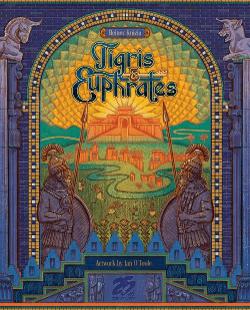
Tigris & Euphrates
Players build civilizations in the ancient Fertile Crescent by placing tiles to create kingdoms and monuments. Each player manages four types of leaders—farming, trade, religion, and government—to collect points in those categories, but the final score is determined by the weakest category, encouraging balanced development. Civilizations expand and collide on the board, producing external conflicts where only one leader of a type survives, and internal conflicts that can replace leaders within a kingdom. An advanced variant adds a multi-tile monument that players can construct by trading in tokens; monuments are permanent and grant additional scoring opportunities.
- Players
- 2–4 best 4
- Playing time
- 60–120 min
- Age
- 14+
- Complexity
- 3.5 / 5
About the game
- Design
- Publisher






Expansions
See them in Ludoya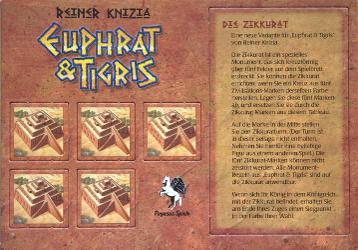
Where to buy it
Shop prices and second-hand copies, checked every day.
On Ludoya's tables
Full stats in Ludoya- 369
- Plays logged
- 399
- Players
- 1h 23m
- Average play
- 130
- In collections
- 39
- On wishlists
- 4
- Pre-ordered
7.1/10
from 87 Ludoya reviews
Mestremuten6.0 Rating: 3/5 Production value: 3/4 Is the game in my collection/Love to have?: 0/1
Played it 5 times
SrCornelius7.0 Local-(217)
First impressions · 2 plays
andycted9.5 3-4 players
Played it 12 times

Rules questions
Answered from the rulebook by Ludoya's rules assistant.
Can I place a leader on any empty space—including river spaces—or place one so it unites kingdoms?
No. A leader must be placed on an empty land space adjacent to a temple, cannot be placed on a river space, and may not be placed so as to unite kingdoms (leaders can be repositioned or withdrawn under other rules) (page 6).
What exactly happens when I play a catastrophe tile on an existing tile or an empty space?
A catastrophe permanently blocks that space and may be placed on an empty space or on top of an existing tile (removing that tile), but it cannot be played on a tile bearing a treasure or monument or on a leader; if it removes the last temple adjacent to a leader, that leader is immediately withdrawn (page 7).
How do revolts work—how is strength counted and who wins ties?
In a revolt the attacker and defender count temples adjacent to their conflicting leaders, then attacker then defender may each once commit extra temple tiles from hand; highest total wins and the defender wins ties; the loser withdraws his leader, the winner gains one amulet, and all committed temples are removed from the game (page 8).
How are wars resolved and how do you get victory points from them?
For a war count each side’s supporters (connected tiles of the leader’s color) and then attacker then defender may commit matching-color tiles from hand; the higher total wins and the defender wins ties; the loser removes his leader and all supporters, and the victor gains one victory point for the withdrawn leader plus one for each supporter removed (committed tiles do not score) (pages 9–10).
When can I build a monument and do the flipped tiles still count for conflicts/supporters?
If a tile completes a 2×2 square of like-colored tiles the active player may flip those four tiles facedown and place a monument (one monument color must match the facedown tiles); the facedown tiles still count as part of regions/kingdoms and link leaders but do not count as supporters in conflicts, and monuments cannot be destroyed (page 11).
How is the winner decided at game end and how are treasures used for tiebreaks?
The game ends when only one or two treasures remain or the bag is empty; players then allocate their treasures among the four spheres as they choose and compare players’ weakest sphere—whoever has the highest lowest-sphere wins, with ties decided by comparing next-lowest spheres (if all four spheres are equal, tied players share victory) (page 14).





Free, on web, Android and iOS
Play Tigris & Euphrates with Ludoya
- Keep it in your collectionTrack your copy and its expansions, lend it to friends, or put it on your wishlist and get told when the price drops.Add it to your collection
- Log every playScores, winners, timers and photos, then your stats: win rate, favourite player count, best score.Log a play
- Settle rules questionsAsk anything about the rules and get an answer from the rulebook, with the page to check it on.Ask the rules assistant
- Find people to play it withClubs, game nights and events near you that bring this game to the table.See events
Game facts (players, playing time, age, credits) from BoardGameGeek.