
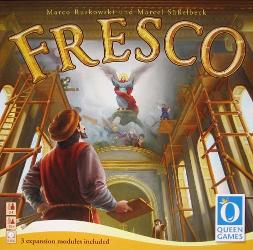
2010 · Renaștere
Fresco
Players are master painters restoring a Renaissance church fresco by buying, mixing and applying paints to specific fresco segments. Each round begins with selecting a wake-up time to determine turn order, balancing early access to actions against apprentice happiness. Players assign apprentices to tasks such as purchasing pigments, mixing colors, working on fresco panels, painting portraits to earn money, or sending apprentices to the opera to raise morale. Scores come mainly from completing fresco sections that require particular paint combinations, so players manage funds, resources and timing while competing for paints and painting opportunities. Optional expansion modules add extra rules and complexity.
- Jucători
- 2–4 ideal 4
- Timp de joc
- 60 min
- Vârstă
- 10+
- Complexitate
- 2,6 / 5
Despre joc
- Ilustrație
- Publisher



Extensii
Vezi-le în Ludoya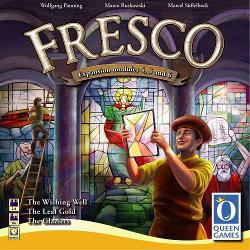
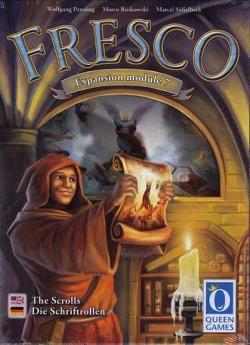
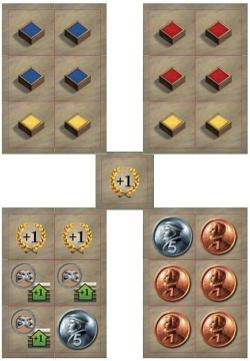

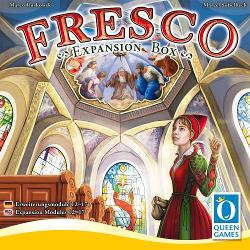
Fotografii de la mesele Ludoya
Toate fotografiile în LudoyaDe unde îl cumperi
Prețuri din magazine și exemplare la mâna a doua, verificate zilnic.
La mesele Ludoya
Toate statisticile în Ludoya- 188
- Partide înregistrate
- 222
- Jucători
- 1h 34m
- Durată medie
- 90
- În colecții
- 12
- Pe listele de dorințe
7,1/10
din 59 de recenzii Ludoya
Mestremuten7,0 Rating: 3/5 Production value: 3/4 Is the game in my collection/Love to have?: 1/1
- Base -
Bonito eurogame, completito. Perfecto para iniciarse....


Întrebări despre reguli
Răspunsuri din regulament de la asistentul de reguli Ludoya.
When do we choose our get‑up time and what does it do (mood, market price, turn order)?
Choosing get‑up time happens in Phase 1 (the player in last place on the victory track chooses first); the space you pick immediately adjusts your mood, sets your market price, and determines the player order for Phase 2 (earliest get‑up acts first). (pages 4–5).
If I place two apprentices at the cathedral, can I restore two fresco segments in the same round?
Yes — each apprentice you deploy at the cathedral entitles you to one cathedral action, so two apprentices let you perform two restores (or altar actions), resolving them when it’s your turn at that location. (pages 5–6).
How exactly does buying at the market work, and what happens when we close a market booth?
Each apprentice you placed at the market can buy one market tile from the selected booth at the price set by your get‑up time; you pay the cost, take the paint pieces and hide them behind your screen, then return all tiles of that booth to the linen bag. Alternatively, you may forfeit buying and close the booth as a free action, returning its tiles to the linen bag. (pages 5–6).
When and how can I move the bishop, and what are the bishop bonus points?
Before restoring any fresco segment you may move the bishop exactly one space in any direction by paying 1 Thaler; if the bishop stands on the restored segment you gain 3 bonus points, if it is adjacent you gain 2 bonus points. (page 7).
Is the order for choosing get‑up times the same as the order for performing actions?
No — the order for choosing get‑up times is determined by players’ positions on the victory point track (last chooses first), while the order of performing actions in Phase 2 is determined by the chosen get‑up times (earliest get‑up acts first). (pages 4–5).
How does restoring the altar work and what about blended/wildcard paints?
You can restore the altar either by returning one each of basic paints (yellow, red, blue) for 2 VP — substituting any of them with green/orange/purple adds +1 VP per substitute — or by returning three different blended paints (orange, green, purple) for 6 VP. (page 7).









Gratuit, pe web, Android și iOS
Joacă Fresco cu Ludoya
- Păstrează-l în colecția taȚine evidența exemplarului tău și a extensiilor lui, împrumută-l prietenilor sau pune-l pe lista de dorințe și află când scade prețul.Adaugă-l în colecția ta
- Înregistrează fiecare partidăPuncte, câștigători, cronometre și fotografii, apoi statisticile tale: rata de câștig, numărul preferat de jucători, cel mai bun scor.Înregistrează o partidă
- Lămurește întrebările despre reguliÎntreabă orice despre reguli și primești un răspuns din regulament, cu pagina unde îl poți verifica.Întreabă asistentul de reguli
- Găsește oameni cu care să-l jociCluburi, seri de jocuri și evenimente de lângă tine unde se joacă acest joc.Vezi evenimentele
Datele jocului (jucători, durată, vârstă, autori) de pe BoardGameGeek.