
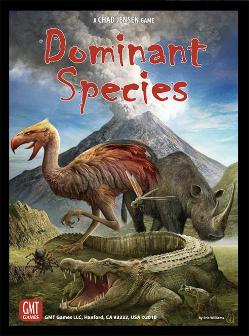
2010 · Animals
Dominant Species
Players represent one of six major animal classes as an ice age slowly transforms the landscape. Hex tiles form an evolving map where tundra overlays convert habitats and creature cubes show species presence across terrain. On each turn players place and later execute action pawns to perform speciation, migration, adaptation, environmental change, and glaciation. Cards grant one-shot or recurring benefits, and element discs track traits and environmental effects. Control of terrain and successful propagation earn victory points; final scoring evaluates dominance on each tile to determine which animal has most effectively adapted.
- Players
- 2–6 best 4
- Playing time
- 120–240 min
- Age
- 14+
- Complexity
- 4 / 5
About the game
- Design








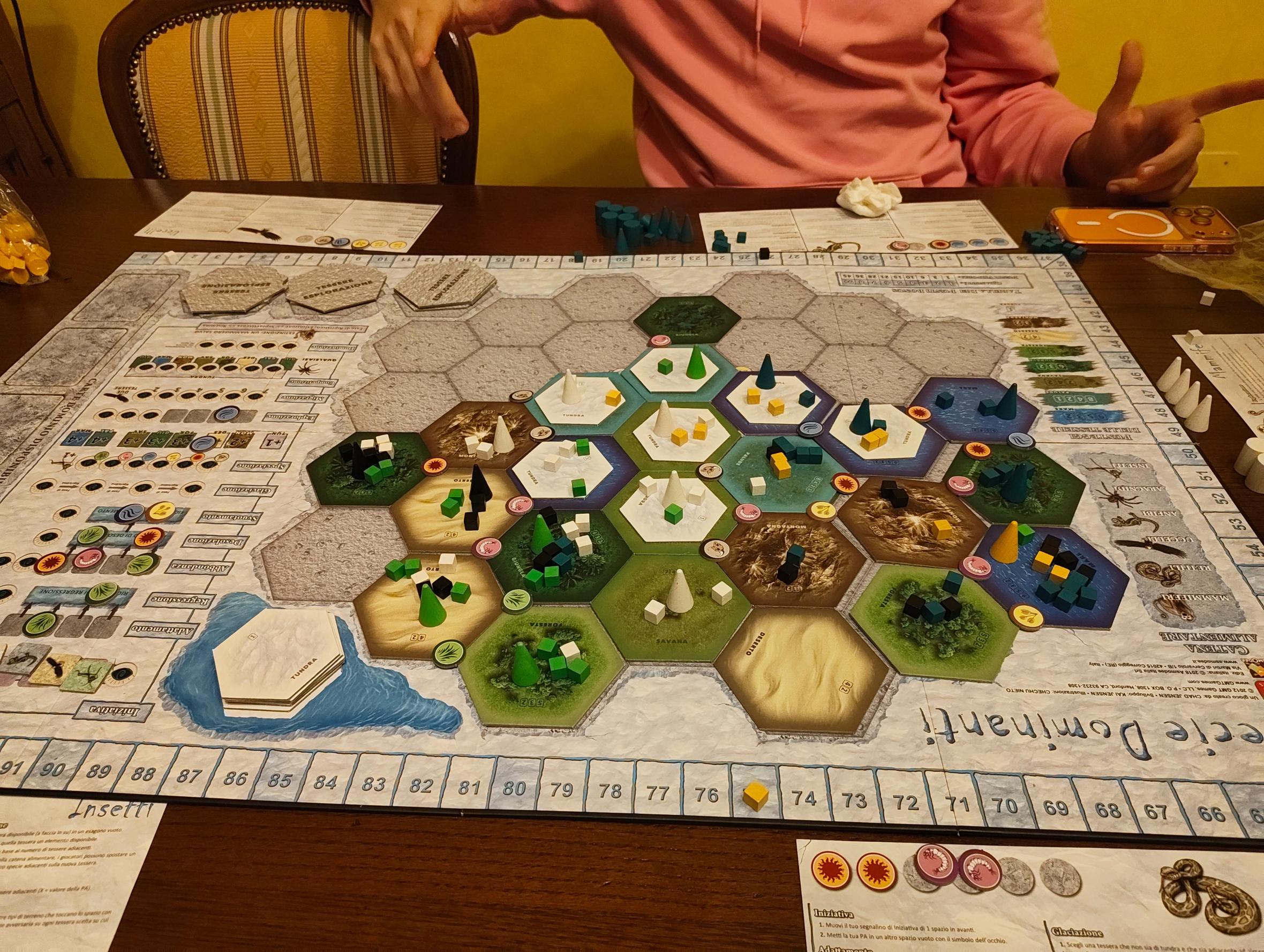
Photos from Ludoya tables
All photos in Ludoya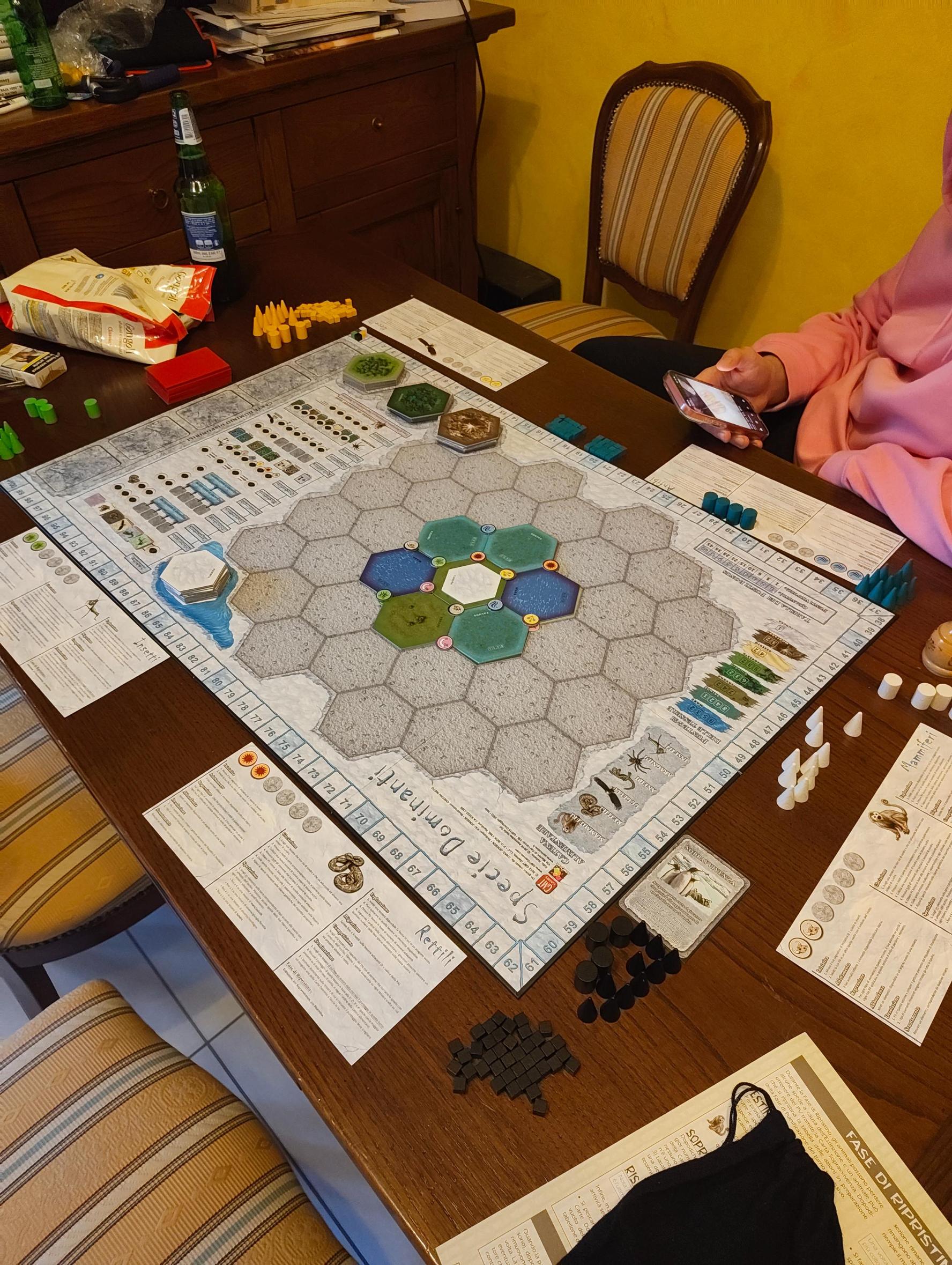
Where to buy it
Shop prices and second-hand copies, checked every day.
On Ludoya's tables
Full stats in Ludoya- 273
- Plays logged
- 488
- Players
- 3h 48m
- Average play
- 120
- In collections
- 20
- On wishlists
7.8/10
from 83 Ludoya reviews
BWizard9.3 [c] (15x) GAMING EXPERIENCE: ★★★★★★★★★★ (5x) DEPTH / WEIGHT: ★★★★★★★★★☆ (5x) LUCK: ★★★★★★★★☆☆ (10x) REPLAYABILITY: ★★★★★★★★★★ (6x) MECHANICS: ★★★★★★★★★★ (6x) PLAYER INTERACTION: ★★★★★★★★★★ (3x) SCALABILITY (PLAYER COUNT): ★★★★★★★☆☆☆ (2x) LENGTH: ★★★★★★★★★☆ (2x) CLARITY OF RULES: ★★★★★★★★☆☆ (6x) COMPONENT QUALITY: ★★★★★★★☆☆☆ [/c] GMT P500 :thumbsup: Probably my favorite workerplacement game. :thumbsup: I made a fully translated (book, cards) version of it. :thumbsdown: A bit too heavy and long for an evening gamenight after work - at least according to my friends. :(
andycted8.4 3-5p AP Feast ! On paper - and right after buying it - this was meant to be one of my favourite games. After a couple of games it became apparent that the rules design is excellent, even original, but the game isn't fun to play to me. Mostly this comes down to the insane amount of things you have to calculate and evaluate before every move. Which would be ok if the evaluation allowed some improvisation or different path, instead it's a pure optimisation of the move. It's not a game that allows quick intuitive moves, it requires a lot of processing... Which makes even non-AP players…well, AP ! Shame because it's an excellent design - but the kick in the teeth for me are the cards - I can't really factor in those too. I love heavy games and I will play this game if the opportunity arises, but for the weight, it feels like a chore to me towards the end (by the way, it's too long!)
Mestremuten8.0 Rating: 5/5 Production value: 2/4 Is the game in my collection/Love to have?: 1/1
Rules questions
Answered from the rulebook by Ludoya's rules assistant.
Do I have to place all my action pawns before any actions resolve, and can I skip actions?
During the Planning Phase players take turns in Initiative order placing APs until everyone has no APs left; once that is done the Execution Phase begins and APs are removed in a fixed top-to-bottom, left-to-right order to perform actions. Actions are voluntary — when your AP is removed you may forfeit that action entirely. (p.9)
How does the Initiative action work — how do I move up the Initiative track and when do I get to place another AP?
When your Initiative AP is removed you swap your initiative marker with the animal directly to your left (unless you are already first), then place the AP you just removed into any vacant eyeball space, effectively making the last AP placement of the turn and improving your turn-order position for the next Planning Phase. (p.10)
How do I count matching elements on a tile, and what makes a species 'endangered'?
To count matching elements, sum the number of occurrences on the tile of your animal's left-most element, then add counts for its second element, third, etc., to get a total match number. A species on a tile that matches exactly zero elements is 'endangered' — endangered species cannot claim dominance and are vulnerable to extinction. (pp.6–7)
Does dominance happen automatically when I match the most elements, or do I have to do something?
Dominance is held by the animal that matches more elements on a tile than any other single animal with presence, but it is not automatic — a player must verbally and physically claim (place a dominance cone) and players are responsible for calling and updating dominance when elements or species change; ties mean no dominance. Endangered species can never claim dominance. (p.7)
When do I move species and when can I eliminate opponents — can birds move two spaces during Migration?
Migration happens after Wanderlust with APs resolved left-to-right; you pick up to X of your species (where X is the eyeball number) and move each to an adjacent tile — birds may move up to two tiles but cannot move over blank hexes. Competition happens after Migration, letting you choose tiles of specified terrain to eliminate one opposing species on each chosen tile; eliminated species are removed from earth and out of play. (p.15)
What exactly happens during Glaciation to tiles, species and elements?
Glaciation converts a non-tundra tile adjacent to tundra into a tundra by placing a tundra tile on top, you remove and set aside all species from that tile then return one species of each animal to the new tundra while the remainder go back to their owners' gene pools, elements surrounded by exactly three tundra tiles are removed, and you score bonus VPs based on adjacent tundra. (p.13)
Similar games






Free, on web, Android and iOS
Play Dominant Species with Ludoya
- Keep it in your collectionTrack your copy and its expansions, lend it to friends, or put it on your wishlist and get told when the price drops.Add it to your collection
- Log every playScores, winners, timers and photos, then your stats: win rate, favourite player count, best score.Log a play
- Settle rules questionsAsk anything about the rules and get an answer from the rulebook, with the page to check it on.Ask the rules assistant
- Find people to play it withClubs, game nights and events near you that bring this game to the table.See events
Game facts (players, playing time, age, credits) from BoardGameGeek.