

2017 · Economic
Notre Dame: 10th Anniversary
Players lead influential families in late 14th-century Paris and vie for prosperity and prestige while managing the welfare of borough residents around the cathedral. Gameplay revolves around hiring character cards and placing influence markers to trigger sector actions across a personal borough, using neighbors’ resources, marketplaces, and action resolution to advance buildings, gain coins and prestige, or shift public health and rat markers. Period-based character abilities introduce varied tactical options, and expansions add additional character effects and a small trade-routes module for extra variability. Scoring measures prestige and reputation; the player with the most prestige at the end of the game wins.
- Players
- 2–5 best 3
- Playing time
- 45–75 min
- Age
- 10+
- Complexity
- 2.5 / 5
About the game
- Design
- Publishers





Photos from Ludoya tables
All photos in Ludoya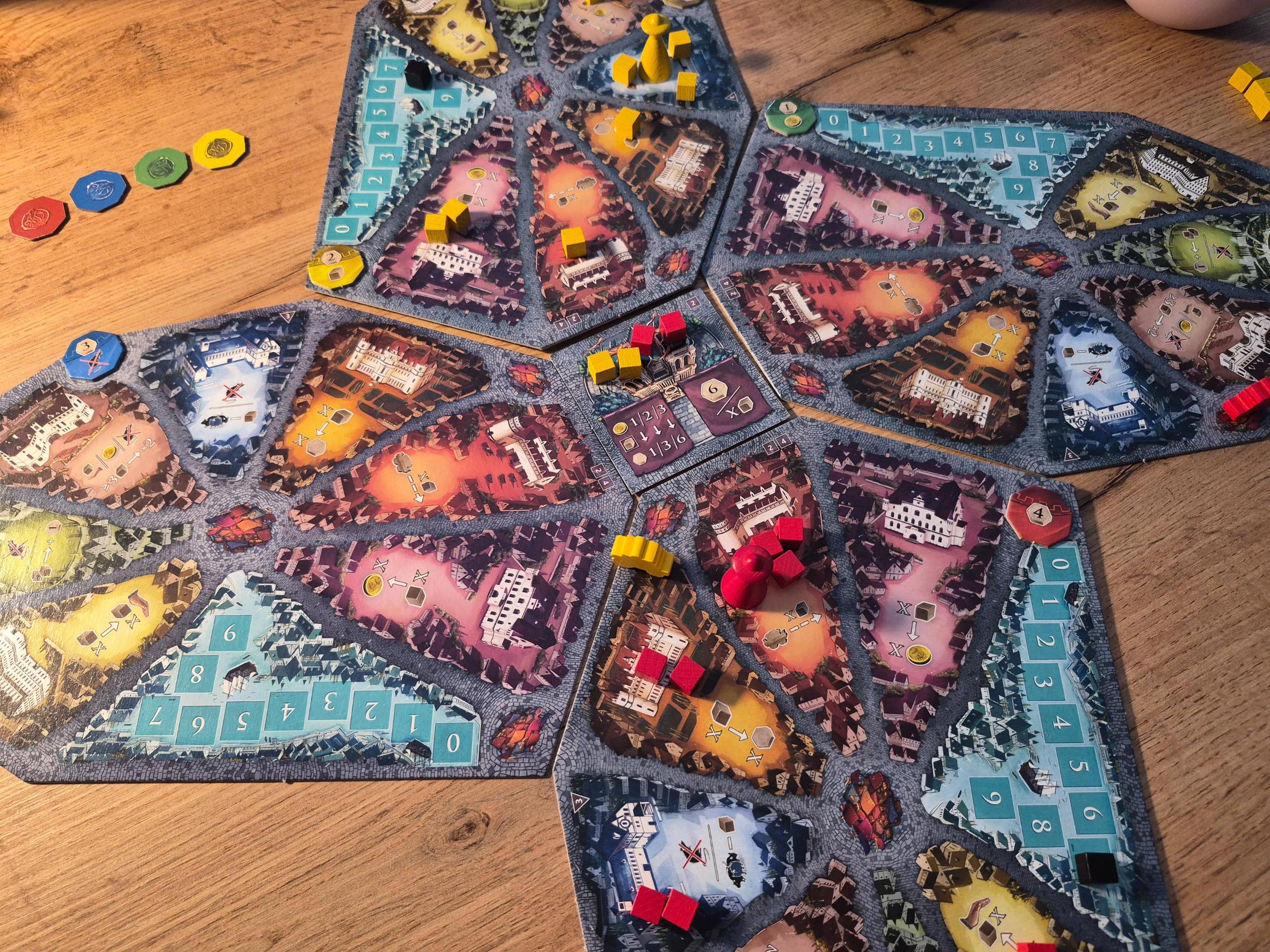
Where to buy it
Shop prices and second-hand copies, checked every day.
On Ludoya's tables
Full stats in Ludoya- 72
- Plays logged
- 129
- Players
- 1h 18m
- Average play
- 57
- In collections
- 1
- On wishlists
6.4/10
from 15 Ludoya reviews
- Base -
Evan4.6 This is a really interesting engine building and drafting game with a ton of player interaction. The idea is that each player gets a symmetrical deck of cards. On their turn they draw three cards from their deck, keep 1 and pass the others, until everyone has a three card hand again. Then each player gets to resolve two of the three cards as actions. The actions build on each other, so all following times you preform action A, Action A gets stronger in it's effect. You do this three times, and at the end of each of these there is a scoring of the center tile. The game has an interesting system where if you don't take actions to prevent rats, then you wind up taking penalties. It's curiously a viable strategy to both invest into rat prevention and ignore rats completely and focus on grabbing as many points as possible and just eating the penalties. Since each player only gets one card per age that allows them to place a cube into the center scoring area, these cards tend to not get passed, which can make the center scoring a little anti-climactic. ★ Art, Iconography and components functional ★ Clever or interesting mechanisms ★ Reasonably low downtime between turns with mildly AP players ☆ Multiple plays stay interesting ★ Low or mitigatable luck elements ★★★☆☆ Raw enjoyment

Rules questions
Answered from the rulebook by Ludoya's rules assistant.
When do I discard action cards — do I discard before hiring persons, and what happens to the third card I don't use?
You play and resolve two action cards in Phase 3 and then discard the cards you played to the common discard stack; the third card is not executed and is simply discarded (placed hidden under your second card) — then you proceed to Phase 4 to hire a person (see page 3).
How is the plague value calculated and how do hospital/park/Doctor effects change my rat movement?
The plague value is the sum of the rats on the three person cards for the round, and each player moves their rat marker that many spaces adjusted by reductions; influence markers (and the trusted friend) in your hospital subtract from that movement, the Park/Hospital actions each move your rat one space back when executed, and hiring the Doctor reduces the plague value to 0 for you that round (pages 7, 6, and 9).
What happens if my rat marker would move past space 9 on the plague track?
If it would move past space 9 you stop on space 9, immediately return 2 prestige points to the supply, and remove one influence marker from the sector with your most markers (the trusted friend counts for determining that sector but may not be removed) (page 8).
How are prestige points from Notre Dame distributed at the end of a period and what happens to those markers?
At the end of each period the number shown on Notre Dame (6/8/10/12) is divided equally among all influence markers on Notre Dame (divide and round down), each player takes that amount per marker, and then all influence markers on Notre Dame are returned to the general supply (page 7).
If I have no influence markers in my personal supply, can I still execute an action that requires placing one?
Yes; if you have no markers in your personal supply you may move an influence marker (not your trusted friend) from another sector or from Notre Dame to the sector for the executed action so you can perform it — you may not take markers from the general supply (page 7).










Free, on web, Android and iOS
Play Notre Dame: 10th Anniversary with Ludoya
- Keep it in your collectionTrack your copy and its expansions, lend it to friends, or put it on your wishlist and get told when the price drops.Add it to your collection
- Log every playScores, winners, timers and photos, then your stats: win rate, favourite player count, best score.Log a play
- Settle rules questionsAsk anything about the rules and get an answer from the rulebook, with the page to check it on.Ask the rules assistant
- Find people to play it withClubs, game nights and events near you that bring this game to the table.See events
Game facts (players, playing time, age, credits) from BoardGameGeek.