

2018 · Tudományos-fantasztika
New Frontiers
Players build competing galactic empires by selecting a shared action each round that everyone may take while only the selector gains a bonus for choosing it. Setup determines which developments are available, letting players plan strategies around a mix of fixed and randomly selected small and large developments. Worlds are drawn from a bag during the Explore phase and must be settled with colonists, sometimes requiring payment or conquest. Settled worlds and developments provide special powers, goods, or immediate windfall benefits. Goods are produced, traded for credits, or consumed for victory points, and play ends when one of several game-ending conditions is met; the highest victory point total wins.
- Játékosok
- 2–5 legjobb: 4
- Játékidő
- 45–75 perc
- Kor
- 14+
- Bonyolultság
- 3 / 5
A játékról
- Tervezés
- Publisher




Kiegészítők
Nézd meg őket a Ludoyában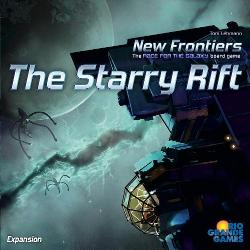
Hol vásárolhatod meg
Bolti árak és használt példányok, naponta ellenőrizve.
A Ludoya asztalain
Teljes statisztika a Ludoyában- 87
- Rögzített játszmák
- 123
- Játékosok
- 1h 17m
- Átlagos játékidő
- 26
- Gyűjteményekben
- 11
- Kívánságlistákon
6,5/10
17 Ludoya-értékelés alapján
Balleflass6,0 Very cool economic action selection game like Race/Roll for the Galaxy. Every possible tech is displayed from the start which takes a few minutes for every player to get an overview of. After that, it's smooth sailing. Low downtime because everyone takes part of every action selected by every player. The trick here is to choose the right tech, right planets and try to exploit the various orders the actions gets selected.
Evan4,6 This is a quick playing role selection game where one player picks a tile, then each player follows and does the same action, and then the player who chose the action gets some special benefit. You draw planet tiles, adding them to your board, activate those tiles by placing meeples on them, use those tiles to produce cubes, then sell those cubes for points, and you buy technology tiles that improve your engine in various ways. The game is much smoother to play than it's design cousins of Race for the Galaxy and Roll for the Galaxy. There's nothing really new here, but what's here is smooth and refined. I like how the tiles have both iconography and text, so it's clear what things do when you draw them, and then as the game goes on you get used to the icons and can tell what your things do at a glance. ★ Art, Iconography and components functional ★ Clever or interesting mechanisms ★ Reasonably low downtime between turns with mildly AP players ★ Multiple plays stay interesting ★ Low or mitigatable luck elements ★☆☆☆☆ Raw enjoyment
Szabálykérdések
A Ludoya szabályasszisztense válaszol a szabálykönyv alapján.
How does action selection and the priority track work — who goes first when an action is resolved?
The selecting player chooses an action tile and moves their turn disk partway; then players resolve that action in priority-track order starting with the selecting player (who also gets the selecting bonus), wrapping around the track as needed — not in clockwise order (p.3).
When I Explore, do explored worlds count toward my limit and where do I place them?
Draw seven, each player picks one in priority order and the selecting player then takes a second; place explored (gray-side) worlds on the right end of your mat, they count toward your maximum of nine total explored+settled worlds, and their powers are inactive until you settle them (p.5).
When I settle a world can I pay part with Military and part with credits?
No — to settle you must have the listed colonists and either pay the world's credit cost (non‑military) or have Military equal/greater than its defense (military); you may not combine Military and payments (p.6).
What happens if Produce wasn't selected in previous rounds — how does production work?
If Produce wasn't selected in prior rounds, it accumulates credits; the selecting player collects those credits, then every production colony without a good gets a matching good and the selector also produces a good on one windfall colony if possible; at round end add 1 credit to Produce if it wasn't selected (p.7).
Do I have to consume goods when I do the Trade/Consume action, or can I keep them?
Selling one good (Trade) is optional, but if you have Consume powers and goods you must use each applicable Consume power — in any order — until you've used them all or have no applicable goods left; some Consume powers are explicitly optional (p.8).
Is there a limit to how many credits I can have or can I give credits to other players?
There is no limit to how many credit chips a player may hold (credits are public information), and players may not give away or exchange credits (or tiles, goods, colonists, or VP) with each other (p.10).




Akiknek megvan, ezeket is birtokolják





Ingyenes, weben, Androidon és iOS-en
Játszd a(z) New Frontiers játékot a Ludoyával
- Tartsd a gyűjteményedbenKövesd a példányodat és a kiegészítőit, add kölcsön a barátaidnak, vagy tedd fel a kívánságlistádra, és szólunk, ha csökken az ára.Add hozzá a gyűjteményedhez
- Rögzíts minden játszmátPontok, győztesek, időzítők és fotók, aztán a statisztikáid: győzelmi arány, kedvenc játékosszám, legjobb pontszám.Játszma rögzítése
- Döntsd el a szabályvitákatKérdezz bármit a szabályokról, és választ kapsz a szabálykönyvből, az oldallal együtt, ahol ellenőrizheted.Kérdezd a szabályasszisztenst
- Találj játszótársakat hozzáKlubok, játékestek és események a közeledben, ahol ez a játék asztalra kerül.Események megtekintése
Játékadatok (játékosok, játékidő, kor, alkotók) forrása: BoardGameGeek.