
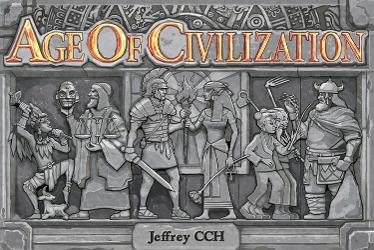
2019 · Starożytność
Era Cywilizacji
Gracze prowadzą niewielką cywilizację przez sześć rund, przydzielając robotników do badań nad technologiami, budowy cudów, handlu z innymi oraz rozwijania kultury lub potęgi militarnej. W trakcie rozgrywki każdy gracz kontroluje maksymalnie trzy historyczne cywilizacje: zaczyna z jedną, a następnie decyduje, kiedy ją wznieść, zaanektować lub zmienić główną cywilizację, aby odnowić siłę roboczą albo zyskać zdolności dziedzictwa. Moment i kombinacja wyboru cywilizacji kształtują decyzje strategiczne. Tury koncentrują się na przydzielaniu robotników i zarządzaniu zasobami, gdy gracze równoważą ekspansję, postęp technologiczny i możliwości zdobywania punktów w tej usprawnionej rozgrywce o budowaniu imperium.
- Gracze
- 1–4 najlepiej w 3
- Czas gry
- 30–60 min
- Wiek
- 10+
- Złożoność
- 2,3 / 5
O grze
- Projekt
- Grafika
- Wydawca


Gdzie kupić
Ceny w sklepach i egzemplarze z drugiej ręki, sprawdzane codziennie.
Przy stołach Ludoya
Pełne statystyki w Ludoya- 59
- Zapisane rozgrywki
- 76
- Gracze
- 31m 56s
- Średnia rozgrywka
- 23
- W kolekcjach
- 4
- Na listach życzeń
6,2/10
z 13 recenzji w Ludoya
Sup7,0 KS Avril 2020
Pierwsze wrażenia · 1 rozgrywka
Simple, small-sized worker-placement game. Haven't played the KS mini-expansions. PROS - Easy to understand and teach. - Nice introductory game to the worker-placement genre. One (big) step ahead from Mint Works. - The random setup grants different games, and there are tons of content to increase its replayability. - It's a pretty short, fast game. CONS - It's supposed to feel like a civilizations game, but it just doesn't. Not enough development for that. - The differences between games are not that big, mainly because of how short the games are and how limited the development feels. - In the same way, the combos are not flashy and their reach is narrow.
Zagrane 3 razy


Pytania o zasady
Odpowiedzi z instrukcji od asystenta zasad Ludoya.
Can I use any action card that’s showing, or only certain ones each round?
Only Wonder, Research, and Exploit are always available; the three action cards beneath them are also available that round. Other action cards can’t be assigned workers until they become available (p. 10).
Do my workers come back after I use them?
Workers on white action slots return to you at the end of your turn, as do unassigned workers. Workers on red slots are sacrificed and returned to the supply; for example, Wonder and Exploit require a sacrificed worker (pp. 12, 17).
When I rise a new civilization, do I keep my old abilities and workers?
Your old civilization’s main ability stops working, but its legacy ability remains active. You return all your workers to the supply and take the number shown for the new civilization’s population (pp. 14–15).
What happens if I annex a civilization instead of rising one?
Your main civilization and its main ability stay the same, and you gain the annexed civilization’s legacy ability. You don’t reset your workers, but gain one if you have fewer than four (p. 15).
If I rest, can I still take an action, and how many workers can I have?
Rest means taking no actions and assigning no workers; you immediately gain 2 coins and 1 worker. You can have at most 4 workers at a time (p. 11).
Do I have to assign all my workers to actions?
No. You may leave workers unassigned, and they return to you at the end of your turn (pp. 11–12).



Kto ma tę grę, ma też
 In Vino Morte2016
 Victus: El joc de cartes – Barcelona 17142014
 Demon Worker2016
 Condottiere2007
 Przepowiednia: Kto złamie starożytną klątwę?2018
 Alien Frontiers2010
 Blitzkrieg!: World War Two in 20 Minutes2019
 13 Minutes: The Cuban Missile Crisis, 19622017
 Blueprints2017
 O mój Zboże!2016
 Catacombs (Third Edition)2015
 Manila2005
Za darmo, w przeglądarce, na Androidzie i iOS
Graj w Era Cywilizacji z Ludoya
- Miej ją w swojej kolekcjiŚledź swój egzemplarz i jego dodatki, pożyczaj go znajomym albo dodaj go do listy życzeń i dostań powiadomienie, gdy cena spadnie.Dodaj do swojej kolekcji
- Zapisuj każdą rozgrywkęPunkty, zwycięzcy, minutniki i zdjęcia, a potem twoje statystyki: procent zwycięstw, ulubiona liczba graczy, najlepszy wynik.Zapisz rozgrywkę
- Rozstrzygaj spory o zasadyZapytaj o dowolną zasadę i dostań odpowiedź z instrukcji, ze stroną do sprawdzenia.Zapytaj asystenta zasad
- Znajdź ludzi do wspólnej gryKluby, wieczory gier i wydarzenia w pobliżu, na których ta gra trafia na stół.Zobacz wydarzenia
Dane gry (gracze, czas gry, wiek, twórcy) z BoardGameGeek.