
2022 · Fantezie
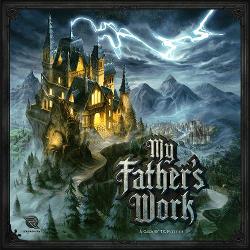
My Father's Work
Players take the role of rival scientists who inherit a lab, a journal page, and an estate, then pursue decades-spanning research across three generations. On each turn they allocate time between studying the journal, conducting experiments, upgrading rooms and tools, and interacting with the town to gain resources or reputation. Experiments and upgrades score points but most active progress is lost between generations, so players must decide what knowledge to pass on and what to attempt in a single lifetime. The game balances engine-building, resource management, and risk from public backlash and madness, with scoring based on completed experiments, estate improvements, and legacy carried into the next generation.
- Jucători
- 2–4 ideal 3
- Timp de joc
- 180 min
- Vârstă
- 14+
- Complexitate
- 3,1 / 5
Despre joc
- Design
- Publisher




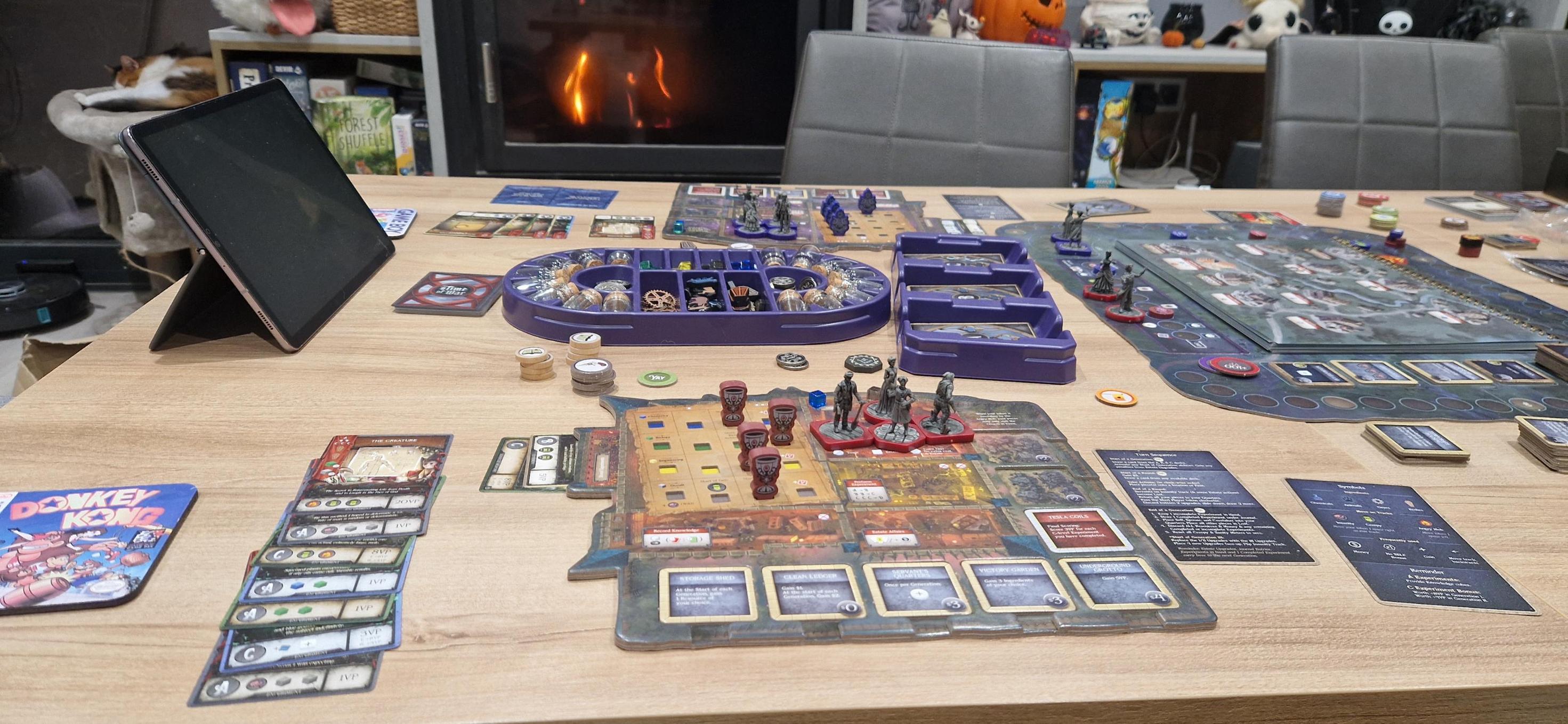
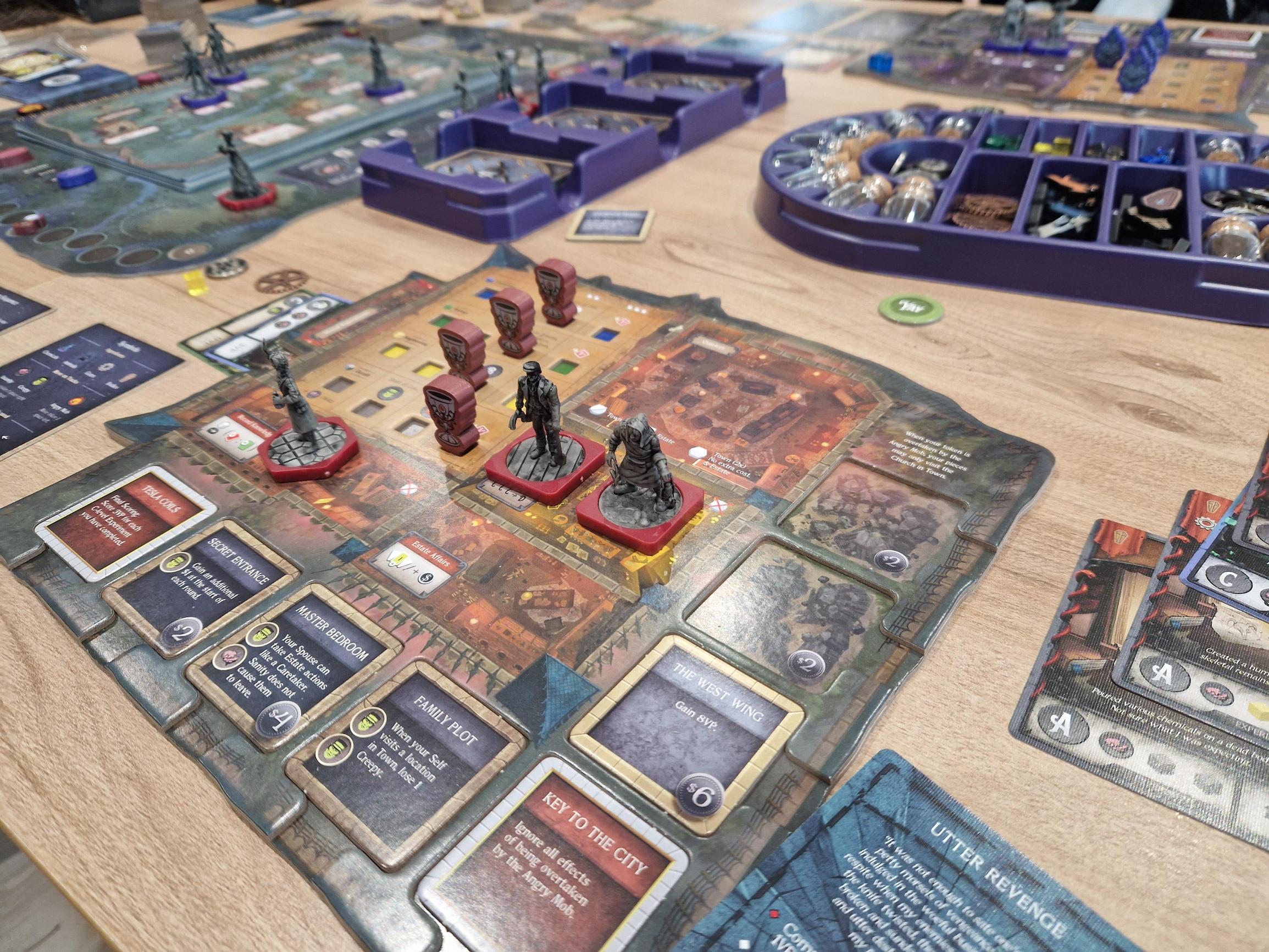
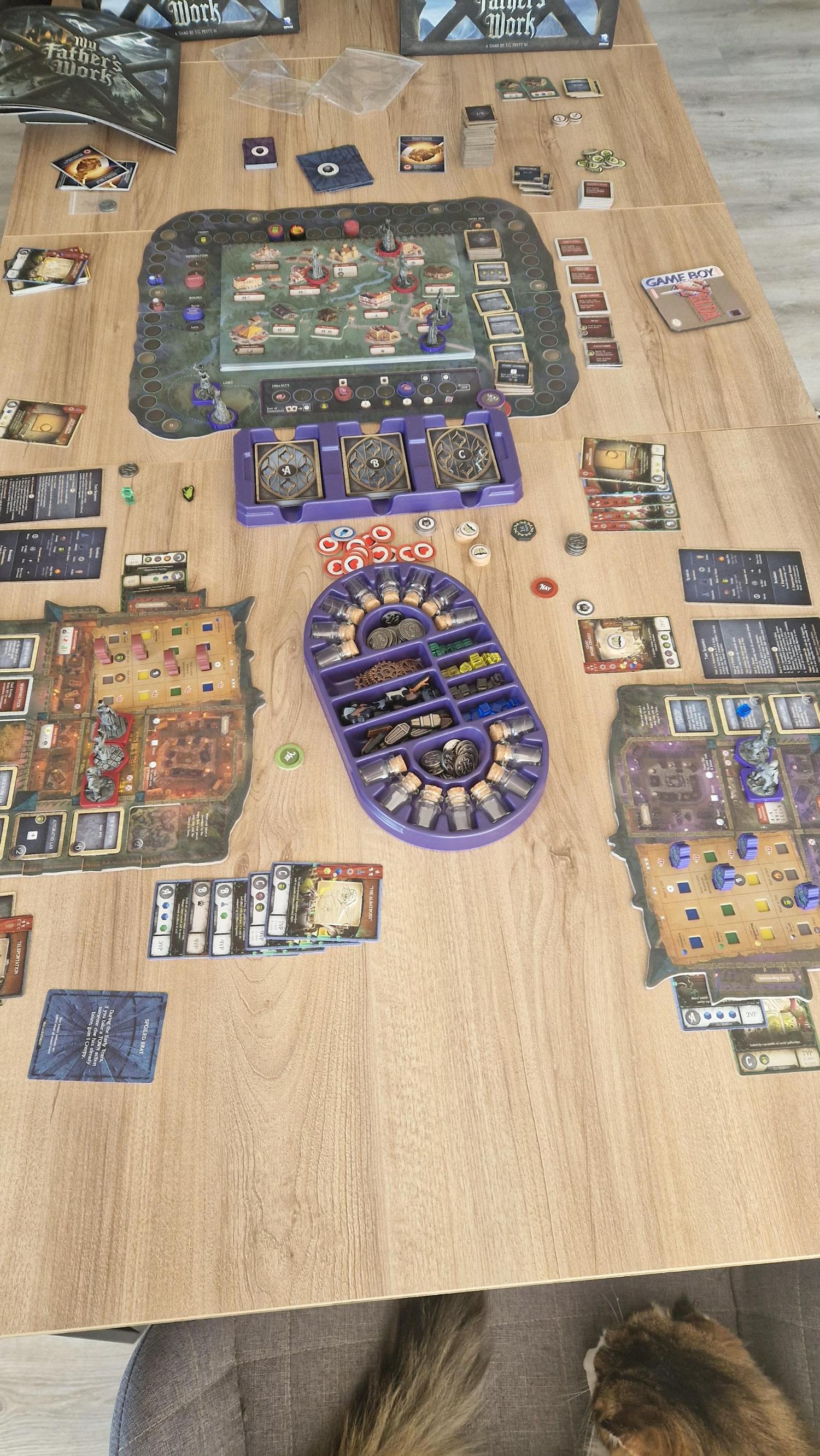
Fotografii de la mesele Ludoya
Toate fotografiile în Ludoya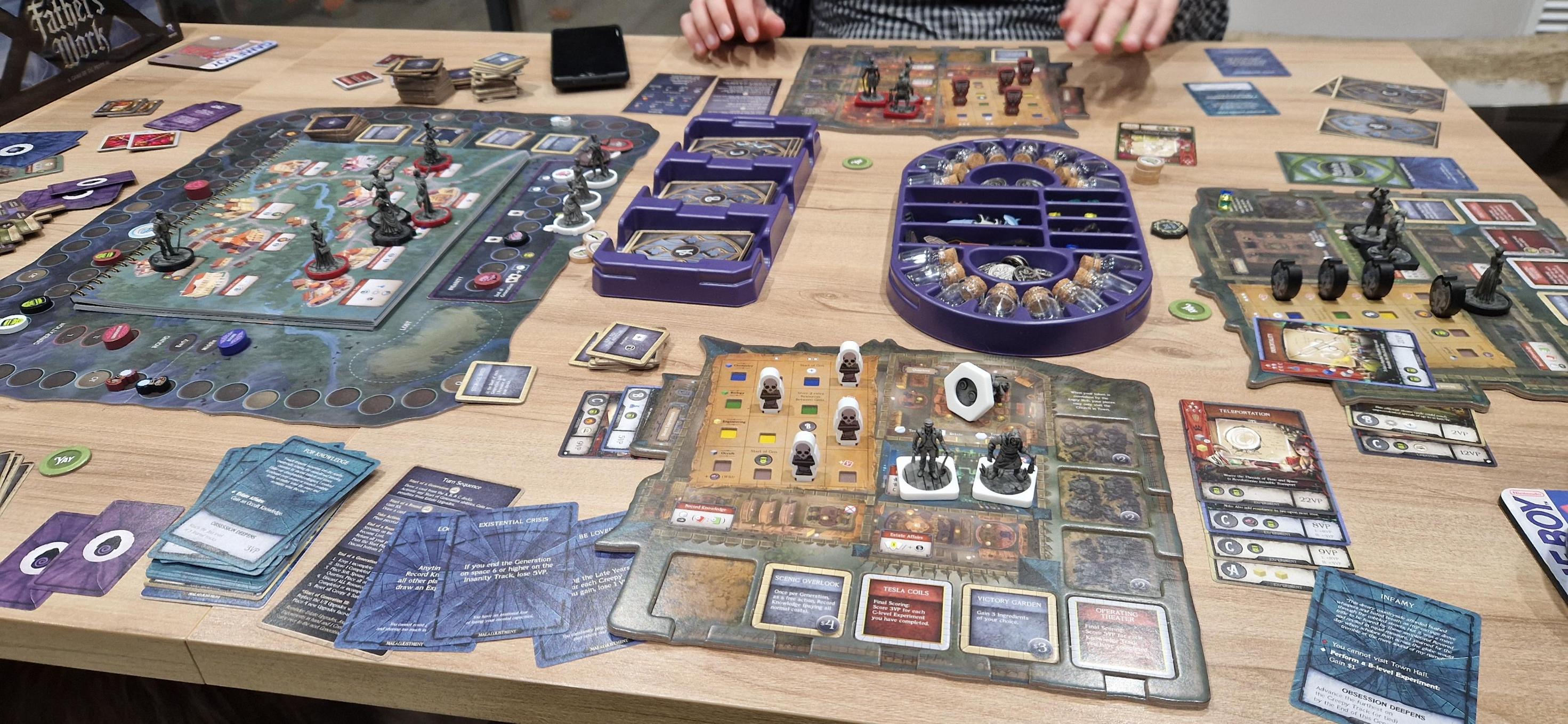
De unde îl cumperi
Prețuri din magazine și exemplare la mâna a doua, verificate zilnic.
La mesele Ludoya
Toate statisticile în Ludoya- 35
- Partide înregistrate
- 61
- Jucători
- 3h 31m
- Durată medie
- 36
- În colecții
- 15
- Pe listele de dorințe
7,6/10
din 9 recenzii Ludoya
Shnizz5,9 Neat ideas, top notch production, very tight Euro style gameplay. Reminded me of trickerion (gameplay) and charterstone (legacy elements) . Could score much higher, if it was less random.
Întrebări despre reguli
Răspunsuri din regulament de la asistentul de reguli Ludoya.
If a Town location already has pieces on it, do I have to pay $1 for each piece I place there?
No — if a Town Location already contains any player's pieces you pay a single $1 to the supply as an added cost, regardless of how many pieces are already there or how many you place at once (pg. 11).
Does my Self always let me do a Town action twice and avoid the $1 crowd penalty?
Usually yes — the Self performs the Town action twice and avoids the $1 occupied-location cost, but Locations marked with the No Self Bonus symbol (x1) only allow the Self to perform that ability once; penalties from a Location are only applied once per turn (pgs. 12–13).
If I use Servants on Record Knowledge or to perform an Experiment, do those Servants return to my Quarters at round end?
No — Servants assigned to Record Knowledge (and both Servants used to Perform an Experiment) are returned to Lost at the end of the round rather than back to your Quarters (pg. 12; end-of-round steps on pg. 22).
How does Occult Knowledge work — can it be used as other knowledge and does it make me go insane?
Occult Knowledge is wild and may substitute for any Knowledge type during an Experiment, but each Occult cube you use in an Experiment forces you to move one space on the Insanity Track; collecting or recording Occult Knowledge does not cause Insanity (pgs. 20, 18).
What do the Journal Track 'free Knowledge' and level abilities actually do, and can I use that free Knowledge to advance the Journal?
Each space you advance on a Journal Track grants a permanent free Knowledge of that type usable only toward Experiment costs (not to pay for advancing Journal Tracks), and reaching later spaces grants the listed permanent abilities (pg. 18).
What carries over between Generations and what gets discarded at the Generation end?
At the end of a Generation you keep your Journal progress, Stored Experiments, Estate Upgrades, and one Experiment card in hand, but discard all Resources and money and place most pieces on Lost (pg. 23); follow the full End‑of‑Generation checklist on page 23 for details and timing (also see end-of-round steps on pg. 22).
Jocuri similare
 Abomination: The Heir of Frankenstein2019
 Grimcoven2025
 Lands of Evershade2026
 Outlive2017
 Tainted Grail: Kings of Ruin2024
 Manhattan Project: Energy Empire2025
 Arydia: The Paths We Dare Tread2025
 Folklore: The Affliction2017
 Wondrous Creatures2024
 Andromeda's Edge: Deluxe Edition2024
 Andromeda's Edge2024
 Bureau of Investigation: Investigations in Arkham & Elsewhere2022
Cei care îl au mai au și


Gratuit, pe web, Android și iOS
Joacă My Father's Work cu Ludoya
- Păstrează-l în colecția taȚine evidența exemplarului tău și a extensiilor lui, împrumută-l prietenilor sau pune-l pe lista de dorințe și află când scade prețul.Adaugă-l în colecția ta
- Înregistrează fiecare partidăPuncte, câștigători, cronometre și fotografii, apoi statisticile tale: rata de câștig, numărul preferat de jucători, cel mai bun scor.Înregistrează o partidă
- Lămurește întrebările despre reguliÎntreabă orice despre reguli și primești un răspuns din regulament, cu pagina unde îl poți verifica.Întreabă asistentul de reguli
- Găsește oameni cu care să-l jociCluburi, seri de jocuri și evenimente de lângă tine unde se joacă acest joc.Vezi evenimentele
Datele jocului (jucători, durată, vârstă, autori) de pe BoardGameGeek.