
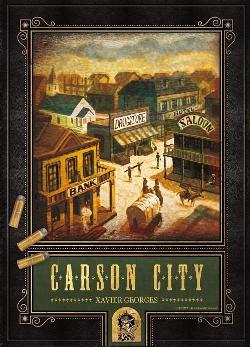
2009 · Bybyggeri
Carson City
Players draft one of seven character roles each round and deploy cowboys to action spaces to build structures, settle plots, or improve roads. Actions include claiming terrain, constructing buildings and houses, hiring pistols (hired help), collecting money, and triggering duels when multiple cowboys occupy the same location. Resolution of conflicts uses dice to determine outcomes, and players score points for controlled plots, buildings, mountains, hired help, and accumulated money. The game runs four rounds and combines worker placement, area control, and tactical combat to determine the highest-scoring player.
- Spillere
- 2–5 bedst 4
- Spilletid
- 90 min
- Alder
- 12+
- Kompleksitet
- 3,2 / 5
Om spillet
- Design
- Illustration
- Publisher



Udvidelser
Se dem i Ludoya Carson City: Gold & Guns2012
 Carson City: A New Beginning2010
 Carson City: The Lawyer / Editor2015
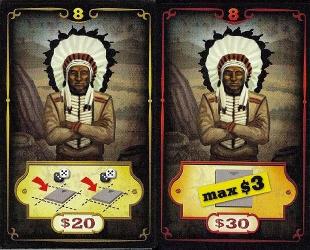 Carson City: The Indian2009
 Carson City: Horses & Heroes2015
 Carson City: Father Christmas Promo Card2018
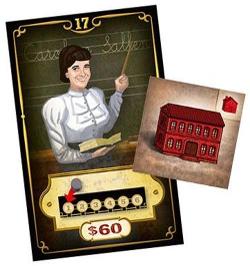 Carson City: The Teacher & Town Hall2015
 Brettspiel Adventskalender 20182018
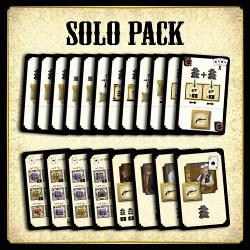 Carson City: Solo Pack2024
Fotos fra Ludoyas borde
Alle fotos i Ludoya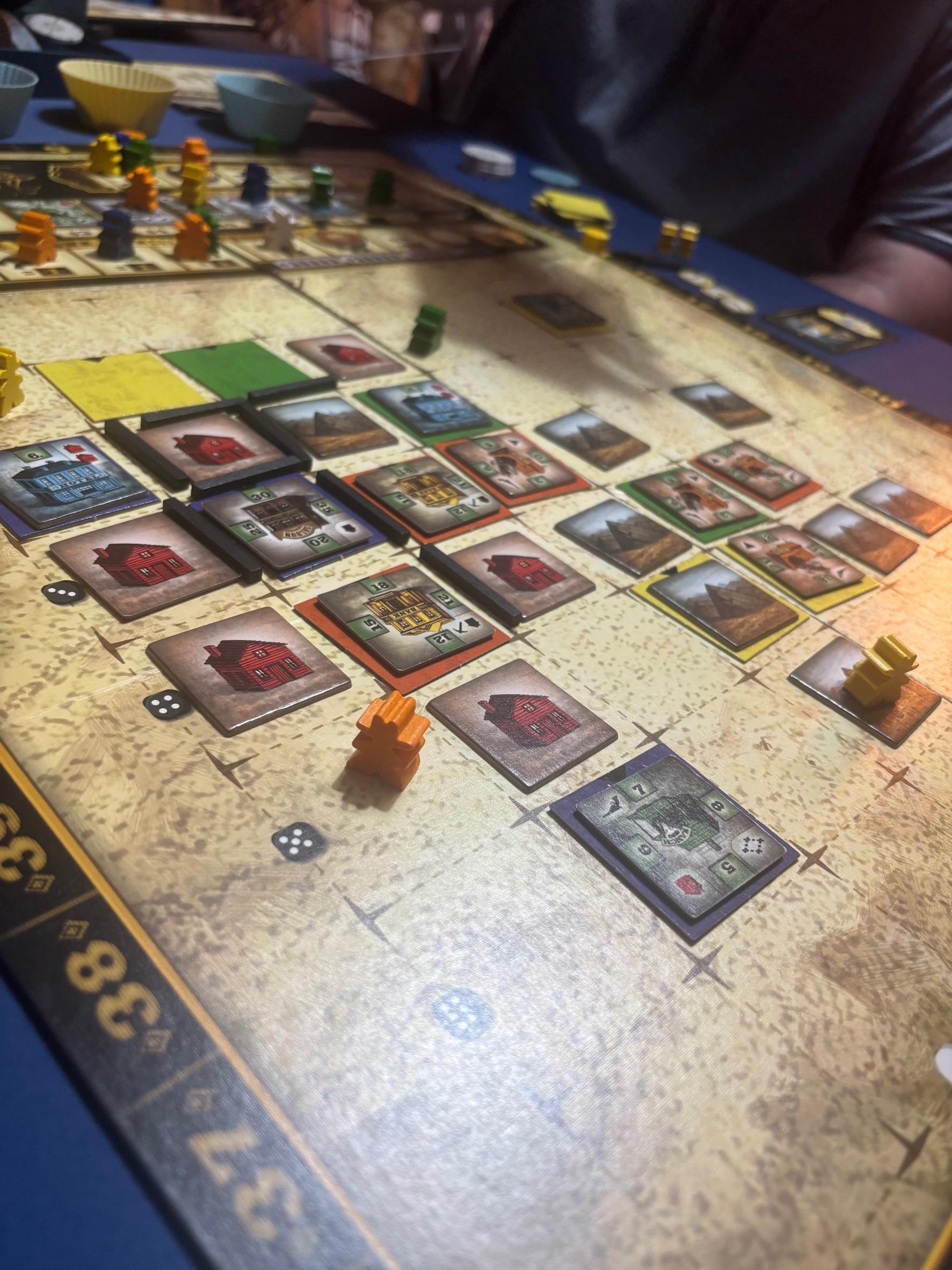
Hvor du kan købe det
Butikspriser og brugte eksemplarer, tjekket hver dag.
På Ludoyas borde
Al statistik i Ludoya- 202
- Registrerede partier
- 254
- Spillere
- 1h 55m
- Gennemsnitligt parti
- 26
- I samlinger
- 18
- På ønskelister
6,4/10
fra 43 anmeldelser på Ludoya
Evan4,6 This is a curious western themed worker placement game. The game features a method of action blocking where you can place your meeple in a spot someone else has claimed to have a duel with them right before resolution for the right to execute that spot. You can also place your meeples on other player's buildings to take half of that buildings production until they duel you off. The duel consists of adding up unspent guys plus gun tokens and then rolling a D6. This can feel a little random at times, but it's mitigatable randomness by focusing on getting more gun tokens. The loser of a duel gets the worker back to place again in the next round, whereas normally spent workers are lost. The worker being returned to the player, also means they get 1 extra firepower if they have another duel that round. I like a lot about this game. I love how the city expands. I like that when you build most buildings you need to place a red house token somewhere legal for it to be, which both serves to fill up the map awkwardly, but also gives players big scoring opportunities when they place buildings that want to be adjacent to houses. I like the mitigatable action blocking, although the D6 thing is a little troublesome. I also like how players can sort of hinder the leader by blocking their scoring action or by taking some of their money for themselves. Here are my problems with the game... With 3 players the game is too loose. The board grows too slowly and the action spaces feel empty. With 6 players the game is far far too tight, with few to no actions you can take other than start a duel if you aren't going very early in turn order. The Train station building from the expansion seems to be worth way too many points. I'm not sure why the job that gives you the unduelable worker goes first (or second if playing with the 0 guy) in turn order. This seems like a doubly strong ability, as you can't place the unduelable worker in a space to start a duel. The iconography on the building tiles is pretty poor. The buildings require you to read a passage in the rulebook every time a new type of one flips, and they can be hard to remember in the face of remembering all the other rules. In the second expansion they use one of the same icons from the base game to have a different meaning, which is really troublesome. The biggest problem with the game is the endgame scoring. Throughout the game there are action spots available that let you covert dollars into points at different ratios. In each of the 4 rounds, the next best conversion spot disappears. Based on the character ability tile you select, you have a different ability to hold money between rounds. Any money you can't hold and didn't spend gets turned into points at a 10:1 rate, as opposed to 2/3/4/5:1 rate. All of these conversion spots are duel-able, which means taking the spot doesn't mean that you'll necessarily get to resolve it. The only sure way to convert dollars to points is at the end of the game, you discard down to your dollars held limit at that 10:1 rate, and then you can convert the remaining money at 6:1, which isn't bad, but it is bad when you look at how different the money held skills are. Several guys in the base setup only can hold $20, whereas one can hold over $100. For me, this makes scoring a frustrating experience. :nostar: Art and components :star: Innovative mechanics :star: Handles 5 or more players :nostar: Good with different player counts :star: Low time between turns :star: Comfortable complexity :star: Re-playability :star::nostar::nostar: Enjoyment
Mestremuten7,0 Rating: 3/5 Production value: 4/4 Is the game in my collection/Love to have?: 0/1
Carlos8,0 Mucha interacción y tiempo de duración bien acotado.

Regelspørgsmål
Besvaret ud fra regelbogen af Ludoyas regelassistent.
Can I place a cowboy on an action or parcel that's already occupied? What happens then?
Yes — you may place a cowboy on a square or parcel already occupied; that triggers a duel in which each involved player rolls a die and adds their firepower (cowboys + revolvers in reserve); the highest total wins the right to perform the action and losers return their cowboy to their personal reserve (tie broken by lower turn-order number). (p. 3)
Are there action spaces where multiple cowboys can be placed without a duel?
Yes — some squares explicitly allow multiple cowboys without a duel: Wages gives $4 per cowboy on the square, and one Roads square gives one road per cowboy on it; other action squares follow the board's sequence and duel rules. (pp. 3–4)
Do I need a road to build on a parcel? Any exceptions or extra requirements?
Generally a parcel must be reached by a road (at least one road touching a corner) to build, and many buildings also force you to place a house on a free road-reached parcel; exceptions: ranches and mines do not need a road. You may also buy a building and keep it in front of you to place later (see timing rules). (pp. 4, 6)
What happens if I finish the turn with more cash than my personality's cash limit?
Any money above your personality's cash limit must be spent; for every $10 you must spend you receive 1 victory point (you may spend more money voluntarily and still get 1 VP per $10). Each personality card shows its cash limit. (pp. 3, 7)
Do houses that belong to other players (or owner-free houses) count toward my building incomes?
An owner-free house increases neighbouring buildings' values for everyone, but a house built on a parcel belonging to a player only benefits that player's buildings (the same distinction applies to mountains/mines). (p. 5)
Can I attack a church or a prison, or attack buildings next to someone else's church?
No — you may not attack a church or a prison; furthermore a church prevents attacks on all directly adjacent buildings of its owner, and building a church next to a building being attacked cancels that attack. (p. 6)




Gratis, på web, Android og iOS
Spil Carson City med Ludoya
- Hav det i din samlingHold styr på dit eksemplar og dets udvidelser, lån det ud til venner, eller sæt det på din ønskeliste, og få besked, når prisen falder.Føj det til din samling
- Registrér hvert partiPoint, vindere, timere og fotos, og så din statistik: vinderprocent, foretrukket spillerantal, bedste score.Registrér et parti
- Afgør regelspørgsmålSpørg om hvad som helst i reglerne, og få et svar fra regelbogen med siden, hvor du kan tjekke det.Spørg regelassistenten
- Find nogen at spille det medKlubber, spilaftener og arrangementer nær dig, hvor dette spil kommer på bordet.Se arrangementer
Spilfakta (spillere, spilletid, alder, medvirkende) fra BoardGameGeek.