
2003 · Økonomisk
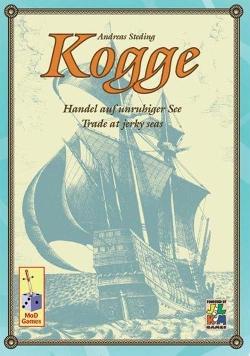
Kogge
Navigate shifting Baltic Sea trade routes, trade goods between cities, and establish trade houses while storms, pirates, tolls, and other hazards disrupt merchant voyages.
- Spillere
- 2–4 bedst 4
- Spilletid
- 90 min
- Alder
- 10+
- Kompleksitet
- 3,4 / 5
Om spillet
- Design
- Illustration

Udvidelser
Se dem i Ludoya
På Ludoyas borde
Al statistik i Ludoya- 4
- Registrerede partier
- 6
- Spillere
- 1h 38m
- Gennemsnitligt parti
- 1
- I samlinger
- 3
- På ønskelister
4,6/10
fra 1 anmeldelse på Ludoya
Evan4,6 I really had to admit this to myself, let alone anywhere else, but this game is just too complicated for me to enjoy. I really love [Hansa Teutonica](/g/hansa-teutonica), [Firenze](/g/firenze) and [The Staufer Dynasty](/g/the-staufer-dynasty). I wish I could love this too. There's absolutely something wonderful here, but after 2 plays I have to admit to myself that I'm never going to be able to get an intuitive sense of how to play this game smoothly. Essentially, the game revolves around the concept that there are different ports, which each have a number associated with them, and a type of goods they produce. Ports want other types of goods, so in a typical way, you sail around the board delivering goods of other colors to the ports. Here's where things get nuts. Each port has two slots. In each slot, a route token gets placed. The route tokens have numbers matching the city to which that route leads. One of the player actions is to swap a route token from the board with one from their hand, but the one they place down gets added face down, so only that player knows where it goes. Other players can still choose to use it for movement, but they can only guess where it leads. The route tokens are also used for other things. You need 1 or 2 of them matching the city you are in to build a house in that city. Not only that, you have to use them each round to bid with, in order to get a good turn order number, which is what will let you get more good route tokens from the display, and which is what will let you carry out your plans before someone else beats you to the city with all the juicy goods. Even the goods are incredibly tight. When you reach a city you can trade with that city, so for every good you give the city, you can get 2 goods that don't match the good you sold. Each city only produces one type of good, AND they only generate NEW goods when a player used route markers matching that city as part of their turn order bid! Not only that the goods are needed in large sets of 6 to unlock new abilities and goods are needed in different colored sets to construct houses in addition to discarding the route markers matching the city. This game DEMANDS you plan several turns in advance, and then throws a lot of things at you that might disrupt your plans. For my brain, the things it throws are just one too many, and I can tell you which specific one that I think takes this from a game I'm compelled to master to a game that I don't want to bother with anymore. That one is the raid action. If you are in a city with another player you can drop your raid token in that city, (which at most, you only ever get 2 of, but with 4 players, that's still a lot of potential raiding). When you do this the target player divides their goods into 2 groups, and you choose and take one of those groups. There are detriments to doing this. The attacking player loses 10 points per raid token they used, if the game comes down to points in the end (there are 2 victory conditions). The attacking player also may never visit that city again, which can be trouble. It also accelerates the game clock. That being said, when a game that demands you plan as much as this one does incorporates a way for players to directly ruin the process of a single player like that, it feels just a little too harsh. I don't mind this sort of mechanism in a lighter, more tactical game. It's just here, where you need to be keeping track of so many ever-shifting elements, it just feels bad. Now, I understand the reason for this. The goods are available in different quantities, and are limited. The designer needed a way to prevent one player from grabbing up all of one type of good, and holding it, thereby making it impossible for anyone to build new houses. I see the need for some mechanism to solve this, but it doesn't change the fact that when you lose up to three very carefully planned turns of setup to a take-that punch that undoes all your work, it feels bad on the game, or at least, this pvp combat is the one-too-many variable factors that can get in the way of your plans, that makes this game feel too complicated for me. If it was easier to line up a good move, I might not mind this. :star: Art, Iconography and components functional :star: Clever or interesting mechanisms :nostar: Reasonably low downtime between turns with mildly AP players :star: Multiple plays stay interesting :star: Low or mitigatable luck elements :star::star::nostar::nostar::nostar: Raw enjoyment
Gratis, på web, Android og iOS
Spil Kogge med Ludoya
- Hav det i din samlingHold styr på dit eksemplar og dets udvidelser, lån det ud til venner, eller sæt det på din ønskeliste, og få besked, når prisen falder.Føj det til din samling
- Registrér hvert partiPoint, vindere, timere og fotos, og så din statistik: vinderprocent, foretrukket spillerantal, bedste score.Registrér et parti
- Hold score uden papirBrug fællesskabets scoringsark og spilhjælpere, og lad Ludoya lægge pointene sammen.Find scoringsark
- Find nogen at spille det medKlubber, spilaftener og arrangementer nær dig, hvor dette spil kommer på bordet.Se arrangementer
Spilfakta (spillere, spilletid, alder, medvirkende) fra BoardGameGeek.