
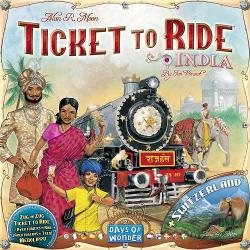
2011 · 基本ゲームの拡張
Ticket to Ride Map Collection 2: India & Switzerland
Two double-sided maps present distinct regional scenarios for Ticket to Ride gameplay. The India side (2–4 players) adds scoring for the longest continuous path and for connecting cities on tickets via two distinct routes; the first two qualifying tickets score +5 each and the next three score +10 each, up to a 40-point bonus. Players still score normally for claiming routes and completing tickets. The Switzerland side (2–3 players) reprints the 2007 design with tickets that may link a city to a country or a country to its neighbors; completing such tickets scores the highest applicable value. Discarded tickets are removed from play, and Locomotives may be used only to build tunnels.
- プレイ人数
- 2–4 ベスト3人
- プレイ時間
- 30–60分
- 対象年齢
- 8+
- 複雑さ
- 2 / 5



Ludoyaのテーブルでは
Ludoyaで詳しい統計を見る- 219
- 記録されたプレイ
- 110
- プレイヤー
- 43m 44s
- 平均プレイ時間
- 84
- コレクション登録
- 3
- ウィッシュリスト登録
7.7/10
Ludoyaのレビュー21件より
FazerGD7.5 +
Mohasz8.0 I really like the India map, it's great for 2 players and it works with more as well. The Mandala rule is a nice touch. The board looks beautiful. I'm not so keen on Switzerland though. It's not particularly bad but it has too many tunnels and can get frustrating easily. Also, the game can end in a ridiculous card drawing fest since there are several repeated country-to-country tickets.
Mestremuten6.0 Rating: 3/5 Production value: 3/4 Is the game in my collection/Love to have?: 0/1

ルールに関する質問
Ludoyaのルールアシスタントがルールブックに基づいて回答しています。
How do Ferry routes work — do I have to use Locomotive cards for the locomotive symbols on the route?
To claim a Ferry you must play a Locomotive card for each Locomotive symbol shown on that route, plus the usual set of cards of the proper color for the remaining spaces (i.e., locomotives cover only the loco-symbol spaces and the color cards cover the others). (page 2)
In 2- or 3-player games can both tracks of a double-route be claimed by different players?
No — in 2- and 3-player games, once one track of a double-route is taken the other track is no longer available; only in 4-player games can both tracks be used. (page 2)
How many Destination Tickets do we draw at the start and during the game, and how many must we keep?
At the start each player is dealt 4 Destination Tickets and must keep at least 2; during the game a draw gives 3 Tickets and the player must keep at least 1. (page 2)
What happens to Destination Tickets I don't keep when I draw or at game start?
Destination Tickets you don’t keep — either at the start or after a mid-game draw — are discarded to the bottom of the Destination Tickets deck. (page 2)
What is the Indian Express bonus (longest path) and who gets it?
A 10-point Indian Express bonus is awarded to the player or players who have the Longest Continuous Path on the board. (page 2)
How does the Grand Tour (Mandala) bonus work — what makes a Ticket qualify and how are bonus points awarded?
A Ticket qualifies for a Grand Tour bonus if its two cities are linked by at least two distinct continuous paths of that player's trains (paths may intersect but may not share trains); bonuses scale by number of qualifying Tickets per the Mandala table (first two qualify for +5 each, next three +10 each, up to a maximum Grand Tour bonus of 40 points). (page 2)
無料・Web、Android、iOS対応
LudoyaでTicket to Ride Map Collection 2: India & Switzerlandを遊ぼう
ゲーム情報(人数、プレイ時間、対象年齢、クレジット)の出典:BoardGameGeek。