
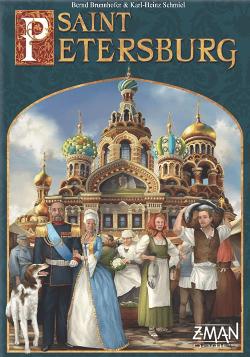
2014 · Kortspill
Saint Petersburg (Second Edition)
Players act as administrators and developers in early 18th-century Saint Petersburg, recruiting workers, constructing buildings and currying favor with nobles to shape the city. On each turn players draft and buy cards from a shared display across phased rounds—workers, buildings, nobles (and optionally market cards)—then collect income and score points at the end of each phase based on held cards. The game ends when a deck depletes and the round finishes; final scoring awards extra points for unique noble sets and other modular bonuses. Optional modules add new card types, scoring rules and a fifth player slot, and can be combined for varied gameplay.
- Spillere
- 2–5 best 4
- Spilletid
- 60 min
- Alder
- 13+
- Kompleksitet
- 2,7 / 5
Om spillet
- Illustrasjon
- Utgiver




Utvidelser
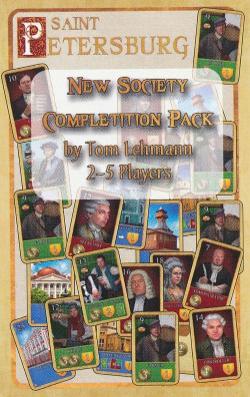
Se dem i Ludoya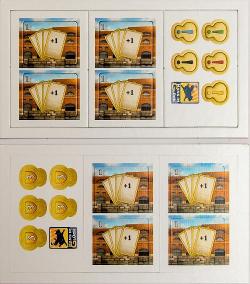

Hvor du kan kjøpe det
Butikkpriser og brukte eksemplarer, sjekket hver dag.
På Ludoyas bord
All statistikk i Ludoya- 117
- Registrerte spilløkter
- 62
- Spillere
- 1h 36m
- Gjennomsnittlig spilletid
- 17
- I samlinger
- 8
- På ønskelister
6,0/10
fra 15 anmeldelser på Ludoya
La primera vez que lo jugué me gusto...al cabo de un tiempo eche otra partida y me destrempo tanto...que dije: no puede ser!! Lo jugué con las expansiones para quitarme ese sabor amargo pero ni por esas. Acabe vendiéndolo y ahora lo disfruta otra persona....que le vamos a hacer!
Evan4,6 This is a wonderful and elegant tableau builder, where each round is divided up into sections where a single type of card is available for purchase, and then only that type pays out in points and dollars. Then you move onto the next type of cards. It has a wonderful tension about when you should buy and what you should focus on, as you are constantly short of cash and working hard to balance your budget. The built-in marketplace module adds a lot too as you need to worry about placing in different goods majorities in addition to making sure you have the money at the end of the round to grab up some of the high value buildings and nobles cards, and then additionally that you save enough money between rounds to be able to afford the money producing cards that get unveiled at the start of the new round. ★ Art, Iconography and components functional ★ Clever or interesting mechanisms ★ Reasonably low downtime between turns with mildly AP players ★ Multiple plays stay interesting ★ Low or mitigatable luck elements ★★☆☆☆ Raw enjoyment
Enfundado.

Regelspørsmål
Besvart fra regelboka av Ludoyas regelassistent.
Do I have to buy a worker during the very first worker phase?
Yes — in the very first worker phase each player must buy a worker on each of their turns so every player ends the phase with two workers (page 8).
During a noble (or building/worker) phase, am I restricted to buying only that color of cards?
No — you may buy any card in the tableau regardless of the current phase; the phase only determines which color of cards is added to the board and which color is scored (page 10).
How do price reductions stack and when do they apply?
Price reductions are cumulative: second-row cards cost 1 ruble less, buying a card with the same name as ones you already own gives −1 per copy, and some cards grant additional reductions, but you must always pay at least 1 ruble (page 14).
If a card shifts to the second row at the end of the round does it cost less, and what if I had taken it into my hand earlier?
Yes — cards shifted down to the second row cost 1 ruble less, but that second-row reduction is lost if the card was previously taken into a player’s hand (pages 11 and 14).
What happens in the exchange phase — do we score and how do exchange cards work?
There is no scoring at the end of the exchange phase; exchange cards replace a previously-played card of the matching color (not another exchange card), cost the difference between their price and the replaced card, and worker exchange cards must match the Worker Symbol (page 11).
How are nobles and leftover money/cards scored at the end of the game?
Final scoring awards victory points for the number of different nobles according to the table, gives 1 victory point for every 10 rubles you have, and deducts 5 points for each card remaining in hand (page 12).









Gratis, på nett, Android og iOS
Spill Saint Petersburg (Second Edition) med Ludoya
- Ha det i samlingen dinHold oversikt over eksemplaret ditt og utvidelsene, lån det ut til venner, eller legg det på ønskelisten og få beskjed når prisen faller.Legg det til i samlingen din
- Registrer hver spilløktPoeng, vinnere, tidtakere og bilder, og så statistikken din: vinnerprosent, favorittantall spillere, beste poengsum.Registrer en spilløkt
- Avgjør regelspørsmålSpør om hva som helst i reglene og få svar fra regelboka, med siden du kan sjekke det på.Spør regelassistenten
- Finn folk å spille det medKlubber, spillkvelder og arrangementer nær deg der dette spillet kommer på bordet.Se arrangementer
Spillfakta (spillere, spilletid, alder, bidragsytere) fra BoardGameGeek.