
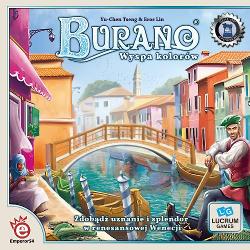
2015 · Budowanie miast
Burano: Wyspa kolorów
Players lead a family on a small Venetian island across four seasons, assigning members to work, develop, and sell goods. Actions include sending men to fish, sending women to produce lace for export, and roofing or painting houses along the canals. Gameplay uses a cube-pyramid engine: players pay coins to operate a color-coded pyramid that triggers specific actions each round. Resources and actions earn victory points through production, sales, and building improvements over 14 rounds. The game focuses on optimizing worker placement, timing pyramid operations, and balancing income with long-term reputation.
- Gracze
- 2–4 najlepiej w 3
- Czas gry
- 90–120 min
- Wiek
- 12+
- Złożoność
- 3,8 / 5
O grze
- Projekt
- Grafika
- Publisher



Gdzie kupić
Ceny w sklepach i egzemplarze z drugiej ręki, sprawdzane codziennie.
Przy stołach Ludoya
Pełne statystyki w Ludoya- 9
- Zapisane rozgrywki
- 14
- Gracze
- 1h 47m
- Średnia rozgrywka
- 16
- W kolekcjach
4,2/10
z 8 recenzji w Ludoya
Evan3,5 Placing delightful colored cubes next to each other or on top of each other as an action selection method is really delightful. It's an interesting and colorful puzzle I fully enjoy. I wish I could say the same about the rest of the game. From what I've read, the second edition of the game solves a lot of the problems I've read about in the first edition, but the game still has a few issues. There appears to be a strong first player advantage. It's not hard for the first player in turn order to grab up a few majorities and drop some big scoring roof tiles before anyone has a reasonable chance to contest them. There's no difference in starting positions for players later in turn order, and they don't have these same opportunities for scoring without battling anyone. The house cards that are earned for placing roof tiles are of wildly different levels of usefulness. For example, all the cards that give you points are points locked in for the rest of the game, except one type of card that gives you points for each person you have in a contestable area. This appears to be an unintentional weakening from a change from 1st to 2nd edition that was paid no attention. The game does have a lot of flip luck, in terms of what fish cards come up, which house cards are available at any given time, and what color roof tiles you randomly draw. The last thing is the actions that you take just aren't that compelling. On your turn you get 1-4 actions, and each action you take means you spend more money. A compelling idea, but when half your actions consist of moving a cube from your pyramid to your "ready area", the efficiency and opportunities for clever moves is overshadowed by a stale feeling. Overall, the game isn't bad for a tactical game, but it doesn't shine as a strategy game, which is a real pity as I love putting bricks on top of other bricks. :star: Art, Iconography and components functional :star: Clever or interesting mechanisms :nostar: Reasonably low downtime between turns with mildly AP players :star: Multiple plays stay interesting :star: Low or mitigatable luck elements :star::nostar::nostar::nostar::nostar: Raw enjoyment







Za darmo, w przeglądarce, na Androidzie i iOS
Graj w Burano: Wyspa kolorów z Ludoya
- Miej ją w swojej kolekcjiŚledź swój egzemplarz i jego dodatki, pożyczaj go znajomym albo dodaj go do listy życzeń i dostań powiadomienie, gdy cena spadnie.Dodaj do swojej kolekcji
- Zapisuj każdą rozgrywkęPunkty, zwycięzcy, minutniki i zdjęcia, a potem twoje statystyki: procent zwycięstw, ulubiona liczba graczy, najlepszy wynik.Zapisz rozgrywkę
- Licz punkty bez papieruKorzystaj z arkuszy wyników i pomocy do gry od społeczności i pozwól Ludoya zsumować punkty.Znajdź arkusze wyników
- Znajdź ludzi do wspólnej gryKluby, wieczory gier i wydarzenia w pobliżu, na których ta gra trafia na stół.Zobacz wydarzenia
Dane gry (gracze, czas gry, wiek, twórcy) z BoardGameGeek.