
1997 · Strategia abstrakcyjna
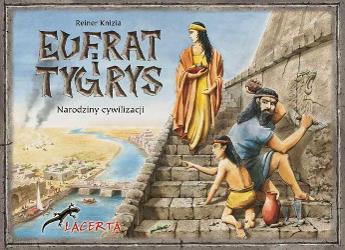
Eufrat i Tygrys
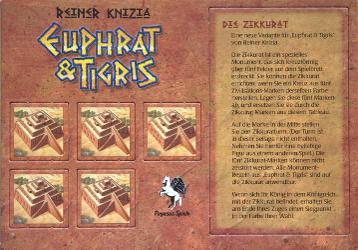
Players build civilizations in the ancient Fertile Crescent by placing tiles to create kingdoms and monuments. Each player manages four types of leaders—farming, trade, religion, and government—to collect points in those categories, but the final score is determined by the weakest category, encouraging balanced development. Civilizations expand and collide on the board, producing external conflicts where only one leader of a type survives, and internal conflicts that can replace leaders within a kingdom. An advanced variant adds a multi-tile monument that players can construct by trading in tokens; monuments are permanent and grant additional scoring opportunities.
- Gracze
- 2–4 najlepiej w 4
- Czas gry
- 60–120 min
- Wiek
- 14+
- Złożoność
- 3,5 / 5






Gdzie kupić
Ceny w sklepach i egzemplarze z drugiej ręki, sprawdzane codziennie.
Przy stołach Ludoya
Pełne statystyki w Ludoya- 369
- Zapisane rozgrywki
- 399
- Gracze
- 1h 23m
- Średnia rozgrywka
- 130
- W kolekcjach
- 39
- Na listach życzeń
- 4
- Zamówione w przedsprzedaży
7,1/10
z 87 recenzji w Ludoya
Mestremuten6,0 Rating: 3/5 Production value: 3/4 Is the game in my collection/Love to have?: 0/1
Zagrane 5 razy
SrCornelius7,0 Local-(217)
Pierwsze wrażenia · 2 rozgrywki
andycted9,5 3-4 players
Zagrane 12 razy

Pytania o zasady
Odpowiedzi z instrukcji od asystenta zasad Ludoya.
Can I place a leader on any empty space—including river spaces—or place one so it unites kingdoms?
No. A leader must be placed on an empty land space adjacent to a temple, cannot be placed on a river space, and may not be placed so as to unite kingdoms (leaders can be repositioned or withdrawn under other rules) (page 6).
What exactly happens when I play a catastrophe tile on an existing tile or an empty space?
A catastrophe permanently blocks that space and may be placed on an empty space or on top of an existing tile (removing that tile), but it cannot be played on a tile bearing a treasure or monument or on a leader; if it removes the last temple adjacent to a leader, that leader is immediately withdrawn (page 7).
How do revolts work—how is strength counted and who wins ties?
In a revolt the attacker and defender count temples adjacent to their conflicting leaders, then attacker then defender may each once commit extra temple tiles from hand; highest total wins and the defender wins ties; the loser withdraws his leader, the winner gains one amulet, and all committed temples are removed from the game (page 8).
How are wars resolved and how do you get victory points from them?
For a war count each side’s supporters (connected tiles of the leader’s color) and then attacker then defender may commit matching-color tiles from hand; the higher total wins and the defender wins ties; the loser removes his leader and all supporters, and the victor gains one victory point for the withdrawn leader plus one for each supporter removed (committed tiles do not score) (pages 9–10).
When can I build a monument and do the flipped tiles still count for conflicts/supporters?
If a tile completes a 2×2 square of like-colored tiles the active player may flip those four tiles facedown and place a monument (one monument color must match the facedown tiles); the facedown tiles still count as part of regions/kingdoms and link leaders but do not count as supporters in conflicts, and monuments cannot be destroyed (page 11).
How is the winner decided at game end and how are treasures used for tiebreaks?
The game ends when only one or two treasures remain or the bag is empty; players then allocate their treasures among the four spheres as they choose and compare players’ weakest sphere—whoever has the highest lowest-sphere wins, with ties decided by comparing next-lowest spheres (if all four spheres are equal, tied players share victory) (page 14).
Podobne gry







Za darmo, w przeglądarce, na Androidzie i iOS
Graj w Eufrat i Tygrys z Ludoya
- Miej ją w swojej kolekcjiŚledź swój egzemplarz i jego dodatki, pożyczaj go znajomym albo dodaj go do listy życzeń i dostań powiadomienie, gdy cena spadnie.Dodaj do swojej kolekcji
- Zapisuj każdą rozgrywkęPunkty, zwycięzcy, minutniki i zdjęcia, a potem twoje statystyki: procent zwycięstw, ulubiona liczba graczy, najlepszy wynik.Zapisz rozgrywkę
- Rozstrzygaj spory o zasadyZapytaj o dowolną zasadę i dostań odpowiedź z instrukcji, ze stroną do sprawdzenia.Zapytaj asystenta zasad
- Znajdź ludzi do wspólnej gryKluby, wieczory gier i wydarzenia w pobliżu, na których ta gra trafia na stół.Zobacz wydarzenia
Dane gry (gracze, czas gry, wiek, twórcy) z BoardGameGeek.