
2018 · Middelalder
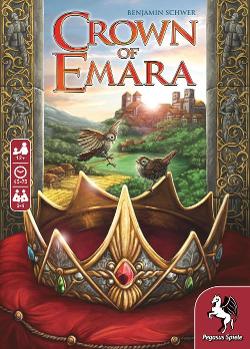
Crown of Emara
Players compete to earn the support of newly arrived citizens and secure succession to the throne by tending to the kingdom’s needs and providing housing. Gameplay combines selectable card actions with worker movement on two separate roundabouts; each player controls two counselors whose positions determine available actions and require planning during downtime. Players promote building in the capital, meet citizens’ demands, and advance on two scoring tracks, with the lower of the two scores determining final standing. Strategic balance of construction, action selection, and counselor placement drives the race to win majority support.
- Spillere
- 1–4 bedst 3
- Spilletid
- 45–75 min
- Alder
- 12+
- Kompleksitet
- 3 / 5
Om spillet
- Design
- Illustration
- Publisher



Udvidelser
Se dem i Ludoya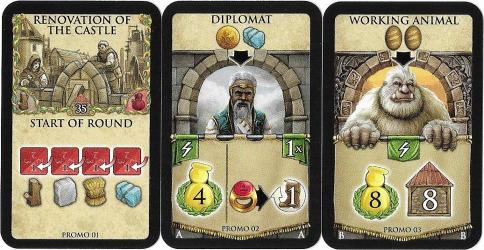
Hvor du kan købe det
Butikspriser og brugte eksemplarer, tjekket hver dag.
På Ludoyas borde
Al statistik i Ludoya- 107
- Registrerede partier
- 95
- Spillere
- 57m 13s
- Gennemsnitligt parti
- 44
- I samlinger
- 5
- På ønskelister
5,8/10
fra 25 anmeldelser på Ludoya
Evan4,6 The central board here is made of up two four-space roundels. Each player gets three action slots and a symmetrical deck of bonus cards. Each of the three action slots has a movement value which is either 1 2 or 3 steps. You place a bonus effect card into a slot, move one of your two pawns that many steps to resolve the action in their ending space, and gain the bonus printed on the card you played in whatever order you like. There are also bonus actions that allow you to place workers into production spaces increasing the output when you go there, or pick up special ability cards that give you various bonus effects. This game is raw efficiency where the only player interaction is competing to be the first to get cards or production spaces. Never the less I did enjoy the puzzle presented. I felt like I had interesting options every turn and both short term and long term goals. The game ends once each player has played every card in their deck twice so once you are used to the engine of the game you can plan out your moves well in advance. The only downside is that the experience while short feels a bit limited. There are minor engine building aspects that you can take advantage of, but the game runs a little too short for them to feel satisfying. To a certain extent you are also on rails with the game as the places to get points, and the way you gt those points don't feel substantially different game to game. Only the details of which special cards are in the mix change, and most of those cards have one time, or very limited effects. It's overall a good game that feels like it had a little more potential than it realized, that I got tired of quicker than I'd hoped. Perhaps a little more player interaction would have been welcome to spice things up. :star: Art, Iconography and components functional :star: Clever or interesting mechanisms :star: Reasonably low downtime between turns with mildly AP players :nostar: Multiple plays stay interesting :star: Low or mitigatable luck elements :star::star::nostar::nostar::nostar: Raw enjoyment
Regelspørgsmål
Besvaret ud fra regelbogen af Ludoyas regelassistent.
Do I have to do the Card Action, the Movement Action and the Bonus Actions in that exact order on my turn?
You may perform the Card Action, Movement Action and up to three different Bonus Actions in any order you choose, but you must finish each action before starting the next one (page 5).
If the slot I played my Action Card in says “2 steps”, can I move only 1 step instead?
No — you must move the exact number of steps shown on the slot (1, 2, or 3); “You may not move less!” (page 5).
The Action Card lets me move 1 step — does that replace the Movement Action from the slot or is it in addition?
The Card Action is resolved first and may include a movement (e.g. “move 1 step”), and then you still take the Movement Action determined by the slot, so you can end up moving from both (page 5).
Can I recruit an Advisor on the Market/Castle/Cathedral if none of my Councilors are at that Town Location?
Normally you must recruit an Advisor at a Town Location where one of your Councilors is present (bonus action) (page 7), but some Card Actions let you perform a Town Location action irrespective of Councilor positions (page 5), and the Steward Advisor allows recruiting irrespective of Councilor positions (page 9).
How do Favor Tokens work and when can I spend them?
You keep Favor Tokens you take from the Cathedral and may discard any of them to receive their reward when a Councilor finishes movement on the indicated City Location or when you perform that Location’s action via a Card Action; you may take the reward even if you don't use the Location's action (pages 6 and 9).
How is the final score determined and what are the tie‑breakers?
At game end you add endgame points (e.g. 2 points per Signet Ring, 1 per Gold Coin/Favor/Book/Bread and 1 per 2 leftover resources) which you may assign to Building or Citizen totals, then your final score is the lower of your Building and Citizen Points; ties are broken by (1) the higher second marker, (2) highest noble rank, then (3) more Citizen Points from highest Nobility Card (page 7).












Gratis, på web, Android og iOS
Spil Crown of Emara med Ludoya
- Hav det i din samlingHold styr på dit eksemplar og dets udvidelser, lån det ud til venner, eller sæt det på din ønskeliste, og få besked, når prisen falder.Føj det til din samling
- Registrér hvert partiPoint, vindere, timere og fotos, og så din statistik: vinderprocent, foretrukket spillerantal, bedste score.Registrér et parti
- Afgør regelspørgsmålSpørg om hvad som helst i reglerne, og få et svar fra regelbogen med siden, hvor du kan tjekke det.Spørg regelassistenten
- Find nogen at spille det medKlubber, spilaftener og arrangementer nær dig, hvor dette spil kommer på bordet.Se arrangementer
Spilfakta (spillere, spilletid, alder, medvirkende) fra BoardGameGeek.