
2012 · Science fiction
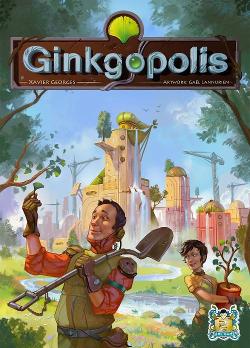
Ginkgopolis
Players develop a vertical eco-city built in symbiosis with nature, placing and stacking colored city tiles that represent housing, resources, and tile generation. Each turn players simultaneously choose construction or urbanization cards to add tiles to the city’s edge or place tiles atop existing ones, then pass unplayed cards to the left. Building over tiles adds power cards to a player’s tableau, granting ongoing abilities and scaling options. Players begin with a set of character cards that provide starting resources and action bonuses while aiming to control the most buildings and optimize resource flow and tile placement for victory points.
- Spillere
- 1–5 bedst 3
- Spilletid
- 45 min
- Alder
- 13+
- Kompleksitet
- 2,9 / 5
Om spillet
- Design
- Illustration
- Publisher



Udvidelser
Se dem i Ludoya
Hvor du kan købe det
Butikspriser og brugte eksemplarer, tjekket hver dag.
På Ludoyas borde
Al statistik i Ludoya- 315
- Registrerede partier
- 342
- Spillere
- 1h 9m
- Gennemsnitligt parti
- 81
- I samlinger
- 23
- På ønskelister
6,6/10
fra 42 anmeldelser på Ludoya
Abstract Eurogame that combines area control, draft, tile placement... Very original, it's difficult to compare to other games, it's pretty unique

Regelspørgsmål
Besvaret ud fra regelbogen af Ludoyas regelassistent.
Can I discard a card on my turn to draw a new one instead of playing it?
You must choose one card to play each turn; you cannot discard a single card to redraw. Twice per game you may spend a New Hand token to discard your entire 4‑card hand and draw 4 new cards (announce “I’m getting a new hand”); unspent New Hand tokens are worth 2 points each at game end (p.3).
When I play an Urbanization card with a tile, do I always put my resource on it and how do I move the Urbanization token?
Replace the matching Urbanization token with your tile, place one of your resources and a Construction Site pawn on it, then move that Urbanization token to an orthogonally adjacent empty perimeter space; if no adjacent space is empty you may place it elsewhere respecting the alphabetical order (you may move other tokens to do so). You also “utilize” orthogonally adjacent buildings to gain their items (p.4).
If I build on someone else's building, who gets the resources that were on it?
When you construct a floor you return the resources on that building to their owner (they place them behind their screen), and if the owner is another player they gain 1 success point per resource returned; you do not gain success points for building on your own building (p.4).
Do I have to pay anything extra when placing a tile that’s a different color or a lower number than the one I cover?
Yes — if the new tile’s number is lower you pay the difference in success points, and if the color differs you must discard one resource to the general supply; if you cannot pay the items needed to place the tile, you take the tile back and resolve the card as if played alone (pp.4–5).
After everyone resolves actions, whose unused cards do I take and when do we draw?
After resolving actions each player takes the 3 unused cards from her right‑hand neighbor (including the First Player card if present), then, starting with the new first player and continuing in order, each player draws from the deck to return to a hand of 4 cards (p.5).
How exactly are district points awarded and what are the tie‑breakers?
In each district the player with the most resources gains points equal to the total number of resources in the district, and second place gains points equal to the number of resources of her color; ties are broken by tallest building, then by highest building number, and if all resources belong to one player she receives both first and second place points (p.6).













Gratis, på web, Android og iOS
Spil Ginkgopolis med Ludoya
- Hav det i din samlingHold styr på dit eksemplar og dets udvidelser, lån det ud til venner, eller sæt det på din ønskeliste, og få besked, når prisen falder.Føj det til din samling
- Registrér hvert partiPoint, vindere, timere og fotos, og så din statistik: vinderprocent, foretrukket spillerantal, bedste score.Registrér et parti
- Afgør regelspørgsmålSpørg om hvad som helst i reglerne, og få et svar fra regelbogen med siden, hvor du kan tjekke det.Spørg regelassistenten
- Find nogen at spille det medKlubber, spilaftener og arrangementer nær dig, hvor dette spil kommer på bordet.Se arrangementer
Spilfakta (spillere, spilletid, alder, medvirkende) fra BoardGameGeek.