
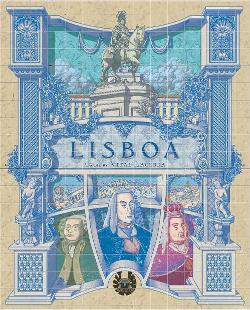
2017 · City Building
Lisboa
Players act as nobles in charge of rebuilding Lisbon after the 1755 earthquake, working with engineers, architects and the Marquis to reshape the downtown map. Gameplay uses a real map of central Lisbon and a card display where players add or replace cards each round to schedule hearings, gain character favors and obtain construction licenses and store permits. Players place buildings and open businesses according to preassigned street types, manage influence, workers, church power and royal treasure-driven economy, and score via iconic buildings and stores. The game runs for a fixed number of rounds; the highest total of collected wigs determines the winner.
- Players
- 1–4 best 3
- Playing time
- 60–120 min
- Age
- 12+
- Complexity
- 4.6 / 5
About the game
- Design
- Art
- Publisher



Expansions
See them in Ludoya
Photos from Ludoya tables
All photos in Ludoya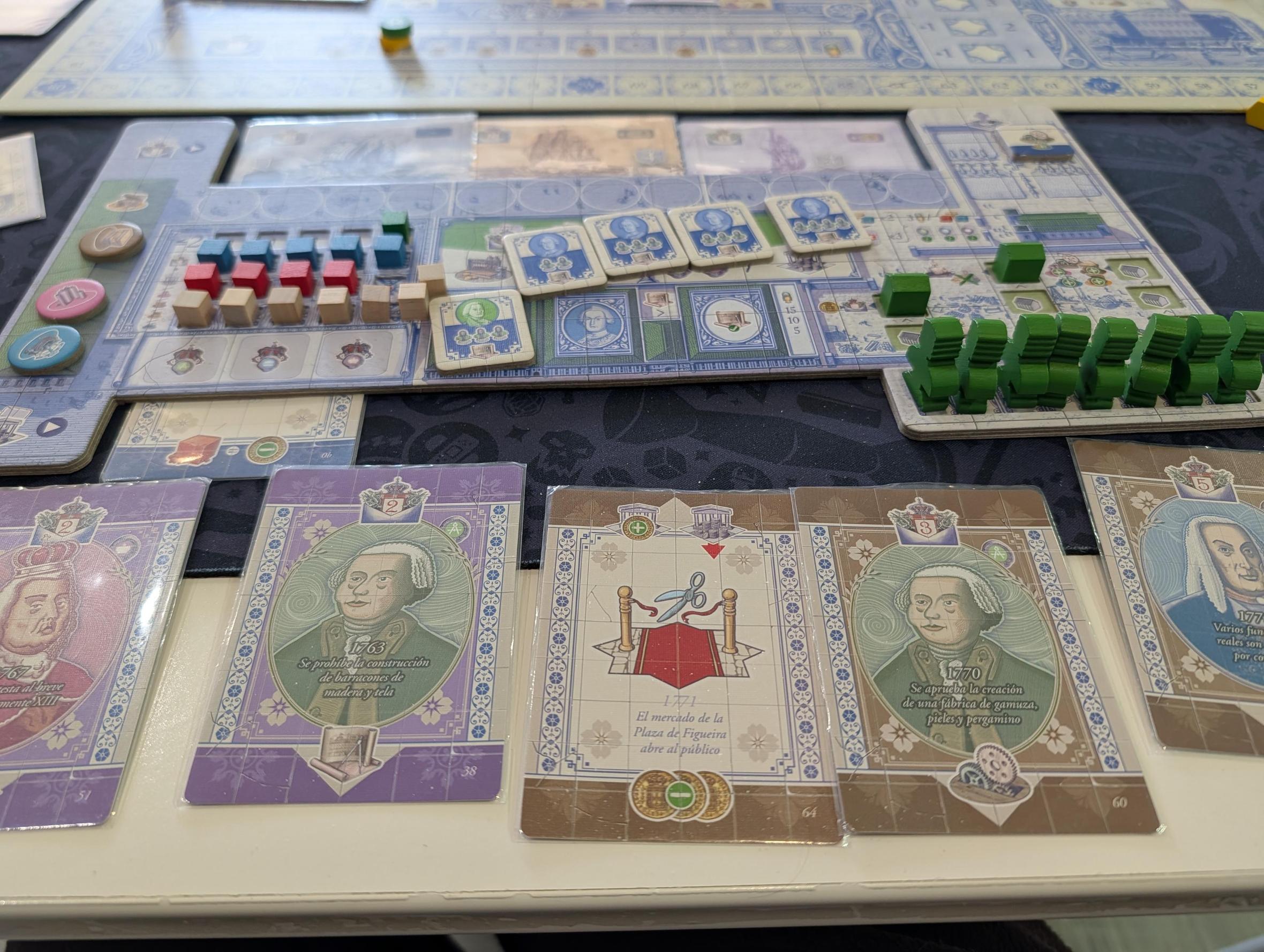
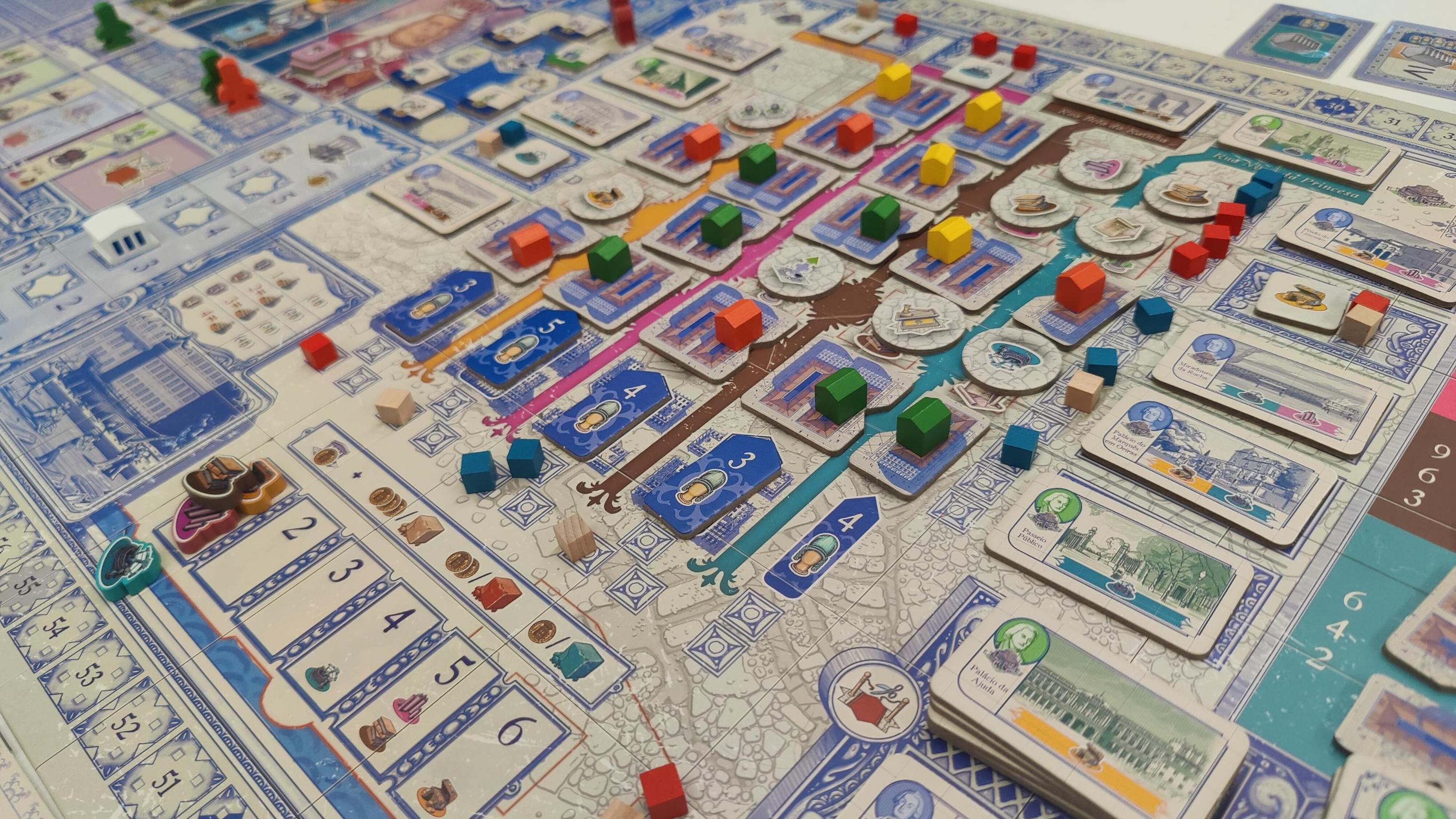
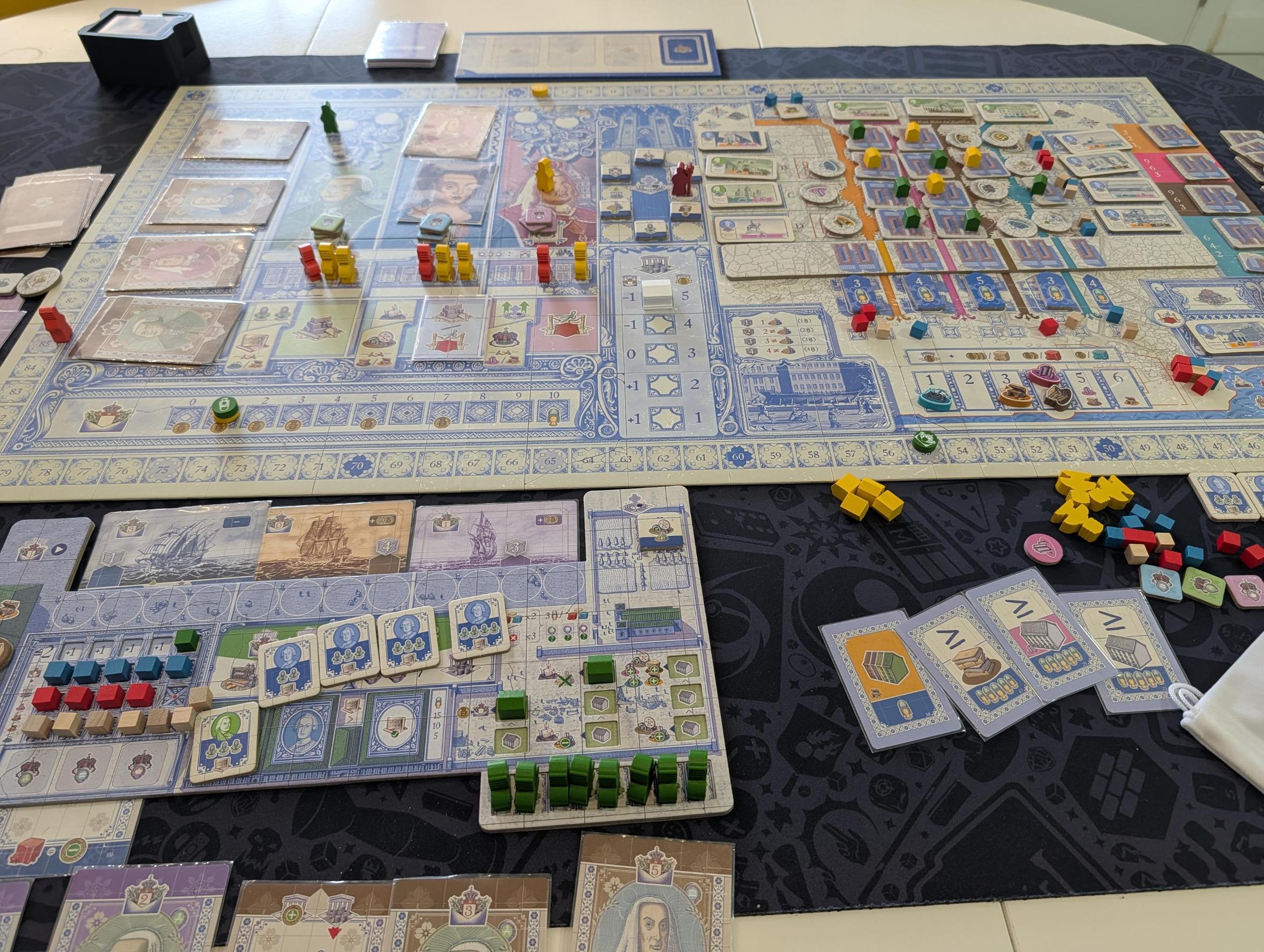
On Ludoya's tables
Full stats in Ludoya- 329
- Plays logged
- 373
- Players
- 2h 40m
- Average play
- 114
- In collections
- 57
- On wishlists
6.5/10
from 57 Ludoya reviews
Garfield2.0 #HandManagement #TilePlacement OMG! This feels like work, not fun! Don't believe anyone who is telling you "it's simple, you only play a card as an action...". First it takes very long to explain (you will forget the half) and then it takes far too long to play it. Huge downtimes! I can't say anything positive about this game. It's convoluted with possible actions. A game doesn't get better if you put a gazillion of possibilities in it, it just force people to think longer and increase downtime. And a player aid that is bigger than some others complete rulebooks? WTF? Don't get me wrong, I like heavy board games, but I prefer heavy ones with less possibilities but still complex. What a waste of time, never again! [c] Theme: :star::nostar::nostar::nostar::nostar: <!-- size 7]It feels like work, so +1 for that... --> Gameplay: :star::nostar::nostar::nostar::nostar: <!-- size 7]Very clumsy, too much possibilities --> Interaction: :star::nostar::nostar::nostar::nostar: <!-- size 7]Not much --> Artwork: :star::star::nostar::nostar::nostar: <!-- size 7]Nothing special --> Luck: :nostar::nostar::nostar::nostar::nostar: <!-- size 7]No --> Strategy: :star::star::star::star::star: <!-- size 7]Yes --> Components: :star::star::star::nostar::nostar: <!-- size 7]Good --> Play duration: :nostar::nostar::nostar::nostar::nostar: <!-- size 7]Far too long --> Easy to teach: :nostar::nostar::nostar::nostar::nostar: <!-- size 7]Too much possibilities --> Setup time: :star::nostar::nostar::nostar::nostar: <!-- size 7]Close to nightmare --> No downtime: :nostar::nostar::nostar::nostar::nostar: <!-- size 7]Worst I've ever played --> Replay value: :nostar::nostar::nostar::nostar::nostar: <!-- size 7]Imho no, always the same --> [/c]
Balleflass6.5 Was in my top 5 games for a year or so. Now after a couple of plays lately I've grown tired of the random decrees. Sometimes you pick some decrees only to see that some better ones turn up at the end of your turn right for your opponent to pick... There are a bunch of issues, but they are mostly general issues I have with this designer's games. As in, you do somewhat few actions/choices during such a heavy game.
Evan5.9 This game is overly complicated in that special Vital way, but the parts fit together a little more cohesively than previous games. That's not to say that this game couldn't use a little streamlining, but I guess if you are into Vital's style of game this is probably your bag. It took me 3/4ths of the way through my first game before I started really understanding the flow and consequences of the different action options. The game flow is pretty nice. There are a dizzying number of options to do on your turn, but ultimately it comes down to play a card, then do 2 things based on the card you played and where you played it to. The graphic design helps and hurts in different ways. When you need to do something, there's usually an indicator reminding you to do it, however, the board layout and artwork is disorientingly busy. The icons are very small, and the numbers to look up what the icons mean are even smaller. This is also a game where you can expect to still be looking up what icons do even deep into the game, as some icons are used to mean two different things depending on the context of their appearance, and other icons are used only once and then never again. The player interaction in this game is more about predicting your opponents and trying to piggy back their moves more than it is about actually being able to do much to get in their way and hurt their scores. There are some surprising but minor luck elements of the game such as the order in which endgame scoring cards come out onto the display, and the tokens you start with. Generally I like the experience of this game. Playing it does wear me out however, whereas a really solid medium euro will energize me. :star: Art, Iconography and components functional :star: Clever or interesting mechanisms :star: Reasonably low downtime between turns with mildly AP players :star: Multiple plays stay interesting :star: Low or mitigatable luck elements :star::star::nostar::nostar::nostar: Raw enjoyment
Rules questions
Answered from the rulebook by Ludoya's rules assistant.
If I play a card into my Portfolio, can I Visit that Noble or Sponsor that Treasury action?
No — playing a card into your Portfolio is only for taking action 1 or 2 (Sell Goods or Trade with the Nobles); to Visit a Noble or Sponsor an Event you must play a card into the Royal Court instead (see page 9).
Do I have to have a good to play a card into my Portfolio?
Yes — after you tuck a card into your Portfolio you must perform Sell Goods or Trade with the Nobles, both of which require at least one good, so be sure the card’s immediate reward/penalty leaves you with a good or you cannot play it into your Portfolio (page 9; playing-to-Portfolio steps on page 10).
Can other players follow my Visit, and what must they do to follow?
Yes — opponents who hold the matching Royal Favor tile may follow: they return the tile, spend the Visit cost in Influence (calculated from the Treasury marker and officials in the Noble’s office), and then take one of the three actions that Noble offers (page 16).
What exactly triggers the end of a period or the end of the game with rubble sets?
Completing your 2nd rubble set immediately triggers the End of the Period; completing your 4th rubble set immediately triggers the End of the Game (finish the round and play a final round) — each rubble set also scores 3 wigs at period end and game end (page 22).
If a Noble or Treasury card has a penalty I can’t pay when I tuck it into my Portfolio, can I still play it?
Yes — if you cannot pay a penalty depicted on the card you may still play it into your Portfolio; cards with penalties simply provide different rewards/Influence and the penalty is applied as described (page 10).
When a Ship fills and 'sets sail', who gets wigs and when do Ships return?
When the number of goods on a Ship equals its hull size the Ship immediately sets sail: the Ship’s owner flips those goods face-down as packed crates and earns 1 wig per newly packed crate; Ships return to dock with empty cargo holds at the beginning of their owner’s turn (page 11).












Free, on web, Android and iOS
Play Lisboa with Ludoya
- Keep it in your collectionTrack your copy and its expansions, lend it to friends, or put it on your wishlist and get told when the price drops.Add it to your collection
- Log every playScores, winners, timers and photos, then your stats: win rate, favourite player count, best score.Log a play
- Settle rules questionsAsk anything about the rules and get an answer from the rulebook, with the page to check it on.Ask the rules assistant
- Find people to play it withClubs, game nights and events near you that bring this game to the table.See events
Game facts (players, playing time, age, credits) from BoardGameGeek.