
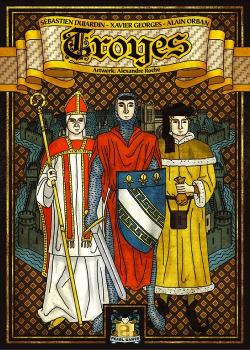
2010 · Economic
Troyes
Players recreate centuries of a medieval Champagne city by managing a personal pool of dice and a hand of cards that represent religious, military, and civil affairs. Dice are allocated to projects such as cathedral construction, disaster response, and civic tasks; cards enable actions, recruitments, and scoring opportunities across the three social domains. Players may spend money to hire opponents’ dice for temporary use and compete for influence, prestige, and victory points. Includes player-driven timing through dice placement and card play; later editions add a solo mode and bonus cards.
- Players
- 1–4 best 3
- Playing time
- 90 min
- Age
- 12+
- Complexity
- 3.4 / 5
About the game
- Publisher





Expansions
See them in Ludoya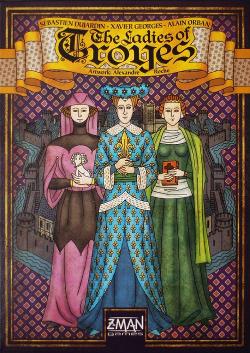
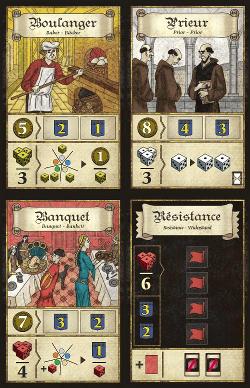
Photos from Ludoya tables
All photos in Ludoya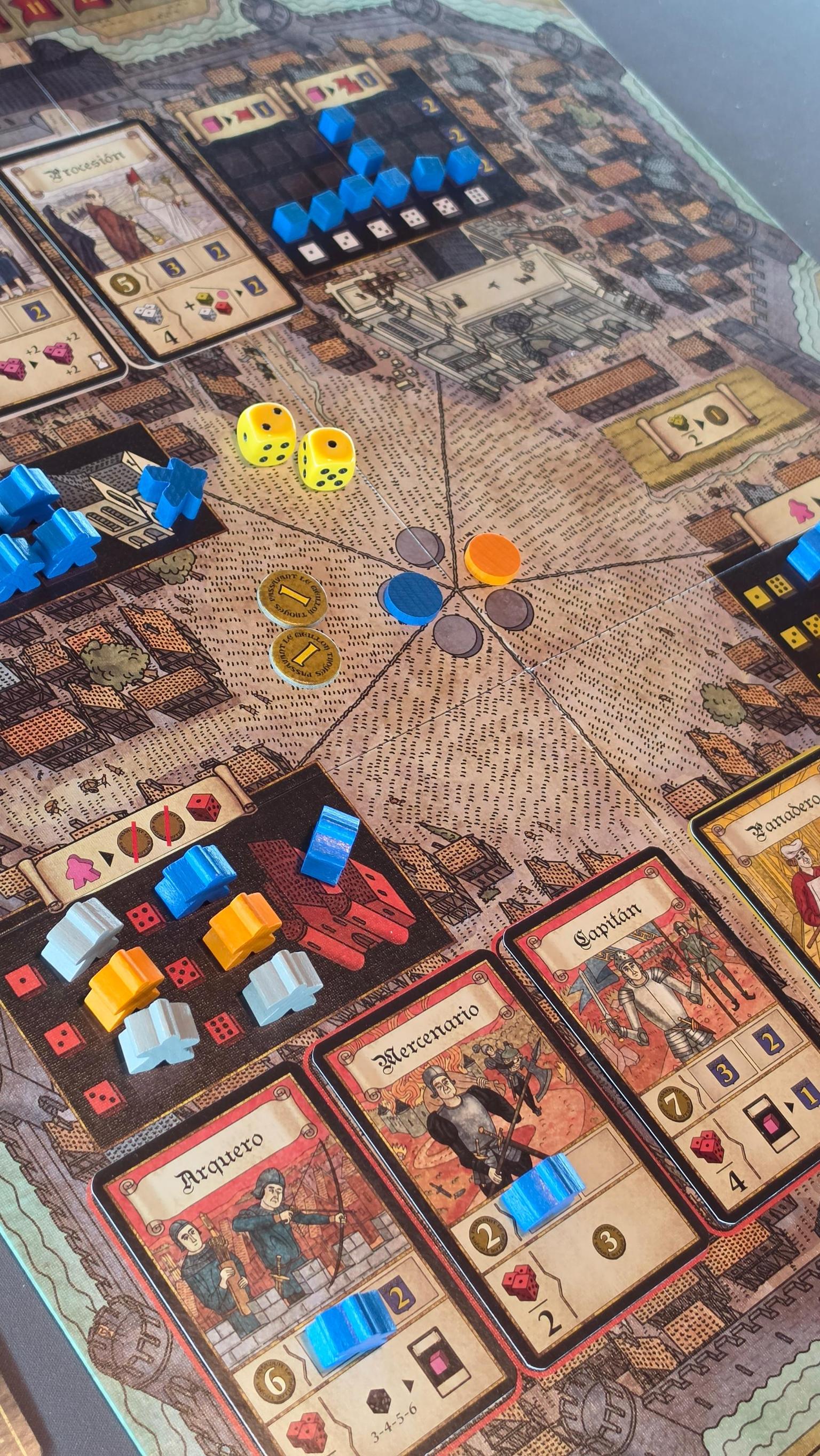
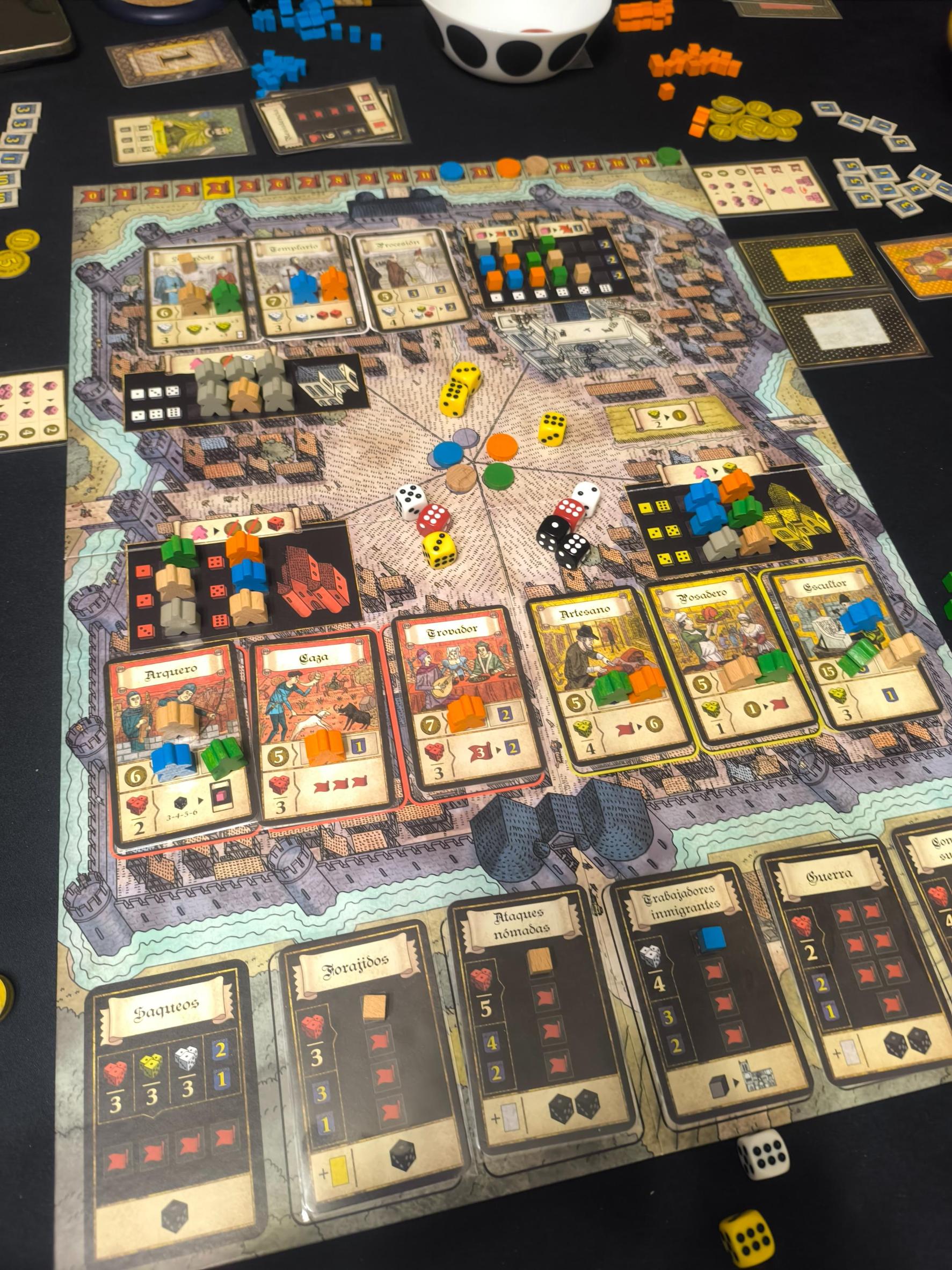
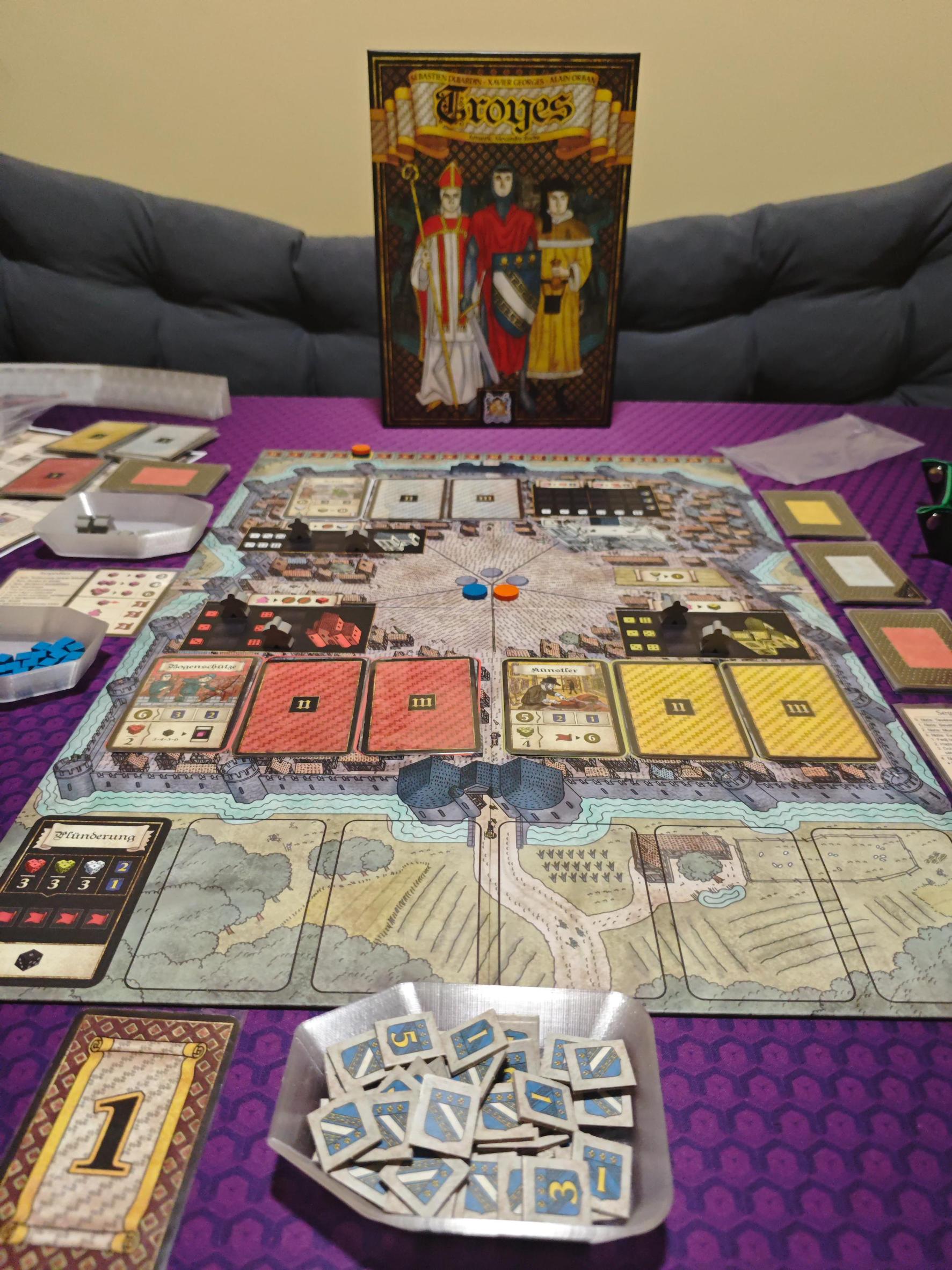
Where to buy it
Shop prices and second-hand copies, checked every day.
On Ludoya's tables
Full stats in Ludoya- 807
- Plays logged
- 536
- Players
- 1h 30m
- Average play
- 163
- In collections
- 34
- On wishlists
- 1
- Pre-ordered
7.1/10
from 109 Ludoya reviews
Garfield7.0 #50 Nice dice mechanism. But it's always better if you roll high? So it's a little bit luck dependent? If you always roll low you won't win for sure. Have to try with expansion. [c] Theme: :star::nostar::nostar::nostar::nostar: <!-- size 7]No --> Gameplay: :star::star::star::nostar::nostar: <!-- size 7]Placing dice to do something --> Interaction: :star::star::star::nostar::nostar: <!-- size 7]Blocking each other --> Artwork: :star::star::star::nostar::nostar: <!-- size 7]Ok --> Luck: :star::star::star::star::nostar: <!-- size 7]Dice rolling --> Strategy: :star::star::nostar::nostar::nostar: <!-- size 7]Not sure --> Components: :star::star::star::nostar::nostar: <!-- size 7]Ok --> Play duration: :star::star::star::nostar::nostar: <!-- size 7]Ok --> Easy to teach: :star::star::star::nostar::nostar: <!-- size 7]Ok --> Rules quality: :star::star::star::star::nostar: <!-- size 7]Very good --> Setup time: :star::star::star::nostar::nostar: <!-- size 7]Ok --> No downtime: :star::star::star::nostar::nostar: <!-- size 7]Ok --> Replay value: :star::star::star::nostar::nostar: <!-- size 7]Different random cards --> [/c]
Evan4.6 My group was a big fan of this game, but it never really worked for me. First and foremost the look of this game really bothers me. The garrish patterns combined with the ketchup red and mustard yellow really bothers me, more than it should. I like to think that I'm a mechanisms over theme guy, but art like this I find troublesome. Additionally, this game is very guilty of difficult to understand icons. Each game doesn't have that many cards, but the cards will often have one time use icons on them, so it hurt my experience substantially that when I played this it was before a BGG card lookup player aid was available. I'm not thrilled with the way your meeples get kicked out of the various offices. I'm also not thrilled with the feeling you get when your opponent buys the die you needed out from under you. These two forms of negative player interaction would be forgivable in a game with a better look to it, but when combined with the visual static of the game, it hurts an already difficult experience. I'm also feeling a little done with the game mechanism where there are invader cards collecting at the bottom of the board that players need to collectively fend off. It's so perfectly executed in Lowlands, that it's hard to imagine going back. The expansion is also troublesome. The purple die module means that my issue with people stealing my dice out from under me is resolved, as nobody can steal your purple die, but the flip side of that is it removes key tension from the game that's really the game's soul. I may not like the steal mechanism, but without the threat of it, there's a hollow feeling to the rest of what happens. There's also a module where you walk your people around the exterior of the board that feels very tacked on. I was unimpressed, and it certainly didn't add anything that saved the experience of the base game for me. It's rough, because I really should like this game. I understand it's a good game. I just can't manage it. :nostar: Art, Iconography and components functional :star: Clever or interesting mechanisms :star: Reasonably low downtime between turns with mildly AP players :star: Multiple plays stay interesting :star: Low or mitigatable luck elements :star::star::nostar::nostar::nostar: Raw enjoyment
Mestremuten9.0 Rating: 4/5 Production value: 4/4 Is the game in my collection/Love to have?: 1/1
Rules questions
Answered from the rulebook by Ludoya's rules assistant.
When does the black die remove a plaza and what do I have to cross out?
At the start of each half day the black die destroys the plaza it sits on; starting on day 3 it also forces every player to cross out the die on their scoresheet that matches the black die’s value and the plaza’s color, and you must cross out any unconstructed buildings in that colored section of the column. Constructed buildings are not destroyed, and a Fortress in that column protects you from the die destruction (see page 4).
When do I flip a plaza and when do I rotate the wheel?
At the end of each half day the town crier flips the destroyed plaza to its opposite face before returning it to the wheel, and at the end of each full day the town crier turns the wheel’s small layer one step clockwise to show the next day number (page 5).
How exactly do I gain resources from a die—do I circle as many as the die’s value?
When you take the Gain Resources action you circle as many resources as the die’s value, left to right on the track of that color; when you gain citizen-type resources you circle the corresponding citizen on its track (page 6).
How do Influence, Deniers and Knowledge modify dice when I perform an action?
Influence (red) lets you adjust the chosen die’s value by ±1 per influence spent, deniers (yellow) pay the cost to use a die position, and spending 2 knowledge (white) lets you change the color of the die you chose (page 6).
What does the Fortress do—does it prevent my buildings from being crossed out?
Building a Fortress in a column protects you from black-die attacks on that column (so you don’t have to cross out the attacked die there) and immediately grants the pictured citizen and any applicable link bonus; note that already-constructed buildings are never destroyed by events (pages 7 and 4).
Do I need a white die to build a Cathedral and how does it score at the end?
Yes—the Cathedral action requires a white die; each Cathedral you build unlocks endgame scoring for a specific building type, and you record 1 VP for your first two Cathedrals, 2 VP for the next two, and 3 VP for the final two, which is the VP gained per building of that type at game end (page 8).
Similar games


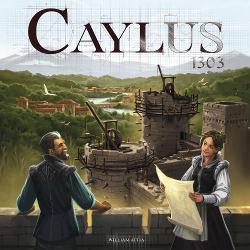


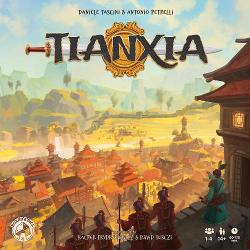


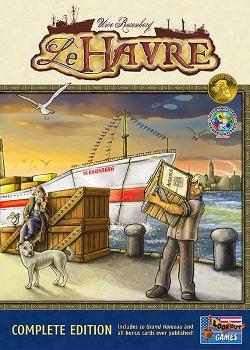
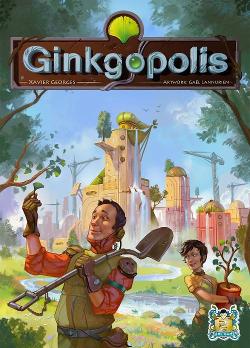



Free, on web, Android and iOS
Play Troyes with Ludoya
- Keep it in your collectionTrack your copy and its expansions, lend it to friends, or put it on your wishlist and get told when the price drops.Add it to your collection
- Log every playScores, winners, timers and photos, then your stats: win rate, favourite player count, best score.Log a play
- Settle rules questionsAsk anything about the rules and get an answer from the rulebook, with the page to check it on.Ask the rules assistant
- Find people to play it withClubs, game nights and events near you that bring this game to the table.See events
Game facts (players, playing time, age, credits) from BoardGameGeek.